
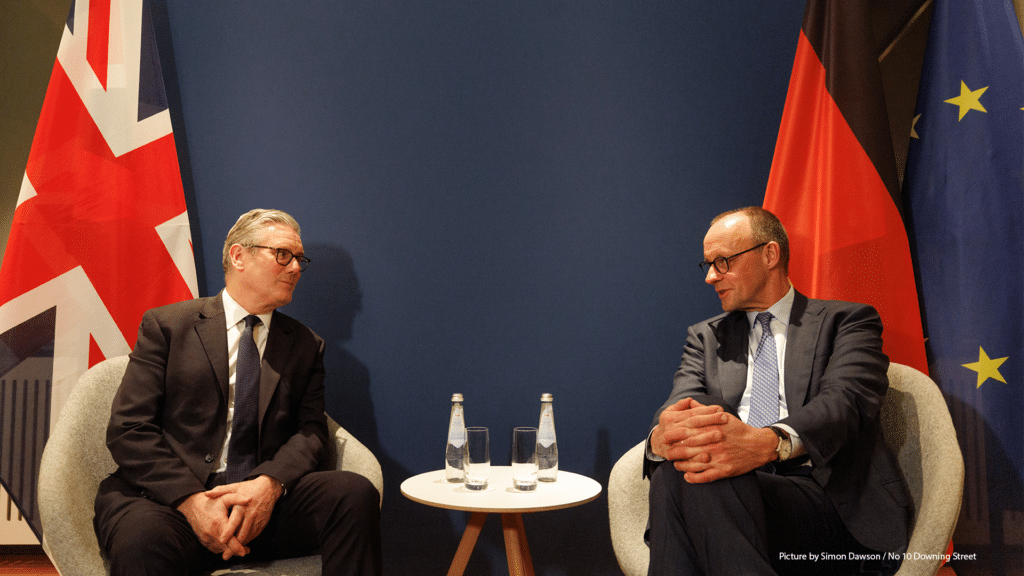
Andrew M Dorman reflects on the key points made by Keir Starmer at the Munich Security Conference that outlined the extent of current security threats, as well as the need for greater UK-EU cooperation and decreased dependence on the US.
At last weekend’s Munich Security Conference, Keir Starmer joined his European colleagues in stressing the threat posed by Russia by the end of the decade and the need for rearmament.
Starmer also emphasised the important contribution that Britain’s defence industrial base makes to European security. At the same time, he also highlighted that Europe’s capabilities represented less than the sum of their parts due to the underlying inefficiencies of having multiple platforms all doing the same thing rather than a single standard product.
This was all to be expected and formed part of a wider pitch for far greater EU-UK integration. Within the speech Starmer made five important commitments.
First, Starmer was clear, there is little time left to prepare, citing NATO planners stating that Russia could be ready to use military force against the alliance by the end of this decade. This throws into question the UK’s existing commitment to spend 2.5% of GDP on defence by 2027, 3% by the end of the next parliament, and 3.5% by 2035. In the days that followed, rumours have circulated that the UK will increase defence spending to 3% of GDP by the end of this parliament rather than the next. In practice, such spending is the minimum needed if the delayed Defence Investment Plan (DIP) promised for last Autumn can be delivered.
Second, the re-integration of the UK with the EU needs to be brought forward and broadened beyond defence to include the wider economy, with closer economic and political alignment, if not integration.
Third, whilst emphasising the role of NATO as the heart of European defence, Starmer moved much closer to the traditional Gaullist goal of European autonomy. This was put quite starkly, arguing that Europe being responsible for its own defence is the ‘new law’.
Fourth, the current financial deficit in the DIP means that the UK is facing the prospect of a choice between providing ground forces to support NATO’s eastern flank and naval forces to the defence of the Atlantic. Starmer has made clear that the UK cannot afford to make such a choice, as both are important. Here the UK taking over the NATO Joint Force Command Norfolk from the US is significant. It marks Europe taking the lead in the important areas of the Atlantic and High North and reinforces Europe’s commitment to the defence of Greenland and Iceland.
Fifth, Starmer implied that the US nuclear guarantee was no more and that in future the UK and France should provide this to the other NATO members. This represents a major change in NATO’s nuclear strategy. It also represents an attempt by the UK to head off a debate amongst other European states about whether to develop a capability. Following this logic through raises significant questions about the UK’s own nuclear capabilities. Currently, a combined UK-French nuclear force has two nuclear submarines continuously at sea plus a few French aircraft equipped with nuclear launched missiles. This would need to be enlarged.
If both France and the UK were to each acquire an additional ballistic missile carrying submarine on top of their current plans to acquire four each then both could potentially maintain a continuous at-sea deployment of two submarines each. In addition, the UK would need to acquire an additional delivery system, perhaps in partnership with France and carried by Royal Air Force aircraft, in order to provide NATO with a choicer of nuclear options.
These five new commitments raise questions about the UK’s relations with the US. Starmer’s one difference from the line taken by the likes of France’s President Macron and Germany’s Chancellor Merz revolved around Europe’s relationship with the US. Whilst he agreed with them on their emphasis on Europe developing its own capabilities, he still emphasised the importance of the US relationship with Europe, noting the contribution that the US has made over the last 80 years but stating that this partnership needed radical change.
What explains this variation? There are two theories currently in play. The first is the hope within much of the UK establishment that the Trump presidency represents an aberration and that some form of new normality will return in 2029. Optimists promoting this view would highlight the number of potential Democrat candidates that were at the Munich conference and the speech made by the US Secretary of State Marco Rubio. This group argue that 80 years of UK-US military and intelligence integration remains in the best interests of both nations and that the UK and Europe need to simply focus on the burden-sharing issue freeing up the US to focus on China.
The second argument being put forward is that in many respects Starmer agrees with his European counterparts that the US commitment to Europe is coming to an end. However, given, in the UK’s case, 80 years of integration and dependence on the US, creating European alternatives will take time and therefore the US shouldn’t be prematurely pushed away as Europe frantically seeks to plug the gaps. Starmer is therefore seeking to buy time for the UK and Europe both to rearm vis-à-vis Russia and fill the gaps left by a departing United States. Undoing 80 years of US-UK military integration will take a decade or more to unpick.
Only time will tell which of these two views is right. In practice the actions that result from either view are much the same in the immediate short-term. The question for Starmer over the next few months is whether he will adhere to these new commitments. The first indications will be a fully-funded DIP and an announcement about bringing forward an increase in defence spending all before Easter. Without them, Britain’s continuing claim to be Europe’s leading military power looks increasingly fanciful and symptomatic of a government that is floundering.
By Andrew Dorman, Professor of International Security, King’s College London.