
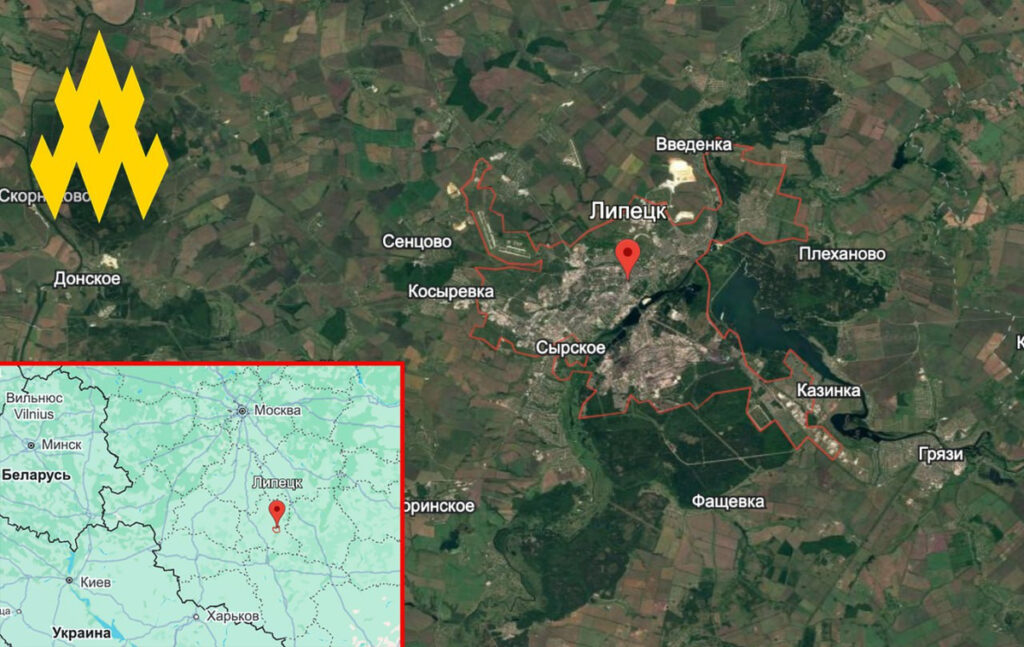
The Ukrainian partisan movement Atesh has claimed responsibility for the destruction of a military communications tower in the Russian city of Lipetsk, saying the facility was used to coordinate Russian armed forces units.
In a statement published on its official Telegram channel, Atesh said its agents carried out a sabotage operation that destroyed a communications tower involved in transmitting data and coordinating security and military training.
Follow our coverage of the war on the @Kyivpost_official.
The sabotage took place in Lipetsk, more than 450 kilometers (280 miles) from the Ukrainian border, underscoring the vulnerability of Russia’s deep-rear military infrastructure far beyond the frontline.
According to Atesh, the tower’s coverage area included several key military sites: the 924th Combat Training and Personnel Retraining Center for unmanned aerial vehicle units, the Lipetsk military airfield, and the 260th arsenal of Russia’s Main Missile and Artillery Directorate (GRAU).
Atesh claimed that the destruction of the tower disrupted stable communications in the area, causing interruptions in data transmission and reducing the command and control capabilities of Russian units operating nearby. The group noted that such towers provide both official civil and military communication channels, including backup systems.
The partisans also linked the incident to a broader trend of fires and incidents at GRAU arsenals across Russia, arguing that degraded communications near the 260th arsenal could make any future strike on the facility “far more destructive.”

Other Topics of Interest
‘Chance to Rot in Ukrainian Soil’: Nigeria Warns of Russian Recruitment Scam
In a statement on Sunday, Nigeria’s foreign ministry said citizens of the African country were being lured abroad and deployed to combat zones.
In its statement, Atesh emphasized that even deep inside Russia’s rear areas, critical infrastructure remains vulnerable.
“Every such facility is part of the system that sustains the war,” the group said, adding that its destruction directly undermines the enemy’s ability to coordinate actions and respond operatively.
Atesh also claimed that the agent who carried out the sabotage joined the movement following an earlier agitation campaign in Lipetsk earlier this year.
Russia’s authorities have not publicly commented on the reported incident.
Earlier this month the Atesh partisan movement said Russian units in both eastern and southern Ukraine are struggling to communicate after losing access to Starlink, leaving commanders unable to control their troops.
With Starlink terminals largely offline, Russian communications officers are reportedly in disarray. Attempts to deploy backup communication channels are failing, while Russian electronic warfare systems are regularly jamming even their own radios.
“Without stable communications on the front line, chaos begins,” Atesh said. “The lack of coordination is already leading to heavy losses – and not only from enemy fire.”
One such incident reportedly occurred in the Zaporizhzhia region, where a complete breakdown in communications led to friendly fire. Russian units, unaware of each other’s positions, opened fire on their own forces, destroying an assault group of 12 soldiers, the partisans said.
“Russia’s dependence on civilian technology has turned against it,” Atesh said. “Once communications disappear, command collapses, and troops begin destroying themselves.”