
Warming temperatures in the biggest coffee-growing regions are impacting the price of coffee and the ability to grow it.
CHARLOTTE, N.C. — More than two billion cups of coffee are consumed per day, with approximately two-thirds of adults in the United States indulging, but it’s getting harder to produce and more expensive to buy.
While there are multiple contributing factors to why it’s getting pricier, at least one of them is higher heat in coffee-growing regions.
Dr. Kristina Dahl is the Vice President for Science at Climate Central, which just completed an analysis on coffee-harming heat over the last five years. Dahl says every major coffee-growing country is experiencing more coffee-harming days.
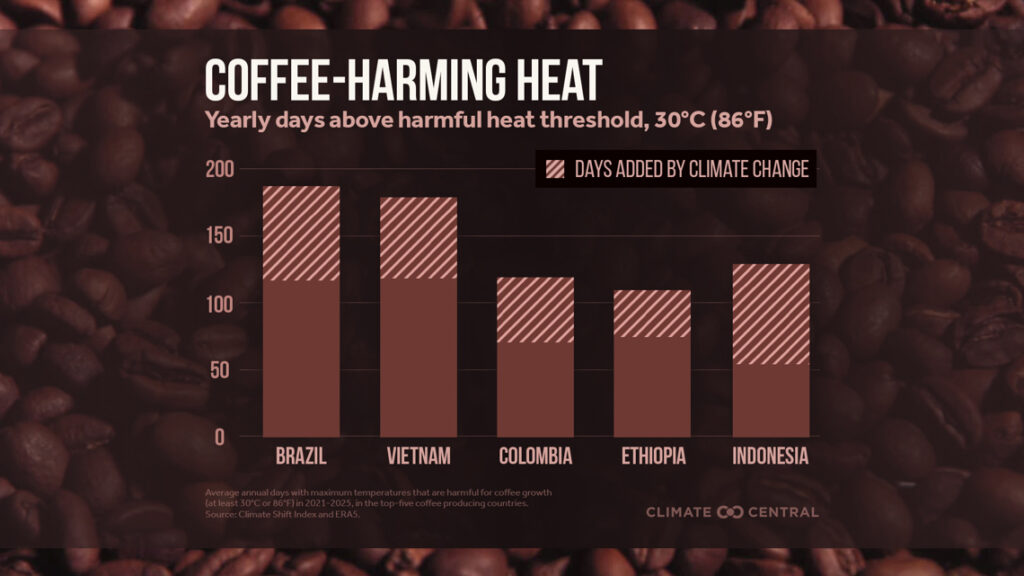
“When we look at the top 5 producers, on average, they’re experiencing about an additional 2 months’ worth of days where the temperatures are hotter than coffee’s optimal range,” explains Dahl.
The top five producers of coffee globally are Brazil, Vietnam, Colombia, Indonesia, and Ethiopia. According to this new analysis, these five countries now experience coffee-harming heat for more than 144 days of the year on average, which would be 57 days fewer without the influence of climate change.

“Both climate change and coffee really highlight just how globalized our world is and how much we depend on each other. What happens in coffee-growing countries affects us. Our emissions affect the climate of the coffee-growing countries; it’s all connected.”
In the United States, there are very few places coffee can be grown, according to Dahl. She says Hawaii can support coffee production, and there is experimental growth in California.
The coffee industry is dominated by two different species of coffee: arabica and robusta. Most of what we drink in the United States is arabica.
Dahl says arabica is more temperature sensitive, not loving temperatures above 80 degrees. Robusta can tolerate up to 90 degrees.
“They are sensitive on the lower end as well. So, for example, in Brazil, where conditions are near ideal for coffee growing, the range for arabica beans is something like 59 to 77 degrees, being optimal. It’s a little bit higher for robusta, around 68 to 86 degrees.”
Dahl says the combination of reducing fossil fuel use and improving some of the growing practices would help to mitigate the effects of climate change on coffee production. This means there are things people can do to slow down warming across the globe, as well as ways to better adapt.
“Doing things like planting shade trees in and amongst the coffee trees can help to shield them from the kind of the hottest, most intense hours of the day in the sunshine,” explains Dahl.
However, Dahl also explains that if we had to move crops or grow them somewhere else, the process to initiate new growth can take years, or even decades.
While higher heat was the biggest contributor in this study, large swings in drier and wetter patterns also impact coffee production.