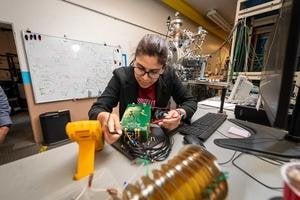
New technique could help build quantum computers of the future
https://www.eurekalert.org/news-releases/1047774

New technique could help build quantum computers of the future
https://www.eurekalert.org/news-releases/1047774
1 Comment
TLDR:
A research team led by Lawrence Berkeley National Laboratory (Berkeley Lab) says that they are the first to use a femtosecond laser to create and “annihilate” qubits on demand, and with precision, by doping silicon with hydrogen.
The advance could enable quantum computers that use programmable optical qubits or “spin-photon qubits” to connect quantum nodes across a remote network. It could also advance a quantum internet that is not only more secure but could also transmit more data than current optical-fiber information technologies.