
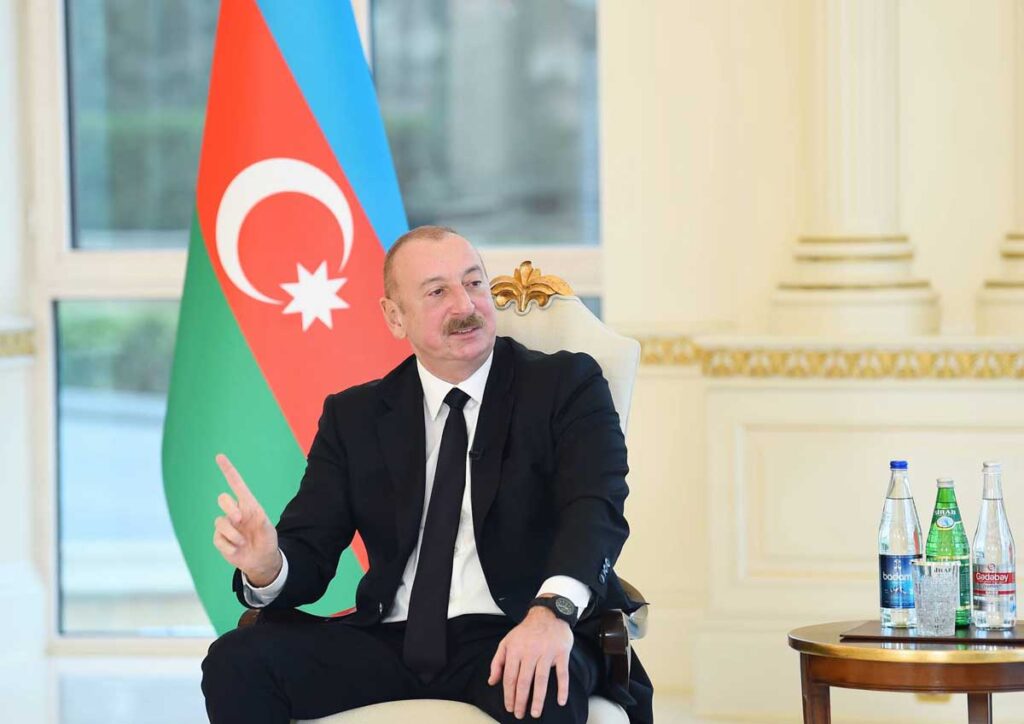
In his recent interview with France 24, Azerbaijan’s President Ilham Aliyev had an opportunity to reinforce two distinct diplomatic tracks: the peace process with Armenia following the Washington summit brokered by the Trump administration and reinforced with Vice President J.D. Vance recent visit to both countries, and the normalization of Azerbaijan’s relations with France after the tensions of recent years. Instead of consolidating these processes through measured and forward-looking language, he chose to reiterate and amplify a series of false and confrontational narratives.
On the Armenia track, Aliyev presented Azerbaijan as the sole architect of peace while portraying Armenians as the structural source of conflict. On the France track, he revived accusations that France had supported Armenian “separatists,” framing this alleged bias as justification for the deterioration of bilateral relations and for Azerbaijan’s own actions, including its interference in Nouvelle-Calédonie and broader information campaign targeting France.
Declaring Peace While Shifting Responsibility
Aliyev declares that peace has already been achieved. Yet Azerbaijan continues to control approximately 250 square kilometers of Armenia’s internationally recognized sovereign territory seized during the 2021–2022 incursions — a reality neither acknowledged as a problem nor presented as requiring resolution.
In the interview, he referred to the proposed transport route under the Trump Route for International Peace and Prosperity (TRIPP) framework — defined with full respect for Armenia’s sovereignty — as the “Zangezur corridor,” reverting to terminology long associated with Azerbaijan’s demand for extraterritorial arrangements. Interestingly, Aliyev refrains from using this this term in presence of the U.S. administration as an alternative to “Trump’s Route.”
Preconditions for Peace
At the same time, Baku maintains preconditions for signing the peace agreement, most notably the demand that Armenia amend its constitution. Azerbaijani officials argue that references within Armenia’s constitutional framework amount to territorial claims over Nagorno-Karabakh. Yet when Armenian representatives raise concerns that Azerbaijan’s own constitution contains language implying claims toward Armenian territory, these arguments are dismissed.
Armenia is already engaged in a broader constitutional reform process as part of its own internal political agenda. However, Azerbaijani rhetoric presents any potential amendment as a concession extracted under Baku’s demand, which becomes a typical case of external intervention in Armenia’s democratic governance and cognitive warfare targeting national identity.
Reversing the Conflict Narrative
Aliyev rejects any responsibility for the displacement of more than 100,000 Armenians from Nagorno-Karabakh. Their departure followed the 2020 war, subsequent military advances, a nine-month blockade that cut off humanitarian access, and the final military capture of the territory in September 2023. However, Aliyev claims that their exodus was voluntary.
While dismissing the view, expressed by many Armenian and international observers, that these events amounted to ethnic cleansing, he asserts that Azerbaijanis who left Armenia at the end of the Soviet Union were themselves victims of ethnic cleansing.
The late-Soviet period involved population movements, but the circumstances were not symmetrical. Armenians fled Baku and Sumgait following violent pogroms. Azerbaijanis left Armenia in the broader context of inter-ethnic tensions and the collapse of the Soviet Union. While Azerbaijan later introduced compensation mechanisms for Azerbaijanis who had left Armenia, Armenians who fled Azerbaijan did not receive comparable compensation for lost property.
War Crimes and the “Worse Than Nazis” Narrative
While denying any responsibility for the grievances underlying the conflict, Aliyev has framed former Nagorno-Karabakh Armenian leaders currently detained in Azerbaijan as perpetrators of war crimes. He has gone further by describing them as “worse than Nazis,” invoking particularly sensitive rhetoric in Europe to justify the exclusion of any possibility of amnesty.
The closed judicial proceedings, conducted without independent oversight, have resulted in convictions and maximum sentences. Amnesty International has underlined that only the fact that Armenian leaders of Nagorno-Karabakh “were tried before a military court in itself raises serious concerns and is incompatible with fair trial guarantees.” At the same time, Armenia returned all Azerbaijani prisoners of war, including Syrian mercenaries, as confidence-building measures, and agreed to withdraw interstate lawsuits against Azerbaijan, including the Application to the International Court of Justice, in which Armenia was winning.
The rejection of amnesty, the imposition of maximum sentences in non-transparent trials, and the use of such language contrast with the spirit of the peace process.
France: From Open Confrontation to Controlled Messaging
Following few years of information campaign against France in its overseas territories and Sub-Saharan Africa — including proved hybrid interference in Nouvelle-Calédonie — triggered by Paris’s support for Armenia, there have been signs of normalization in recent months. Instead of consolidating this shift, Aliyev continued to delegitimize France’s support for Armenia’s sovereignty and deterrence, accusing Paris of spoiling bilateral relations through alleged support for “separatists.”
It is important to note that while the French National Assembly and the Senate have adopted resolutions recognizing Nagorno-Karabakh, the French executive branch — the President and the government — has consistently distanced itself from recognition, reaffirming the principles of sovereignty and territorial integrity and addressing the issue from the human rights perspective. France’s support for Armenia has taken place in the context of Azerbaijani military offensives against sovereign Armenia, expressed politically within the UN and the EU, as well as through the provision of defensive military equipment, to decrease Azerbaijan’s significant military superiority against Armenia used for the consistent threat of the use of force and coercion.
By using the interview platform to reiterate accusations against France, Azerbaijan seeks to reshape both domestic French perceptions and the broader international narrative surrounding the France–Armenia relationship, which is expected to be formalized as a strategic partnership this year.
Conclusion
In the interview, Aliyev spoke of peace with Armenia and improving relations with France. Yet the substance of his remarks preserved the same narratives that have defined Azerbaijan’s post-war posture. Constitutional change remains framed as a prerequisite for a peace agreement; the displacement of Nagorno-Karabakh Armenians is presented as voluntary; revisionist claims are directed at Armenia; the Trump Route for International Peace and Prosperity is referred to as the “Zangezur corridor”; former Nagorno-Karabakh leaders are stigmatized and convicted without amnesty; and France’s support for Armenia continues to be portrayed as interference.
Rather than marking a shift, the interview used the platform to reinforce established positions under the language of normalization — an exercise in narrative warfare rather than reconciliation. This undermines the prospects for sustainable confidence-building and risks transforming diplomatic engagement into a performative process detached from structural conflict resolution.