
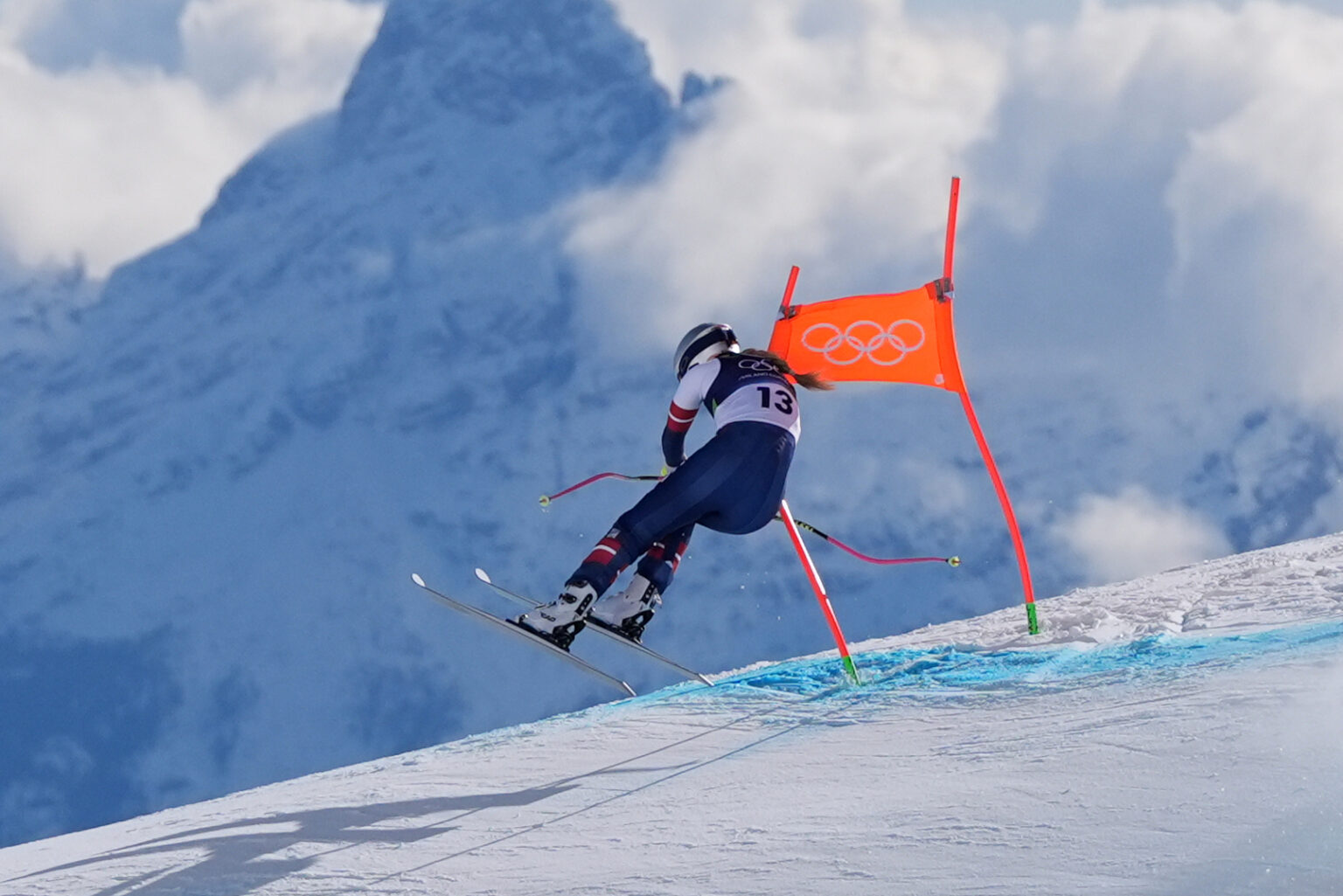
“There was a little compartment in my brain that thought if I pushed just a little harder, I could be one of them,” Tiffany Gee Lewis writes of watching Olympians compete. But as she nears 50, “where I used to see indomitable spirit, now I just see an emergency room.”
This story was originally published by Lookout Eugene-Springfield.
I love the Olympics. Love them, love them, love them.
I am not a big watch sports kind of person, but for two weeks every two years, the Olympics supersedes all other activities. They are my favorite sport, the whole package. I love the grit, the dramatic behind-the-scenes stories, the obstacles the athletes overcome to get on that mountain/rink/halfpipe. I delight in the obscure sports that only get highlighted every four years: luge, curling, biathlon.
And of course, I get emotional watching the flag-waving world come together to light the cauldron and celebrate solidarity for human achievement.
However, I have to admit that the Olympic viewing experience has changed as I age. In my teens and 20s, the athletes looked strong, powerful and invincible. I cheered every triple salchow, leaning forward, my own muscles tense and excited.
There was a little compartment in my brain that thought if I pushed just a little harder, I could be one of them. Sure, I didn’t have a specific sport in which I excelled, but I still believed I was two hairs shy of a podium finish, that if I met Picabo Street on the slopes or Kristi Yamaguchi on the rink, I’d be able to hang.
Now, on the back half of my 40s, the Olympics feel different. There is so much admiration for the athletes. But my goodness, the danger involved in these winter sports. Headfirst down a chute of ice? Ice blades on the feet? Skiing with a loaded gun?
When my husband, Seth, and I watch downhill skiing, we aren’t leaning forward, cheering on the athletes. We are clinging to each other in white-hot terror, our faces half-covered, cringing when a skier is thrown off balance.
Our son watched with us the other night, and after enduring our reactions for 10 minutes, he turned to us and said, “Mom. Dad. You have got to get it together.”
What he doesn’t understand is that when an athlete falls, I feel it. Where others see grit, I see tendonitis. Where others see hours of hard work, I see repetitive stress injury. My body aches for them.
Where I used to see indomitable spirit, now I just see an emergency room.
The world can be broadly divided into two categories: those who have had the pleasure of tearing a major ligament, and those who haven’t.
I wish I could say my venerable ACL tear came while hurdling 80 mph down an icy slope in Italy. Alas, it came while going 0 mph off an Oregon chair lift and crossing skis with my son.
I wouldn’t say that being in the torn ACL club is as fun as, say, book club, but there is a solidarity. I’ve been known to chase people down (now that I can run again!) who are hobbling on crutches, their knee locked in a brace, just to give them a few words of encouragement: It gets better! You will be able to straighten that leg again someday! And even play pickleball!
In the ACL club, you know what the long road to recovery looks like: limited mobility followed by months of physical therapy, the knowledge that you are now patched together by a few tenuous tendons. (Lindsey Vonn, I send you a three-finger salute.)
You also realize that you are not invincible — or maybe that awakening simply comes with age. I was fully 40 years old when I sat myself down and said, “Tiffany, you will probably never compete in the Olympics.”
It was a good chat. I took the news better than expected. Because, hey, I can still admire, cheer, marvel and delight at the super-human feats of these half-insane athletes.
Even if I do it with only one eye open.
Have something to say? Lookout welcomes letters to the editor, within our policies, from readers. Guidelines here.