
In central Novi Sad’s Freedom Square, in front of City Hall, a monumental bronze statue of Svetozar Miletić dominates the area, with a pedestal as high as seven meters. The monument, erected in 1939 when Miletić’s dreams of a free and united Serbian people had been realized, leaves an impression of grandeur, proportionate to the work and personality of the man to whom it is dedicated.
Its author Ivan Meštrović successfully conveyed through the composition of the monument both the grandiosity of Miletić’s personality and his characteristic unruliness and unrestrained nature.
A descendant of generations of frontiersmen, warriors who defended the Habsburg state from Ottoman Turkey, and later a witness to the revolutionary events of 1848/1849 and a participant in the May Assembly of 1848 which proclaimed the Serbian Vojvodina, Miletić was also a witness to its abolition in 1861, which he experienced, like most of his compatriots, as a sign of ingratitude from the Viennese Court.
What he experienced made him an uncompromising fighter for the national cause. Although he was convinced that the Vojvodina as it had existed was not an expression of the needs of his compatriots, in those difficult days of general national despondency he emphasized that a new Serbian Vojvodina would be created, more suited to the real needs of his people.
He openly wrote at the time that with the disappearance of Vojvodina something even more important had disappeared, referring to the loyalty of the Serbs to the Viennese court.
Miletić advocated political cooperation between Serbs and Hungarians, rather than with the Habsburgs. Prince Mihailo shared a similar opinion, as did Prince Miloš as early as 1848/1849, when the actual development of events was the opposite.
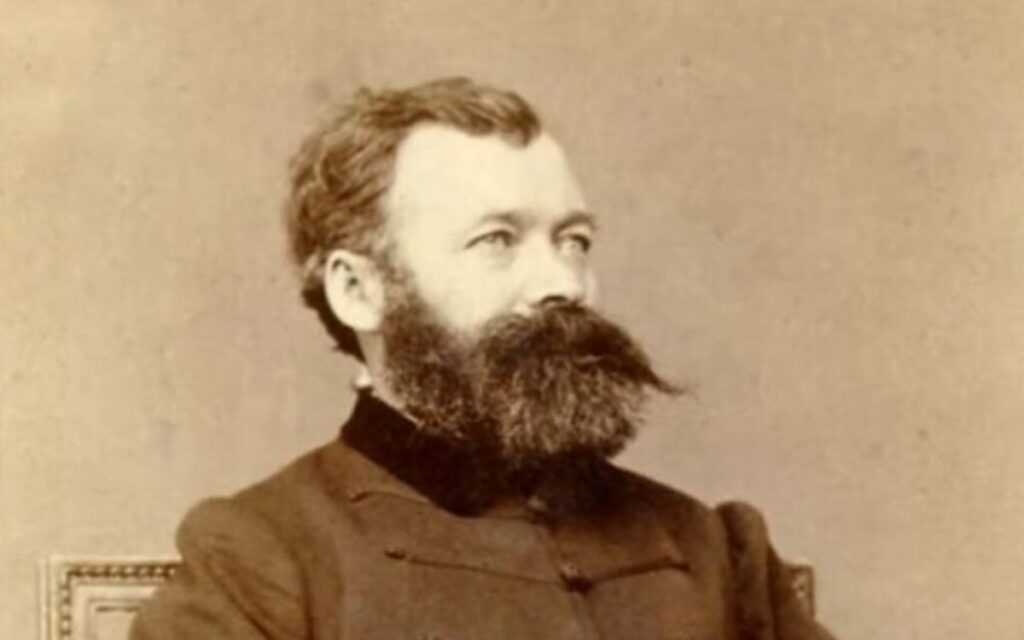
The later leader of the national struggle of Serbs in Austria-Hungary, initially Austria, the beloved mayor of Novi Sad, a lawyer, sharp journalistic pen, and long-time deputy in the Hungarian Parliament, Svetozar Miletić was born in Mošorin, in the frontier region of Šajkaška, in southeastern Bačka.
After schooling in his hometown and nearby Titel, he attended the Serbian Gymnasium in Novi Sad. His father, a cobbler, directed him toward a trade, but then followed advice to provide him with further education. He was an excellent student, if not the best, from the beginning of his schooling and later at the Novi Sad gymnasium. The distinguished Jovan Hadžić (Miloš Svetić), founder of Matica srpska, even claimed that Miletić was the best pupil that gymnasium had ever had. Hadžić therefore influenced well-to-do compatriots, including bishops, to materially support his further education.
He then attended a Protestant lyceum in Pozun, today’s Bratislava. At that time, Serbs often sent their children to Protestant schools due to distrust of Roman Catholic ones, although they were often exceptionally high quality. When Miletić arrived there in 1844, about forty Serbian students were staying in Pozun. They even had an organized society imbued with Pan-Slavic dreams.
He initially studied law in Pest, which was interrupted by the revolutionary year 1848.
Returning to his native Šajkaška, disappointed, he appealed to his compatriots to avoid mobilization for the war Austria was then waging in Italy against nationalists committed to unification. By the decisions of the Congress of Vienna in 1815, Austria had annexed Venice and Lombardy, which would cause the Italian uprising.
After a short stay in Belgrade, he attended the May Assembly in Sremski Karlovci. He participated in the proclamation of Vojvodina. Already then among the most radical, as they say “without a hair on his tongue,” the newly proclaimed Patriarch Rajačić removed him from the Main Committee in Karlovci by assigning him a special mission to Zagreb, from which Miletić returned disappointed.
He continued his education in Vienna in 1849 with the advocacy and funds of Prince Mihailo. As a graduated lawyer he served for some time as a court clerk in Lugoj in eastern Banat (today Romania). Choosing to return to Novi Sad, he opened a law office in the Serbian Athens.
Then, in the second half of the 1850s, he began lively journalistic activity on political topics in the Novi Sad SrbskI dnevnik.
In March 1861 he became mayor of Novi Sad. He undertook a series of radical measures, from declaring Serbian the official language of the administration, through abolishing the local German gymnasium, to initiating the founding of the Serbian National Theatre in Novi Sad, as president of the Serbian Reading Room.
His leading associates at the time were Jovan Jovanović Zmaj, the great poet from a distinguished Novi Sad family that also bore noble status, Jaša Ignjatović, also a writer from Szentendre, and later Laza Kostić and Kosta Trifković, likewise giants of Serbian literature. He participated in the Annunciation Church-National Assembly.
That same year, 1861, he founded the Serbian People’s Liberal Party.
The Hungarian Government, however, soon found a way to remove Miletić from his responsible position.
He was among the organizers of the relocation of Matica srpska to Novi Sad in 1864. In Pest, it is true, the institute founded by Count Sava Tekelija remained, intended for the education of Serbian children in the capital of Hungary.
Miletić’s founding of the newspaper Zastava also left a great mark, a paper to which he gave tone through uncompromising writing. Svetozar Miletić had the courage to openly write and publish what others, even his close associates, only whispered.
He returned to the leading position in Novi Sad in 1867, again briefly for a year, when the Pest government suspended him.
The situation had now become even more complicated, since the Compromise had been reached which shaped the dual Austro-Hungarian monarchy, and Miletić’s advocacy of joint opposition by Serbs and Hungarians to Vienna’s arbitrariness became pointless.
He was arrested, subjected to a fabricated trial, and imprisoned. From then on, the authorities gradually broke him. The harsh prison sentences he endured permanently damaged his health. After another trial in 1876 and the torture he survived, when he was sentenced to six years in prison, he never fully recovered, although he remained active for years. On one hand he suffered severe pain due to bone disease, a consequence of imprisonment, and then psychological troubles began.
Neither pardons nor treatments could help him anymore, except briefly.
Svetozar Miletić left this world in Vršac in February 1901, where his son Slavko was serving at the time. The final farewell to the national martyr Miletić was unprecedentedly massive.
Exceptionally liberal-minded and devoted to justice, in addition to the national struggle, he also left an important mark in advocating for women’s rights. His legacy included the presence of women in politics. As early as the 1860s he advocated the belief that the education of girls was not only a matter of equality but also a prerequisite for building a healthy society. He did not impose life paths on his daughter, respecting her will, choices, and even risks.
Milica not only engaged in writing and political journalism, but was also a representative of early feminism in our environment. She was also a deputy at the Great National Assembly of Serbs, Bunjevci and other Slavs in 1918 in Novi Sad, when the annexation of Vojvodina to the Kingdom of Serbia was proclaimed.
His son Slavko was a physician, and after unification, during the time of the Kingdom of Serbs, Croats and Slovenes, he served several times as a minister.
MORE TOPICS:
Source: RTV Foto: Printscreen RTV