
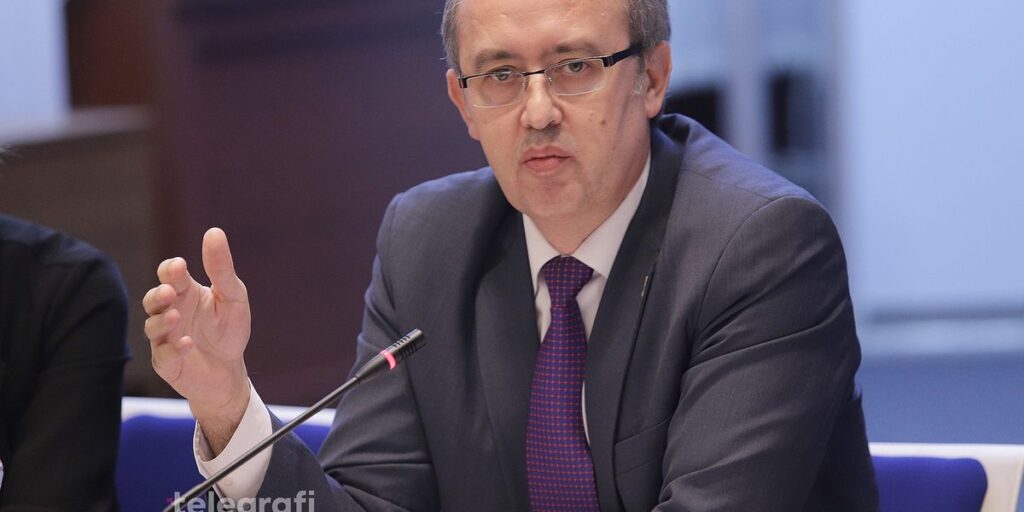
Kosovo Assembly Member from the Democratic League of Kosovo (LDK), Avdullah Hoti, has said that some of the International Monetary Fund’s (IMF) observations from its two-week surveillance mission in Kosovo coincide with observations he has raised in the last four years.
Hoti, through a post on the social network Facebook, wrote that he does not expect any reflection on these issues from the new government either.
“In this government, as in the previous one, expertise is clearly in great deficit. Above all, fiscal and industrial policies that develop the private sector and increase private employment are developed by those who have developmental orientations of the market economy. Instead of the new government focusing on these issues raised by the IMF, the first thing they are doing is preparing the law to set ceiling prices on certain products,” Hoti wrote.
For more, read Avdullah Hoti’s full post:
On February 13, 2026, the IMF mission from Washington concluded a two-week surveillance visit to Kosovo in the framework of consultations under Article IV of the IMF’s Articles of Agreement. According to this article, the IMF has a mandate to monitor the economic and financial policies of member countries with a view to ensuring global monetary stability. Since Kosovo’s accession to the IMF in 2009, which was a historic achievement for the young state of Kosovo, the IMF has conducted several such missions to Kosovo.
At the end of this visit, the mission issued a lengthy statement highlighting several issues that pose a risk to Kosovo’s economic and fiscal stability.
Of course, IMF missions are usually conservative in their stances, but the issues raised this time coincide with the observations I have raised in the last four years regarding the economic and fiscal policies of the Government of Kosovo.
Below I highlight some of the IMF’s observations, as presented in the statement:
1. ECONOMIC GROWTH: has fallen to 3.25 percent at the end of the third quarter of 2025, from 4.75 percent in the same period of the previous year. This has come as a result of weakening consumption and private investment due to the slowdown in credit activity and real incomes. Economic growth this year is expected to reach 3.8 percent and eventually converge with the potential growth rate of 4 percent.
2. INFLATION: In December 2025, it rose to 5.25 percent, compared to just 1.1 percent a year earlier. This increase was due to rising food prices.
3. TRADE BALANCE: has deteriorated due to increased imports, especially energy imports. As a result, the current account deficit with foreign countries has widened to 9.6 percent of the value of Gross Domestic Product, from 8.4 percent in 2024.
4. PUBLIC SECTOR SALARIES: should be linked to the inflation rate.
5. MINIMUM WAGE: should be determined by balancing labor productivity and the cost of living.
6. EXPENDITURE ON GOODS AND SERVICES: opportunities for savings should be identified.
7. BANK LOANS: have reached the level of 60 percent of Gross Domestic Product, which is among the highest in European countries with developing economies, which should be monitored in particular with regard to banks’ exposure to the real estate sector.
8. MICROFINANCE INSTITUTIONS: measures should be taken to supervise these types of non-banking financial institutions, in order to preserve the integrity of the financial system, protect clients, and implement international best practices in this regard.
Of course, the IMF statement also mentions other positive developments that have occurred. But, taken as a whole, the observations listed above highlight the lack of proper macroeconomic and fiscal management of the Kosovo economy in recent years. Here are some of the arguments that prove this:
• The lack of public investment for years, leaving all major road infrastructure arteries half-finished for the past five years, has limited economic growth. This has meant that the economy has missed hundreds of millions of euros due to the failure to implement capital projects, causing negative multiplier effects throughout the economic chain. Furthermore, the fiscal space within the annual budgets for new projects has remained almost zero, as existing unfinished projects have had to be included in the budget year after year. This has made it impossible to free up space in the budget for other projects.
• The railway infrastructure, which is vital to reducing transport costs and protecting roads and highways from damage, has been completely forgotten. Not only have new railway lines not been built, but existing lines have not been maintained and functionalized. One of these lines, the one connecting Klina with Prizren, has almost ceased to function due to some minor interventions that have been missing for years.
• The complete lack of fiscal policies, especially industrial policies, has caused domestic production to stagnate. As a result, the growth of private and public consumption over the years has been almost completely covered by imports, which have doubled in the last four years, reaching 7 billion euros. The structure of imports best highlights the lack of domestic production of basic goods. The production of some of these basic goods, for which imports are increasing, is subsidized by the state budget.
• The lack of adjustment of salaries, pensions and social schemes to the inflation rate has greatly reduced the purchasing power of income. One-off increases in pensions and other schemes have not solved the problem of the decline in the purchasing power of household income due to inflation. These types of increases clearly seem to have had electoral motives.
• Poor management of public spending has led to continuous delays in subsidies for farmers, who are forced to take out loans for agricultural inputs.
• What is the role of microfinance institutions? Why are these institutions allowed to provide loans to families with an interest rate of 21.7 percent and to farmers with 16.3 percent (according to the Central Bank of Kosovo report)?
• Why does the financial sector in Kosovo remain extremely underdeveloped, being focused only on lending? Why has the insurance sector remained focused only on compulsory insurance?
I do not expect any reflection on these issues from the new government either. Economic policies, especially fiscal and industrial policies, require expertise. In this government, as in the previous one, expertise is clearly in great deficit. Above all, fiscal and industrial policies that develop the private sector and increase private employment are developed by those who have a market economy development orientation.
Instead of the new government focusing on these issues raised by the IMF, the first thing they are doing is preparing a law to set price ceilings on certain products.
This is not the solution to the problem of inflation and the decline in the purchasing power of household incomes. History has shown very clearly that, except for products and services offered in monopolized markets, such as energy, water, rail transport and the like, the increase in prices of other goods cannot be limited by laws.
Prices can be kept moderate by reducing production costs, transportation costs, and taxes on those products.
Above all, prices can be kept moderate by implementing industrial policies that support domestic producers in the production of those products. None of these measures have been taken in the last five years; as a result, imports and inflation have continuously increased.