
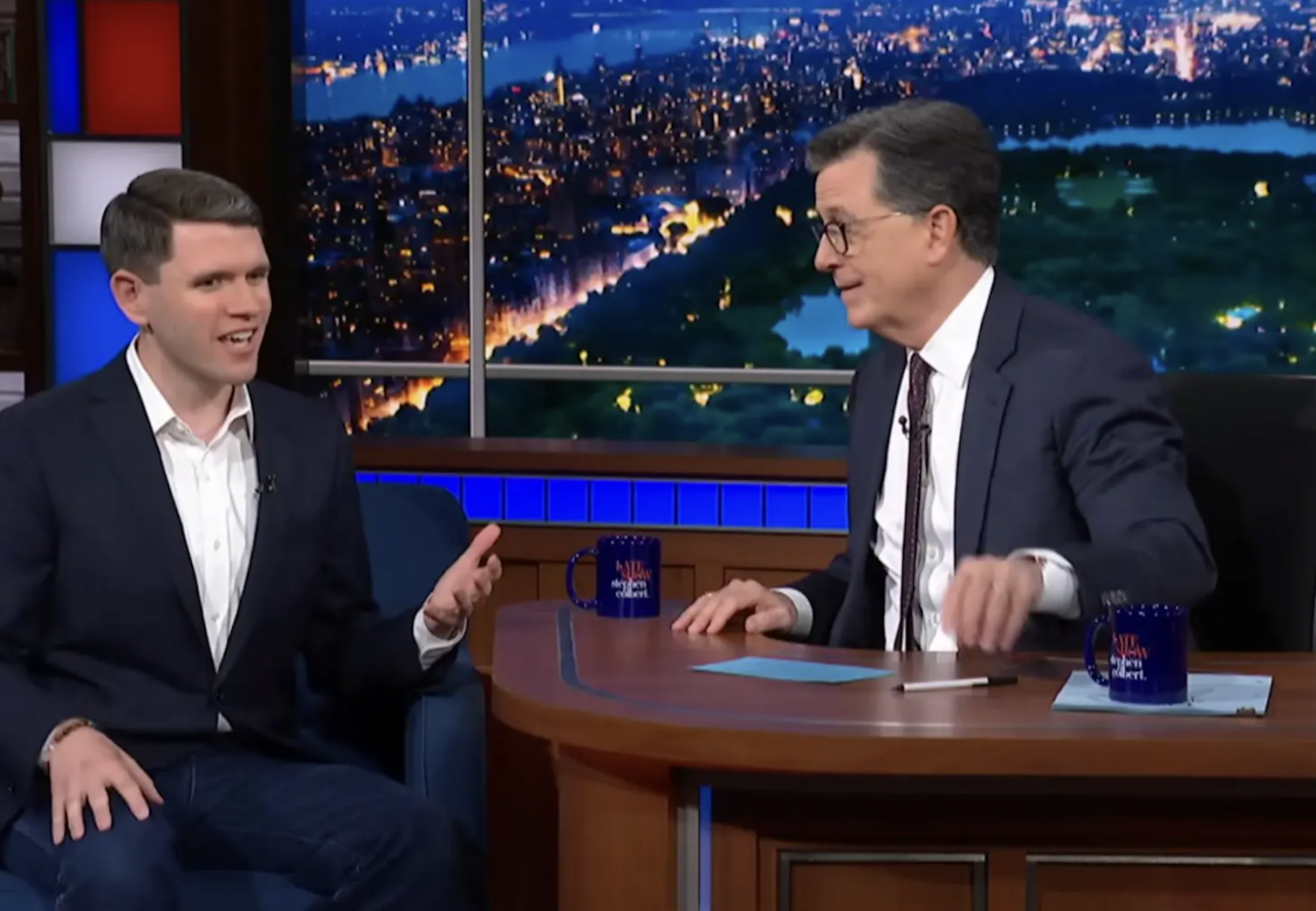
James Talarico doesn’t look like a threat. A baby-faced 36-year-old and Presbyterian seminarian, he has a resume that includes two years in a sixth-grade classroom with Teach for America, a master’s in education policy from Harvard and election to the Texas State Legislature, where he became its youngest member at the age of 29. He doesn’t sound like a threat, either—at least, not in his tone, which is quiet and careful.
But Mr. Talarico may be seen as a threat by the Federal Communications Commission and its Donald Trump-appointed chair, Brendan Carr. On Feb. 2, he appeared on ABC’s “The View.” Less than a week later, Fox News reported that Mr. Carr had launched an investigation into the appearance. This followed the F.C.C.’s Jan. 21 announcement of new guidelines indicating that talk shows would no longer be considered exempt from rules requiring that broadcasters give equal air time to all candidates in a race.
Mr. Talarico is running in a primary to determine November’s Democratic candidate for the U.S. Senate seat currently held by Republican John Cornyn. His chief opponent is U.S. Representative Jasmine Crockett, who in fact did appear on “The View” in January, before the F.C.C.’s new guidelines were released.
Then, last Monday, Mr. Talarico was scheduled to appear on “The Late Show with Stephen Colbert.”That evening, Mr. Colbert announced on air that CBS lawyers forbade him to air the interview on TV out of fear that the F.C.C. would react as it had with “The View.” (Mr. Carr later claimed the public had been “lied to” and denied the new enforcement of rules amounted to censorship.)
Heather Cox Richardson, a Boston College historian whose social media posts are frequently shared among progressives, posted a short commentary the next day in which she noted that, so far, Mr. Carr’s new enforcement has only affected appearances by this particular candidate. She concluded: “He’s trying to change the rules to make sure people don’t listen to James Talarico.”
F.C.C. rules don’t apply to YouTube, so “The Late Show” posted Mr. Colbert’s interview with Mr. Talarico online in its entirety. In a textbook example of the Streisand Effect, it quickly became one of the show’s most-watched clips, accumulating over seven million views in the first 48 hours.
Mr. Colbert opened the interview by jokingly asking, “Do you mean to cause trouble?” Mr. Talarico’s answer to why the F.C.C. is targeting him—“I think that Donald Trump is worried that we’re about to flip Texas”—was met with cheers, and is probably part of the truth. But there may be even more than a U.S. Senate seat at stake. Mr. Talarico’s gentle but fearless proclamation of faith aims to rescue the word “Christian” from a cynical political culture. A movement built around this effort could indeed topple the mighty.
I am one of the many Catholics disillusioned with mainstream U.S. politics. The two-party system forces voters into oversized tents, neither of which is well aligned with Catholic teaching. The American Solidarity Party offers a platform based on everything I value, but as a force for change, it remains, for now, aspirational.
Meanwhile, the ugliness and ill will that have come to define our system in recent decades are spiritually corrosive. If you’re both religious and politically engaged, the practical choice has often seemed to be: Let your political affiliation subsume all others, or take one big step back from following politics to preserve any chance of maintaining hope and charity.
We might assume Mr. Talarico has gained his considerable following because he speaks for committed Christians whose political views lean progressive. It is true that millions of Americans have been overlooked by the dominant, flawed narrative that Christian equals conservative and liberal equals godless.
But what might be most important about Mr. Talarico as a political figure is that he understands the pitfalls of political identification and chooses to lead with his faith rather than his political allegiances. He also exposes how others do the opposite, even as they perform piety. “I think we have to remember to put those big things first, to put the love of God and the love of our neighbors before anything else,” he told Mr. Colbert. “Because right now, what you’ve got is people baptizing their partisanship and calling that Christianity when in reality, your politics should grow out of your faith, and not the other way around.”
Mr. Talarico says he is a Democrat because of the party’s traditional support for those with less wealth and fewer resources. He recounted on Joe Rogan’s podcast how his mother told him early on that Democrats fight for the people. “I don’t know how much our party is still true to that, but I do know that that’s our historical legacy: the party that fights for the little guy. And I think we’re at our best when we do that today,” he said, adding, “I still believe the Democratic Party can get back to those roots.”
He believes that Jesus’ instruction to feed the hungry means Christians should support programs like SNAP and WIC, and that anger at corporate greed is justified. The landing page of his campaign website reads, in all caps, “It’s time to start flipping tables.”
I will admit my knowledge of Mr. Talarico is limited and recently acquired. I don’t think I had heard of him until this year, but by now he has cropped up on programs and outlets from NPR/WBUR’s “Here & Now” and Ezra Klein’s New York Times podcast to Fox News and the Christian Broadcasting Network.
I have heard him articulate faith-based reasoning that leads him to stances I reject. But in many ways he is remarkable, evincing degrees of sincerity and humility rarely seen in a politician. His thoughtfulness and knowledge of Scripture are apparent. He seems almost shy, in a way that pairs strikingly with his moral clarity. I listen to him and think: Here is the kind of unassuming person that should lead.
I’m not alone. In a note accompanying the post of his podcast interview with Mr. Talarico, Mr. Klein noted: “State Representative James Talarico of Texas might have been our most requested guest last year…. He’s clearly saying things that people are hungry to hear.”
Mr. Talarico has reported that people routinely come up to him at campaign events and say conspiratorially, “I’m not a Democrat.” In a country so polarized that we’re watching separate Super Bowl halftime shows, attracting voters who don’t want to admit they like you is a kind of Holy Grail.
Ms. Cox Richardson speculated that the Trump administration fears Mr. Talarico’s message will resonate with MAGA evangelicals looking for “an off-ramp” from Christian nationalism and lead them away from his camp. I am skeptical any such dramatic shift is afoot, but stranger things have happened. If anyone can soften the sclerotic patterns of our body politic, it’s someone like Mr. Talarico. I defy any religious person to listen to him and come away feeling he looks down on their beliefs.
Meanwhile, polls show there are millions of voters who are exasperated with political partisanship. The Independent Center, a resource for non-affiliated voters, found that roughly three-quarters of Pennsylvania and Arizona voters in 2024 had negative views of the political climate. A Gallup poll released in January showed that the number of U.S. voters identifying as independents had reached a new high of 45 percent.
Many left-leaning voters, meanwhile, are highly receptive to the message of the Gospel, but doubt the sincerity of institutions purporting to represent it. To hear the disarming voice of Christ, you usually have to go looking for it—by joining a faith community, or seeking out the guidance of genuine teachers. You’re unlikely to hear it shouted in the public arena. The comment sections under Mr. Talarico’s interviews include a lot of sentiments along the lines of this one: “James Talarico makes me want to be a Christian; Christian nationalists make me want to become an atheist.”
His appeal is broad, like his communications strategy. And while he gladly talks at length about how his values and behavior are inseparable from his faith, his ideal of citizenship in a pluralistic society insists on church-state separation. He told Mr. Colbert: “We are called to love all our neighbors, including our Muslim, Jewish, Buddhist, Hindu, Sikh, agnostic, atheist neighbors. And forcing our religion down their throats is not love.”
Then he added an often neglected point: “That boundary between church and state doesn’t just benefit the state or our democracy—although it certainly does—but it also benefits the church. Because when the church gets too cozy with political power, it loses its prophetic voice…its ability to imagine a completely different world.”
It’s fair to say that, in 2026, most of us are longing for a completely different world. Even if we can imagine it, we probably don’t know what to do with that vision because the current version is so intractable. Our broken politics are a large part of that heavy, pessimistic sense.
Mr. Talarico is suggesting that religious institutions should avoid getting too absorbed with political power and authority, and leave it to politicians—albeit politicians with integrity—to find solutions that work as well as possible for as many people as possible. Ironically, though, Mr. Talarico the political candidate is, in his very manner, giving us glimpses of a different way. There could be a day when the Spirit is able to move more freely in places of government, not chained by our overinvestment in games of power.
It says a lot that the F.C.C. doesn’t want him on the air. We should pay attention.
Related