
Plans to ban smoking for anyone born after 2009 may breach Britain’s agreement with the European Union and cause a legal battle with Brussels.
Seven EU countries have formally expressed concern that the government’s generational smoking ban breaches the Windsor framework, the post-Brexit legal agreement to avoid a hard border on the island of Ireland.
Ministers hope to achieve a “smoke-free generation” by gradually raising the age at which tobacco can be bought, arguing that there is “no freedom in addiction”. The legal smoking age will increase by one year, every year.
Croatia, the Czech Republic, Greece, Italy, Portugal, Romania and Slovakia have all issued detailed opinions or formal comments to Brussels raising serious legal concerns about the proposed law.
Officials in Portugal warned that the proposal was “in clear breach of the principles of the treaties, as well as the Windsor framework”, while Prague said the measures would create “an unjustified barrier to the free movement of goods”.
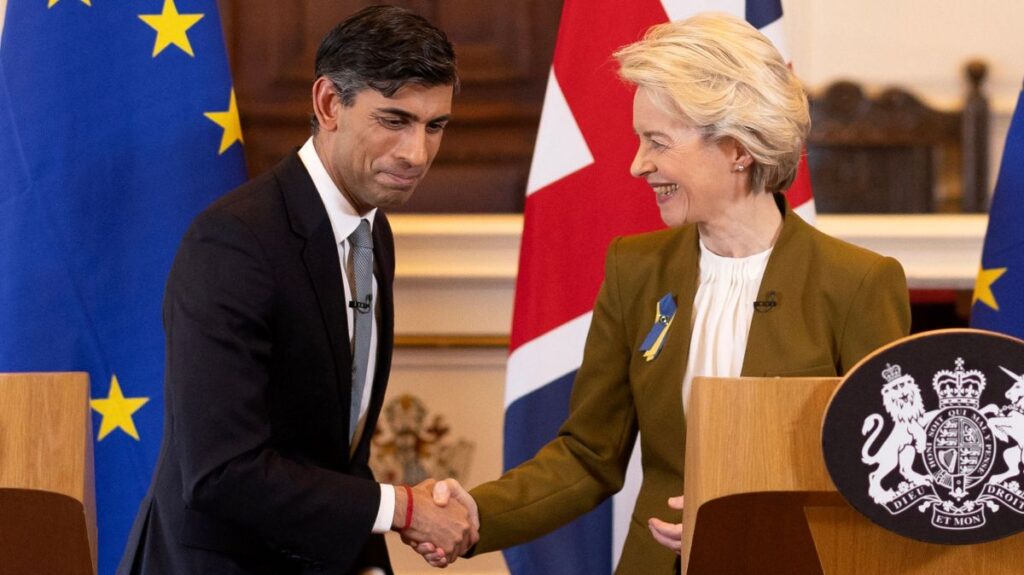
Northern Ireland remains subject to hundreds of single market rules because of the Windsor framework, which was first agreed by Rishi Sunak in February 2023 when he was prime minister, before it was renegotiated by his successor, Sir Keir Starmer, in February last year.
The smoking ban, first proposed by Sunak, was adopted by Labour and ministers notified Brussels of the legislation last August under the terms of the agreement. The government insisted that the legislation was “fully compatible with our international treaty obligations in Northern Ireland”.
Senior figures who oppose the ban believe the government is wrong and want the legal advice they are relying on to be published.
A source said: “It is open to a legal challenge from the EU side. We know that the Irish government considered this step [a generational ban] themselves, but didn’t proceed because it was concluded that it would be contrary to EU law as it presently stands. So there is clearly a tension between the UK government’s position and seven other seven other member states.”
The bill is due to begin its report stage in the House of Lords on Tuesday. If it passes into law and Brussels believes it breaches the rules of the single market, talks would be convened to attempt to diffuse the row. Ultimately the EU could pursue legal action.
Another source who was familiar with the bill said it was “first big test of the Windsor framework” and warned that seven EU states raising objections was a warning sign for future laws.
Britain and Brussels are holding fortnightly talks as they work towards an agreement on Starmer’s reset with the bloc. Ministers hope to announce a deal on food standards, youth mobility and energy co-operation at talks between Starmer and Ursula von der Leyen, the European Commission president, due to be held by the end of May.
The Department for Health said: “The Tobacco and Vapes Bill will apply in Northern Ireland, ensuring that people in Northern Ireland will benefit from the action the government is taking to tackle the leading cause of preventable death in the UK.
“We have provided a comprehensive response to the European Commission on the detailed opinions received, setting out the reasons why our smoke-free generation policy is fully compatible with our international treaty obligations in Northern Ireland.”