
REL: The Kosovo government has no clear position on the model with which it will integrate education and healthcare for Serbs

Express newspaper
24/02/2026 16:51
Granting executive powers through the Association of Serb-majority Municipalities, as a model for integrating education and healthcare into the Kosovo system, is, according to Kosovo politician Rada Trajkovic, the only option for the sustainable survival of the Serb community.
In a statement to Radio Free Europe, she says that there can be no differences from the educational system of the Republic of Serbia, because otherwise, the position and survival of Serbs in Kosovo would be “risked”.
Trajkovic was the director of the Health House in Gracanica, lectured at the Faculty of Medicine of the University in North Mitrovica, which continues to function under the Serbian system, and was also a member of the Kosovo Assembly.
On the other hand, the sociologist from Pristina, Artan Muhaxhiri, who is also an expert on political circumstances, estimates that the most logical approach to the integration of educational and health institutions – which in Serb-majority areas in Kosovo continue to function under the Serbian system – would be “pragmatic eclecticism”, namely “identifying existing international models of a similar nature” and “selecting solutions that would be appropriate for Kosovo”.
“It would not be necessary to start from scratch, because such minority integration practices, even within complex frameworks, have been applied for decades and in many different situations,” he tells Radio Free Europe.
The Kosovo government has no clear position on integration models.
The issue of integrating Serbian healthcare and education in Kosovo was raised in September last year, when Prime Minister Albin Kurti said that the dual system is not sustainable and that its “incorporation and unification” should be done.
At that time, he said that this integration would be worked on together with political representatives of the Serbian community, but also with the international community.
He conveyed this message again to the ambassadors of the QUINT countries – the US, France, Great Britain, Germany and Italy – in mid-January of this year.
But, until now, it was not clearly specified which integration models are being considered.
Regarding this issue, the Kosovo Government did not respond to Radio Free Europe’s questions.
On February 10, former Kosovo Deputy Prime Minister Besnik Bislimi said that the next five to six weeks are very important for the integration of Serbian healthcare and education institutions and added that everyone should be constructive on this issue.
Late last week, the European Union told Radio Free Europe that the status of health and education structures and services supported by Serbia in Kosovo will be resolved within the framework of the dialogue between Pristina and Belgrade, in accordance with the agreements reached and the laws in force in Kosovo.
Official Belgrade insists on the integration of health and education in accordance with the Brussels Agreement, as does the Serbian List – the largest Serb party in Kosovo, which has the support of the current authorities in Serbia.
What does the Association foresee for Serbian health and education?
The Association of Serb-majority Municipalities was agreed in 2013 with the first Brussels Agreement between Kosovo and Serbia, while the principles for it were harmonized in 2015.
This association is also mentioned in the Agreement on the Path to Normalization of Relations, which Kosovo and Serbia accepted in 2023 in Brussels, after which the European Union also drafted a draft statute.
Kosovo, however, has not yet sent this draft statute to the Constitutional Court for review, which should be the first step towards establishing the Association.
The draft statute was never made public, but Radio Free Europe had access to it, and it should resolve numerous open issues, including the functioning of Serbian health and education institutions.
Serbian institutions after the war
After the war in Kosovo in 1999, Serbia relocated its institutions to areas where the majority population is Serb.
Kosovo authorities closed most of them in recent years.
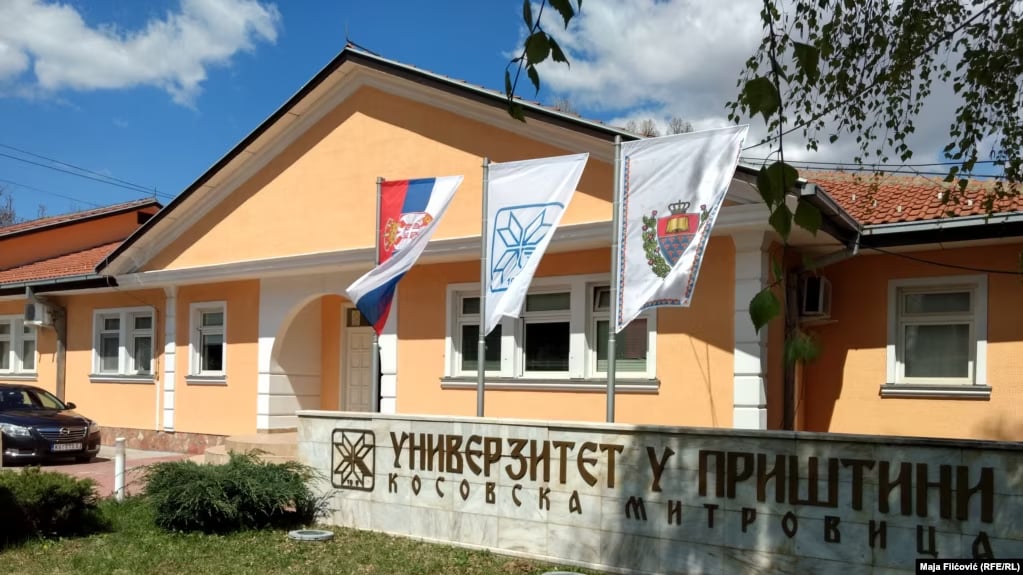
But educational institutions continue to function today, including preschools, primary and secondary schools, as well as the University based in North Mitrovica.
Serbian health institutions – such as local health centers and clinics, the Hospital Clinical Center in Gracanica and the one in North Mitrovica, as well as the Health Center in Pasjan – are also functioning.
These institutions are expected to become private under the umbrella of the Association of Serb-majority Municipalities, with Serbia providing a “financial contribution”.
The draft statute specifies that they have the “status of private foreign institutions” and obtain permits, or licenses, to operate in accordance with current Kosovo laws.
Even when it comes to the curriculum, the draft statute states that it must be regulated in accordance with current Kosovo laws.
Currently, it is not clear what that would look like, considering that Kosovo and Serbia have completely different views when it comes to history or geography, because Serbia does not recognize Kosovo’s independence.
However, the draft statute states that the Association will have competences regarding education, which means cooperation between municipalities, presenting educational policies to central authorities, providing advice to central authorities on the Serbian curriculum, providing advice on changes to the education law, and so on.
According to the draft statute, there would also be a standard of “dual awarding of diplomas”, Kosovar and Serbian, which would be recognized by both Kosovo and Serbia.
The same draft stipulates that educational and health institutions may use facilities built with Serbian funding, but this should not hinder the functioning of Kosovo’s existing education and health system.
Similarly, the Association of Serb-majority Municipalities should have competences in the field of health, facilitating cooperation between municipalities to improve primary and secondary health, representing health and social policies before central authorities, financing infrastructure projects, medical equipment and materials, collecting or financing social assistance, etc.
What is said about health and education in Kosovo’s laws?
Kosovo’s constitution and laws, which were drafted based on the Martti Ahtisaari Plan – the document on the basis of which Kosovo declared independence in 2008 – also provide for rights for the Serbian community, from culture, language, religion and tradition, to education, health, economic and property issues, to the formation of Serb-majority municipalities through the decentralization process.
Today, there are a total of ten Serb-majority municipalities in Kosovo. Six are located south of the Ibar River – Gracanica, Novo Brdo, Štrpce, Ranilug, Kllokot and Partesh, while the other four are territorially connected to the north – North Mitrovica, Leposavic, Zvecan and Zubin Potok.
According to the Constitution of Kosovo, minority communities have the right to be educated in one of the official languages at all levels, which means also in Serbian, because this language, along with Albanian, is in official use throughout the territory of Kosovo.
However, there are currently no Serbian-language educational institutions within the Kosovo system.
Furthermore, the Constitution of Kosovo and the Ahtisaari Plan stipulate that minority communities have the right to establish and manage their own private educational institutions, which may be provided with financial assistance in accordance with international law and standards.
Article 20 of the Law on Local Self-Government of Kosovo grants the municipalities of Gracanica, Shtërpcë and North Mitrovica expanded competencies in terms of secondary healthcare, while with Article 21, the municipality of North Mitrovica has expanded competencies in higher education.
The municipalities of North Mitrovica, Gracanica and Shtërpcë, with these expanded competencies, have the right to provide secondary health care, including the registration and licensing of health institutions, the employment of health workers, the payment of salaries and the training of health workers and those employed in the administration.
When it comes to higher education, the municipality of North Mitrovica, with its expanded competencies, has the right to provide higher education, including the registration and licensing of educational institutions, the employment of teaching staff, the payment of salaries, and the training of teaching and administrative staff.
Muhaxhiri: It is important that integration is based on international standards
Muhaxhiri says that the starting point for integration should be based on international standards and objective criteria, such as the Framework Convention for the Protection of National Minorities and the European Charter for Regional or Minority Languages.
“This would ensure the structural adaptation of the agreement to the institutional framework of the Kosovo system. The main issue is to ensure that the future model of functional integration of values is sustainable in terms of long-term normalization,” says Muhaxhiri.
He adds that representatives of Serbs from different walks of life should participate in this process, because the issue of integrating health and education, according to him, will have the greatest impact on their daily lives.
“Therefore, it is very important that they be actors at the decision-making table and not play passive roles, as formal support for politicians from Belgrade,” says Muhaxhiri.
According to him, this process is extremely important and can be considered one of the foundations for “gradual entry into the preliminary drafting phase of the final agreement” between Kosovo and Serbia.
“The prospects for success will depend on the willingness of Kosovo and Serbia to make real compromises and on the seriousness of the offers and pressures from Brussels and Washington. Clearly, it will be impossible to achieve even the slightest success if both sides are not willing to make concessions,” Muhaxhiri tells Radio Free Europe.
Trajkovic: The role of the international community is essential
Trajkovic believes that the issue of integrating Serbian healthcare and education is also a security issue and that it cannot be resolved without the active participation of the international community, especially the NATO mission in Kosovo, KFOR.
She emphasizes that the integration of healthcare and education should lead to stability and the guarantee of “health and educational security” for members of the Serbian community living in Kosovo.
This, according to her, can only be achieved if these two sectors are integrated based on the Brussels Agreement on the formation of the Association of Serb-majority Municipalities, which would give Kosovo Serbs greater autonomy in decision-making in the fields of health and education.
“I emphasize once again – we preserved and cultivated the education and healthcare system [after the war in Kosovo], with the help and strong guarantees of NATO. Today, a large number of patients are treated outside of Kosovo, in Serbia. The difference in the education system [from the Republic of Serbia] should not exist, simply because it would not ensure the survival and sustainable security of Serbs in Kosovo,” Trajkovic believes.
Western countries have, so far, mainly expressed the view that all Serbian institutions should be integrated into the Kosovo system, including health and education, but that this should happen in consultation with the Serbian community and through the Association of Serb-majority Municipalities. /REL/