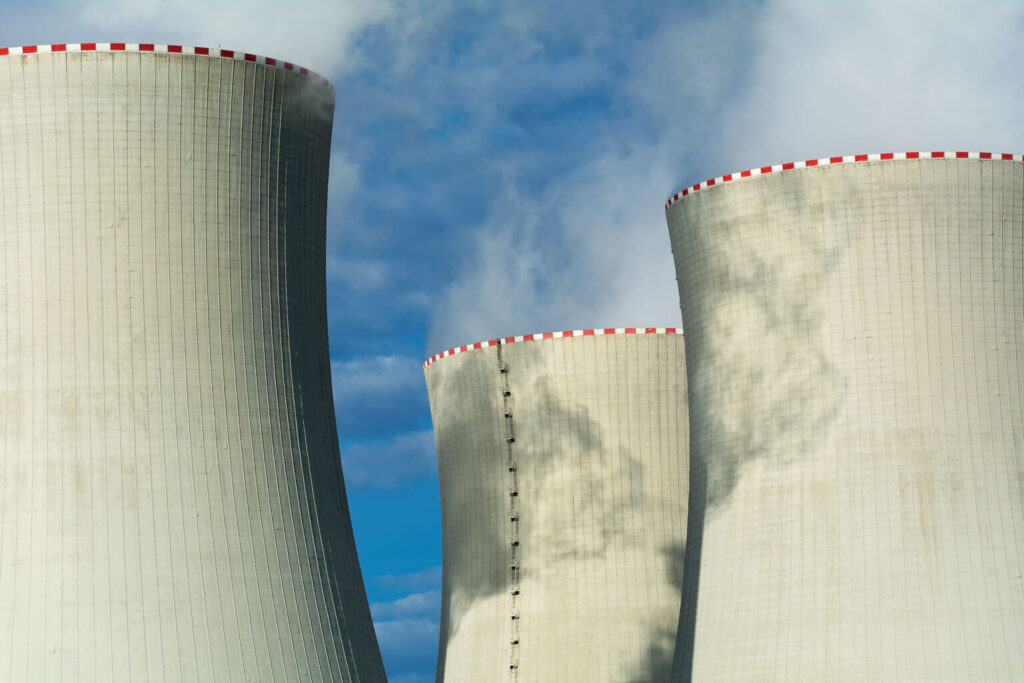

Gov. Tony Evers announced the Wisconsin Public Service Commission will be partnering with University of Wisconsin to identify potential locations for nuclear power plants during his State of the State address last Tuesday.
Evers signed a bill last summer to give $2 million toward a study that must be completed by 2027, citing nuclear energy’s ability to benefit both the economy and the environment, according to Wisconsin Public Radio.
The study’s director and UW nuclear engineering professor Paul Wilson said he was first approached by the PSC to be involved in the project last fall.
“The chief characteristic, in addition to being clean and low emission, is that you can turn [nuclear energy] on and off whenever you need it,” Wilson said. “Trying to get a system where you have no carbon emissions gets very challenging to do with just [other forms of] renewable energy.”
In addition to its utility as renewable energy, the creation of new nuclear power plants would generate a multitude of well-paid union jobs, starting from plant construction to radiation protection technicians, according to Wilson.
Wilson said the goal with the initiative is to encourage developers to consider Wisconsin when building nuclear power plants, rather than expecting a certain number of plants to be developed within a set timeframe.
“To start building [a nuclear power plant] today, it might be eight years before we have electricity, could be longer,” Wilson said. “This is really only about helping take the first step of identifying where one might put a nuclear power facility if they wanted to, and otherwise letting the system decide.”
Nuclear energy makes up 15% of Wisconsin’s energy use, which is 5% less than the national average, according to Wilson.
Wisconsin currently has two nuclear reactors located on Lake Michigan that produce approximately 625 megawatts each, Wilson said. The state previously had two other reactors that have since closed, Wilson said.
“Through the 2010s there were a lot of plants, particularly single reactors where there was not the economy of scale and operational efficiency, [that] were shutting down,” Wilson said. “We’ve [since] seen major recognition that nuclear energy is one of our best tools to avoid emissions of greenhouse gasses.”
Recognition of nuclear energy’s environmental benefits has caused a political reappraisal from those previously turned off by its use, according to Wilson.
It has become a widely bipartisan issue, Wilson said, causing expansion initiatives at the federal level during former President Joe Biden’s term.
The Biden-Harris administration established a $6 billion Civil Nuclear Credit Program in 2022 aimed at keeping current nuclear power plants operating in the face of constraints, according to the U.S. Department of Energy.
“Every single time a nuclear power plant has closed in this country, we have burned more coal and natural gas,” Wilson said. “It’s just an empirical fact. It may not be what people wish when they close nuclear power plants, but it is the fact of what really happens.”