
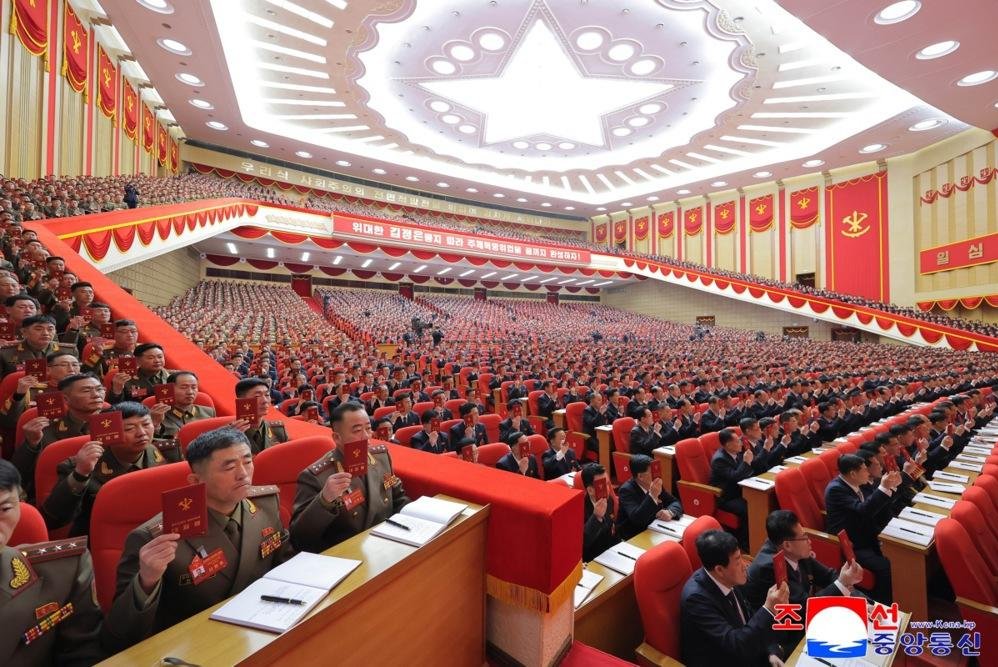
Workers’ Party of Korea members attend the opening of the 9th Congress of the WPK in Pyongyang, North Korea, on Thursday to review the party’s work and outline new strategic goals for the country. Photo by Korean Central News Agency/EPA
Feb. 24 (UPI) — The author prefers to use the lowercase “n” to challenge the Kim family regime’s legitimacy.
On Friday, north Korea began its 9th Party Congress..
On Saturday, Rodong Sinmun published a notable article titled, “Party Congresses that Shine as Watersheds in Our Revolutionary History — The 2nd Congress of the Workers’ Party of Korea.”
At first glance, it might seem like a historical sidebar. But the timing is deliberate. The article appeared the day after the Congress began, signaling that the 9th Congress should be read through the lens of revolutionary legitimacy and historical continuity.
Why recall the 2nd Party Congress?
The 2nd Party Congress, held in March 1948, took place under extraordinary circumstances:
• Korea had not yet been formally divided.
• The northern region was under Soviet military occupation.
• A sovereign north Korean state did not yet exist; the Congress was organized by the party, not a national government.
In other words, this was not a governing assembly of a country. It was a political meeting designed to implement Soviet-style control over the northern half of the peninsula.
Yet, today, north Korea calls that Congress “a watershed in the revolutionary and construction process of our country.”
The phrasing is deliberate. It emphasizes the party over the state, reminding all that in north Korea, the Party comes first. It labels the 2nd Congress as a socialist transition period, framing it as the first stage of state-building and ideological consolidation.
Historically, the 2nd Congress marked the end of the immediate post-liberation power struggle, preparation for state formation and the first steps toward a socialist system. The word “transition period” is key, It signals not just development, but structural change and a new order.
Signaling a new “transition” today
By invoking that “transition period,” the 9th Party Congress hints that north Korea may be entering another structural shift. Possible implications include:
• Policy or ideological adjustments
• Constitutional revision
• Reinterpretation of inter-Korean relations
• Codifying the “two-state theory”
Transition periods, historically and today, are when the party emphasizes unity, leadership consolidation and discipline because the system is most vulnerable to internal turbulence. Reports suggest the party faced internal challenges during the Congress, which may explain the focus on historical continuity.
Linking history to the three revolutions
After invoking the 2nd Congress, the 9th Party Congress reaffirmed the Three Revolutions – ideological, technological, and cultural – first systematized under Kim Jong Il The message has been consistent for decades:
• Ideological revolution: absolute loyalty and revolutionary consciousness
• Technological revolution: modernization of production and industry
• Cultural revolution: transformation of education, norms, and social life
Ideology has always led the agenda. Economic or administrative shortcomings are never just technical. They are always interpreted as ideological.
The revival and reality of the three revolutions
Recently, NK News reported that north Korea held the 5th Conference of Frontrunners of the Three Revolutions in Pyongyang, only six years after the previous gathering. This underscores how the regime continues to emphasize the Three Revolutions as a tool for mobilizing the workforce and reinforcing ideological control.
While the Three Revolutions are framed as modernizing initiatives — improving productivity, technology and culture — observers note that their frequent revival may reflect a weakening of ideological control, forcing repeated mobilization to maintain loyalty.
Daily NK also reported that many activities of these teams often serve propaganda purposes more than real technological or cultural progress, highlighting the gap between official rhetoric and practical outcomes.
In short, the Three Revolutions are not just development campaigns. They are mechanisms for enforcing conformity, loyalty and social control, which explains their persistent prominence at every Party Congress.
Unanimity, control and historical framing
During the Congress, Kim Jong Un was confirmed as General Secretary, with unanimous approval of the Politburo and alternate members.
Unanimity in north Korea is not democracy. It is a performative signal of control, not collective agreement. Combined with the historical invocation of the 2nd Congress, it reinforces the lesson:
• Party authority is absolute
• Ideological conformity is paramount
• History is invoked to justify the present
The emphasis on the Three Revolutions, the unanimous leadership elections and the symbolic recall of a “watershed” Congress frames the 9th Congress not as experimentation or reform, but as continuity of authority.
Personal reflection
For anyone who has lived under this system, these patterns are familiar.
History is never neutral. It is a tool of political instruction.
When the Party recalls the 2nd Congress as a revolutionary watershed, it is not celebrating the past. It is shaping the present.
Unanimity is not political consensus. It is survival. And the Three Revolutions are the instruments through which control is maintained, generation after generation.
Conclusion
The 9th Party Congress spoke of development, modernization and ambitious five-year plans. Yet, the deeper, enduring message is clear: The Three Revolutions remain the foundation of governance in north Korea.
Among the Three Revolutions, ideological revolution always comes first. Every initiative in economic construction, technological advancement, or cultural improvement ultimately hinges on the consciousness and mindset of the people.
If production falls short, the problem is not technology, but ideology. If management fails, it is not the organizational structure, but the attitude of the people that is at fault.
In north Korea, revolution is about changing people, and revolutionizing and mobilizing the workforce is the state’s core task. Full-scale development requires the people to act in unity, to follow strict discipline, to prioritize ideology above all else and to be cultivated as conscious, committed proletarians.
Although the discourse may appear to focus on economic growth, the true axis of policy remains ideological control. Five-year plans are formulated and executed, but the enduring foundation of governance is still the Three Revolutions.
Even if economic targets are missed, production falls below expectations, or the international environment shifts, the basic mode of governance remains unchanged.
The 9th Party Congress thus serves as a clear declaration: north Korea’s political system continues to prioritize ideological conformity and party authority above all else, ensuring the continuity of its authoritarian, long-term rule.
Jihyun Park, a British Korean Conservative politician and regular contributor to the Korea Regional Review, is a north Korean escapee who fled twice from the country — in 1998, which resulted in a forced repatriation, and in 2008, which was successful. She is a senior fellow for human security at the Center for Asia Pacific Strategy.