
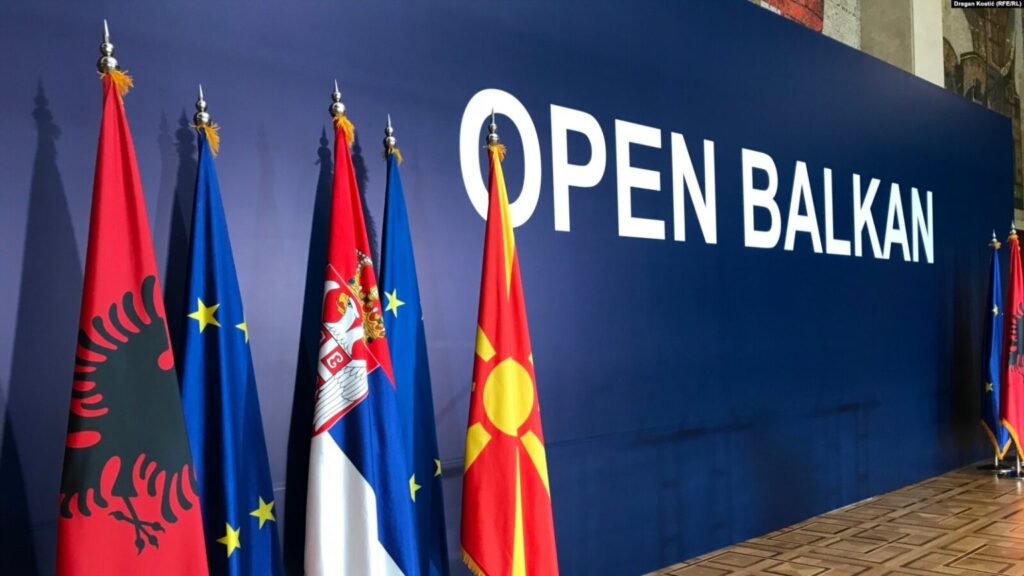
Had the idea of close economic cooperation between Serbia, Albania and North Macedonia taken root in practice, the countries, whose combined market covers almost eleven million people, could only have benefited.
Changes in global relations, as well as the narrow day-to-day political interests of key actors, have led to Open Balkan now being spoken of as yet another missed opportunity. If anyone even remembers the initiative at all.
“The Balkans to the Balkan peoples” – this is a phrase that Serbian President Aleksandar Vučić has uttered on several occasions, including in New York at the United Nations, at the height of the Open Balkan initiative, or Mini Schengen, as some called the idea. The concept was to establish, as a kind of antechamber to the European Union, a space of free movement of people, goods and capital between the countries of the region – specifically Serbia, Albania and North Macedonia. For the mutual benefit of those states, of course. The concept, useful in principle, did not last long.
From the moment the idea was first mentioned publicly, it was accompanied by rumours that it was not an authentic initiative of the officials promoting it – Aleksandar Vučić and Edi Rama. It was said that the concept of cooperation in the Western Balkans had originated in Washington or Berlin and had been sent as a ready-made solution to be implemented as quickly as possible. Some, in a perpetual fear of “Greater Serbian hegemony”, saw Open Balkan as a plan for Serbian dominance in the region without weapons – through economic instruments.
Although we are speaking of as recently as 2019, when the concept was launched, the geopolitical map of the world and the directions of cooperation looked entirely different at that time. It suited the West to preserve its influence and interests in the Balkans through a kind of imitation of the EU space, while the accession of new members was spoken of as a distant, hazy prospect. In the meantime, Joe Biden moved into the White House, only for Donald Trump to return four years later, and the world has become unstable terrain marked by major wars, shaken by an arms race and the division of spheres of interest. The EU membership of Albania and Montenegro is now openly discussed, and the initiative has therefore lost its original purpose.
A cautious approach
Bojan Stanić of the Serbian Chamber of Commerce told NIN that the Open Balkan initiative had in fact begun as the Mini Schengen initiative. He recalls that in 2019 information arrived “from outside” that preparations should be made for Mini Schengen. According to Stanić, no one had any idea what it involved, while the initiative had been formed in the United States and then the leaderships of Albania, Serbia and North Macedonia were informed that it was “their initiative”.
He says the idea was later “rebranded” as Open Balkan, that is, as the creation of a single market based on the four economic freedoms: free movement of goods, services, people and capital.
“It began cautiously. Montenegro was against it, Bosnia and Herzegovina as well, Kosovo – not to mention it. However, in 2022, a summit took place attended by the foreign ministers of Hungary and Turkey and all representatives of the region, including the then Montenegrin Prime Minister Dritan Abazović. They all came and it seemed that this was definitely being pushed as an initiative that would replace the Berlin Process,” Stanić recalls.
When the war in Ukraine broke out, everything stopped, he says. Asked why, Stanić replies that the project had been promoted by the first Trump administration in the United States and Richard Grenell, and that it was sidelined when power changed in America. He adds that the Albanian leader Edi Rama then said that Open Balkan had fulfilled its mission and was finished.
“In practice, we did not achieve the creation of a common market. However, it can be said that it is now possible to travel across all the countries of the region with just an identity card, that the common labour market has begun to function, that qualifications are recognised and that you can find employment if you apply there. You receive treatment similar to that of a resident of that country – you do not, of course, have voting rights and similar privileges, but you may live there for as long as you wish. However, as far as we have heard, perhaps only 400 people applied for those benefits. So, effectively – nothing,” Stanić concludes.
According to him, both Open Balkan and the Berlin Process have now been sidelined since Albania and Montenegro received momentum towards European Union membership and are therefore no longer interested in regional economic integration. He points out that Serbia was the most vocal advocate of economic cooperation, as it produces the most, exporting five billion euros to the region while importing two, and is also unrivalled in the IT sector.
“Serbia, Bosnia and Herzegovina and North Macedonia remain outside that accelerated track towards EU accession. We are reaching a situation in which we believe that these three countries should unite through regional integration and thus seek access to the common European market – integrating into the common European market that includes EU and EFTA members,” Stanić says.
In his view, the Open Balkan initiative has effectively failed due to insufficient alignment around the shared goal of full regional integration in order to accelerate accession to the European single market, particularly at the level of officials – in this case referring to the Albanian side.
“The results are very limited, apart from the increase in intra-regional trade. But I believe that is more a consequence of CEFTA than of Open Balkan,” Stanić concludes.
Caught in political crosswinds
Predrag Bjelić, professor of international trade at the Faculty of Economics in Belgrade, told NIN that Open Balkan went further than CEFTA in certain areas but was exposed to the vagaries of political relations among the three countries. In his view, when political relations deteriorated, particularly between Albania and Serbia, the initiative was pushed aside.
“A second very important factor was that it served as a kind of compensation for the CEFTA-related initiative and the Western Balkans common market, which had stalled due to events such as Kosovo’s blockade and similar issues. That is why we pursued it as an additional initiative. However, I think the EU continues to insist on regional cooperation among all six economies, and Open Balkan was again sidelined. Those are the two main reasons,” Bjelić explains.
Asked whether Open Balkan can be considered effectively concluded, he replies that he and a colleague wrote an analysis showing that the initiative had been reduced to the free movement of labour. Based on statistics, he says, there have not been many applications, partly due to political fears, such as concerns that labour from North Macedonia and Albania would flood the market.
“Our labour market is now open. People would rather go to the EU than come here. I think the initiative, as conceived in that respect, has not delivered full results, at least in the area of labour mobility, where it had the most developed foundations,” Bjelić assesses.
Conflicting signals
Dragoljub Rajić, coordinator of the Business Support Network, told NIN that when speaking about Open Balkan, it depends on whether one approaches it from a political or an economic perspective. Within what has been built between companies and business associations in the region, Open Balkan, in practice, exists within the business community.
“However, the problem lies in politics and political connotations. Serbia’s interest, from our perspective as the largest country in the region, should be to maintain good neighbourly relations with all other countries and to ensure normal foreign trade exchange and cooperation. Just as it should suit the United States to have good trade relations in North America, with South America and globally, so that as a dominant state it can trade and operate – so too should this suit Serbia in the region as the most populous country with a central position,” Rajić explains.
However, he notes that politics here has different interests. At one moment there are positive signals that cooperation with others is needed, while every political crisis brings opposing signals. Rajić points out the unresolved conflict in Kosovo, as well as lingering issues from the wars in the former Yugoslavia in Bosnia and Herzegovina and Croatia.
“The problem is that some countries, such as Croatia and Slovenia, joined the EU, while others did not. There are many open issues that are political rather than economic. Politicians, whenever they run out of room for manoeuvre, interfere in the economy and culture and undermine relationships that the economy and culture have been building for years. People in the region – businesspeople, artists and cultural workers – seek to function normally, to maintain human ties and to set nationalism aside as much as possible. But that is impossible, because politics always pours oil on the fire. Whenever there are elections in Serbia or in neighbouring countries, problems arise,” Rajić warns.
According to him, politicians shape policy according to their day-to-day political needs. Rajić believes that when it suited Serbia’s interests and when President Vučić and those around him wished to show that Serbia was gathering smaller Balkan countries around it – which was a positive signal – that was national policy. Today, he concludes, Open Balkan is a neglected initiative because at the political level it has been deemed easier to accuse Albania, Croatia and neighbouring countries of fomenting internal instability in Serbia than to acknowledge that there is no internal dialogue in Serbia between representatives of the government and the opposition.
(NIN, 24.02.2025)