
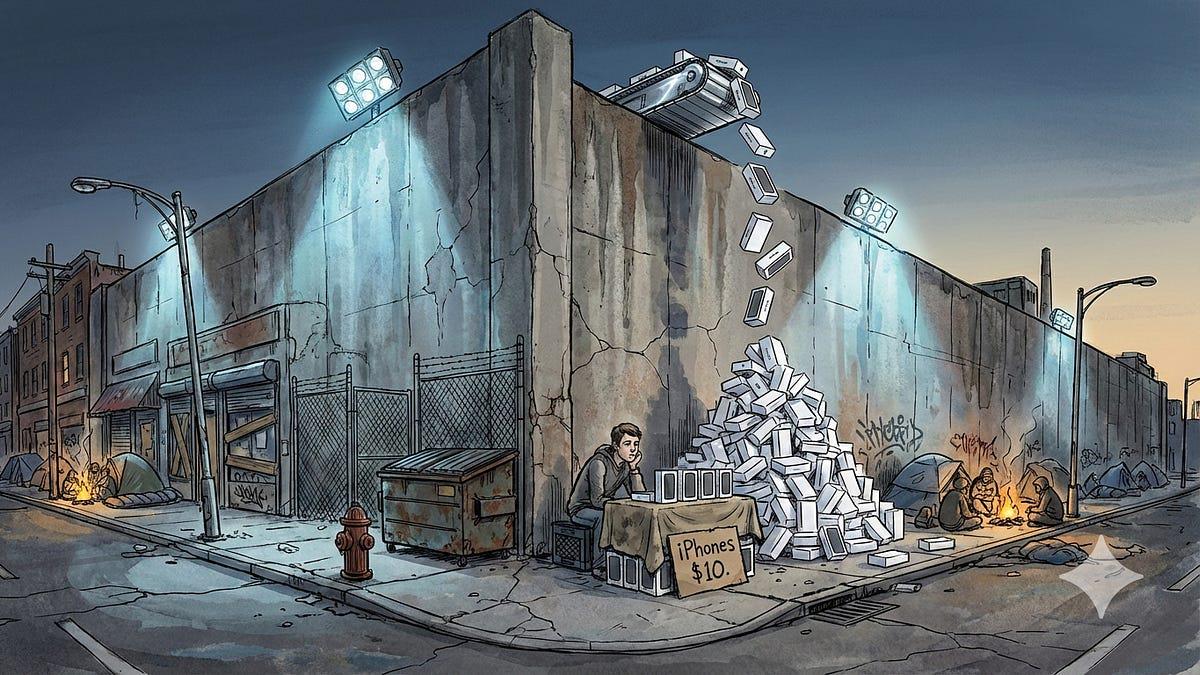
This article makes a very good point. All our current economic thinking is within the paradigm of Neoclassical Economics. Its central tenets are about how to deal with scarcity. But artificial intelligence makes what was formerly scarce abundant. We can see that already. Open source AI is the equal of anything investors are pouring hundreds of billions into. You can have its expertise for free. Soon, that expertise will do the work any lawyer or doctor can do. Everyone on planet Earth will be able to have that for free.
This article looks at how economics will have to be reinvented in that world, the rules of the old world of free markets and scarcity will break down and simply won't work anymore.
After Scarcity: The Economic Models We'll Need Once Abundance Becomes Undeniable
Why do we still look at AI through the lens of neoclassical economics? It's designed to make sense of the economics of scarcity, but AI will be abundant.
byu/lughnasadh inFuturology
19 Comments
I don’t think it’s near to replace lawyers and doctor and it won’t be free for sure.
First we need to figure out what AI can actually do. LLMs are very bad at medicine so the notion that we won’t need doctors is outright absurd. Are you cancelling your health care insurance because you have access to Grok? Come on.
The question is, will you still have the guns you need to take it from the people who control it?
The fact that open source projects are producing ai at the same level as billion dollar companies seems to point to the fact that ai is not changing the world as much as we may hope.
There is not enough energy in the world to make it “abundent” yet.
Even if tomorrow we crack the Fusion problem, we still need to build it, build the infrastructure, build the physical compute power…
Take your best guess at how many people were put out of jobs in 2025 and divide 5 billion by that number.
THAT is the scale of the problem. Even in the US, it is orders of magnitude where 250K were possibly replaced, at the cost of 91TW. There are *161 million workers to replace*.
open source models are free but computing power is not free and that is what you pay for.
>Soon, that expertise will do the work any lawyer or doctor can do.
You *must* have shares in OpenAI or there’s *zero chance* you actually believe this.
And even if you do, you surely don’t believe it, but I could at least understand the grift
The future is becoming increasingly unpredictable and looking at AI through the lens of classical economics misses the point. AI will change everything in ways we can’t yet imagine
I don’t know what I find worse: AI fatalists who believe it’s going to be the end of us all, or starry-eyed techbro visions like this.
LLMs are among the most energy intensive digital technologies we’ve ever invented. The only reason they are so readily available right now is because investors are pumping trillions of dollars into the market. Server farms, electricity and GPU chips are not free. Someone is financing them, and someone will expect a hefty return on this investment. “Abundance” is something only a select few will end up with, and their paycheck depends on the rest of us believing stories just like this.
edit: because it fits, the WSB sub is right now looking at cash burn statistics. Apparently, OpenAI is expected to spend money at ten times the rate of Netflix and Tesla combined. Whatever they’re building, it’s not going to be cheap.
I would love for you to tell me more about how you’re reveling in abundance
AI still takes resources and will be finite thus there is a cost.
Just like how the internet made education redundant because we have all of humanity’s knowledge and expertise at our fingertips, right?
[They said we’d need to work less and have all the luxuries at our fingertips…](https://www.issuesofsustainability.org/helpndoc-content/ClubofRomeLimitstoGrowth1972.html)
…only they apparently hadn’t understood how capitalism works.
‘Free’ lol. I’m paying for it right now in the form of higher electricity and natural gas prices.
From a user’s perspective, I view it to still be in its infancy. I also consider it to already be quite abundant.
The same argument was made about the internet and the information age as a whole, then about Google in particular, and about a lot of “democratized” services since. And while some of it is true, the underlying foundations still follow the old rules: Data centers run on hardware, require electricity, and investors want their money back. All of of that against the backdrop of climate change makes it very clear that scarcity will be the name of the game, at least until we’ve fully transitioned into a solar age of abundant clean energy.
There are good points in there. But we’re a ways from what he is describing. Over the long run global population is collapsing. And technology is increasing at an ever quickening pace. These two phenomenon will result eventually in a post-scarcity world relative to today and the things that are currently scarce.
All we’ve ever known is a world with booming population and slower technology. So that’s most people’s base line of how they look at the future.
It’s quite possible though there are things that will become “new” scarce things in the future that we don’t even fully understand yet. All these same things that are being said about AI were said about the Industrial and Green revolutions. What were we going to do with all the people that didn’t need to work on the farm anymore?? Displaced workers became doctors. Engineers. Etc etc. New scarcities showed up.
And there’s still some huge hurdles to overcome before we’re even close to this World of abundance. Energy is still very scarce. Proper medical care across the world is still very scarce.
Looks a lot like leveraging the fears of AI to move UBI along faster
The whole point of the singularity is we don’t and can’t know what is on the other side. Seems most people are setting out on a fools errand of preparing for some new equilibrium after AI is self improving and self sustaining.
First of all, I welcome any discussion critical of neoclassical economics and its (mountainous) pile of mistakes that have lead us into crisis after crisis. And the basic premise that we need to follow a new model of economics is correct.
However, the neoclassical economic disaster doesn’t inherently fall apart due to AI as the author suggests because the author (and neoclassical economics for that matter) misunderstands the role of labor in value generation, and they don’t address the fact that gimmicks like UBI can keep the Growth imperative within Capitalism going for at least a while, no need to do anything about the neoclassical design itself.
The correct angle to approach this is from the perspective of planetary boundaries, which is the exact opposite of this “post-scarcity” nonsense:
1. AI isn’t going to replace labor, it’s going to supercharge it. Production and productivity will skyrocket, and so will energy and resource demand because those two things are unable to be decoupled. In other words, supercharged growth
2. Capitalism inherently requires this Growth, year after year
3. Growth is an exponential curve
4. Exponential curves get unwieldy *very* fast on its own. This only gets even more drastic when/if AI-caused supercharged growth truly hits.
5. Neoclassical economics has literally zero answer for how this can ever be sustainable, since infinite growth is quite definitionally impossible in a finite system.
Neoclassicists can, and probably will, keep the party alive for a while after AI truly hits. Right up until the point the music stops and the ecological debts of what we did to the planet truly come due.
There is a world in which we can shift away from these growth-dominated economic models, use AI to optimize labor and reduce working hours, all while provided a high standard of living to everyone on the planet. In fact the author mentions one of the ideas in Ecological Economics. Degrowth is the even better option. But daydreaming of “post-scarcity” when AI hits misses the forest for the trees. There is no such thing as a truly post-scarce society because no human civilization, no matter how technologically advanced and expansive you claim it can become, can truly be infinite. We need to recognize that and find equilibrium within our planetary boundaries.