
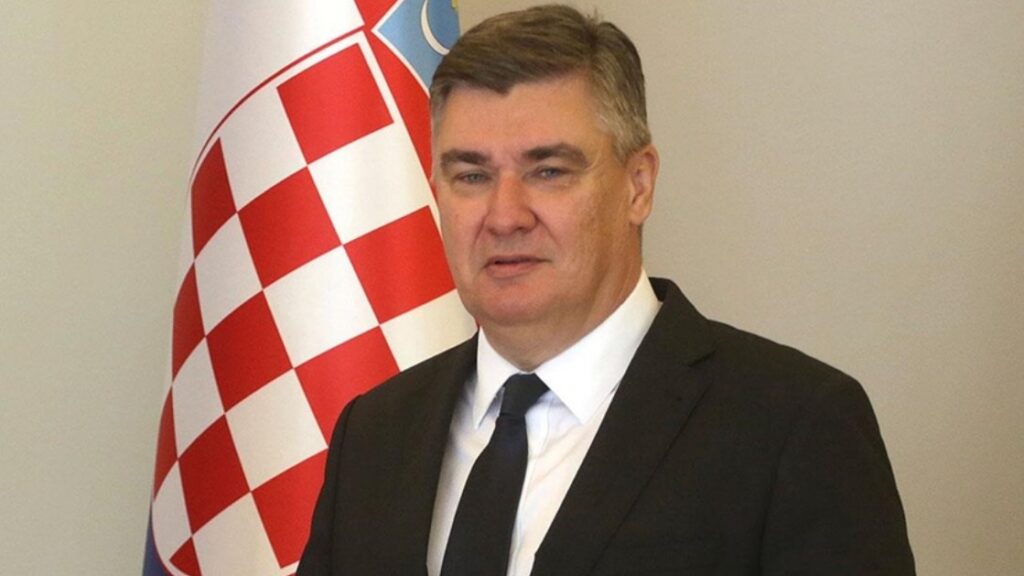
Zagreb – An open power struggle has erupted in Croatia between President Zoran Milanović and the government of Prime Minister Andrej Plenković regarding military cooperation with Israel. While the President has prohibited any cooperation citing violations of international law, the government is moving forward with defense contracts in Tel Aviv.
On Monday, Croatian President Zoran Milanović ordered the immediate suspension of all cooperation between the Croatian Armed Forces (OSRH) and the Israeli military. He justified this move by pointing to Israel’s violations of international humanitarian law.
In an official statement, Milanović emphasized:
„Due to the unacceptable conduct of the Israeli army and the unprecedented violation of all norms of international humanitarian law, I already ordered the termination of any type of cooperation between the OSRH and the Israeli army in May of last year.“
This directive applies to all members of the Croatian military. Simultaneously, the head of state called on the Croatian government to cease all forms of trade in weapons and military equipment with Israel. Milanović stated that in a recent telephone conversation, he had directly warned Prime Minister Andrej Plenković that any form of military cooperation with Israel would be deemed unacceptable.
Despite this warning, Defense Minister Ivan Anušić traveled to Israel on Monday for an official visit. On the platform X, he announced that he had met with Israeli Defense Minister Israel Katz in Tel Aviv to discuss „strengthening bilateral cooperation at the defense ministry level“ and fostering closer ties between the Croatian and Israeli defense industries, as reported by Bloomberg.
Milanović reacted sharply to the visit. In his capacity as Commander-in-Chief, he underscored that the Croatian Armed Forces would not cooperate with the Israeli army in any way, now or in the future. He added that OSRH members would not participate in the implementation of any agreements, contracts, or arrangements with the Israeli military or defense industry, arguing that such deals would be „unenforceable and harmful to Croatia.“
Defense Minister Anušić, on the other hand, highlighted the technological benefits of the partnership. He reported that the discussions focused on the exchange of expertise, particularly regarding advanced Israeli technologies such as the „Trophy Active Protection System.“ He thanked Katz for granting the export license for this system, which is to be integrated into the German Leopard 2A8 tanks being procured by Croatia. Anušić stated: „This makes the Leopard 2A8 one of the best tanks in the world.“
However, President Milanović reiterated his demand that the government suspend all planned contracts for the purchase of weapons from Israel. He argued that it is the Prime Minister’s responsibility to act in accordance with national interests, which, according to Milanović, include cooperation with NATO allies and strengthening domestic industrial capabilities.
Prime Minister Andrej Plenković firmly rejected the President’s interference. Speaking to reporters in Zagreb, he asserted that the nation is free to pursue cooperation with Israel, clarifying:
„The President does not have the authority to decide where the Prime Minister or any minister should travel. Furthermore, cooperation within the military industry does not fall under his mandate.“
While the President serves as Commander-in-Chief, the procurement of military equipment and the conduct of foreign policy are primarily managed by the government. Anušić concluded by reaffirming that the Ministry of Defense would continue to develop the significant potential of the Israeli industry „for the benefit of our Armed Forces and Croatia’s security.“
„Criminal Clique“
This is not the first time the Croatian head of state has voiced sharp criticism of Israel. In an interview last year regarding the situation in the Middle East, he told reporters in Zagreb that his position differs significantly from that of the ruling party and Prime Minister Andrej Plenković.
In this context, Milanović used blunt language regarding the Israeli leadership: „Israel is currently led by a criminal clique that seeks to drag the world into war,“ the President told the press. He further elaborated on the Israel-Iran conflict, stating: „Israel can do whatever it wants, as it has for decades… I believe there should be no dealings with such leadership.“
Humanitarian Crisis in Gaza
In international reporting, at the United Nations, and in reports from human rights organizations, there have been repeated warnings over the past months regarding the dramatic humanitarian situation in the Gaza Strip. In certain contexts, the situation has been described as genocide, leading to international condemnation of Israel.
According to these reports, over 70,000 people have been killed in the Gaza Strip, including many women and children, while hundreds of thousands more suffer from a lack of food, water, and medical supplies.
Furthermore, various academic estimates regarding the death toll exist. Some studies, including assessments by the Max Planck Institute, suggest that the number of fatalities could exceed 100,000 when accounting for both direct and indirect consequences of the conflict. These figures have been presented in part as hypothetical projections in reports, as precise data collection under wartime conditions remains difficult.
In the past, the Israeli government long denied or downplayed such casualty figures. More recently, however, the Israeli military has officially confirmed that numerous civilians, including children, have lost their lives during military operations—a move seen by some as an admission of the high casualty rates.
International Reactions to Israel’s Actions in Gaza
Political voices from around the world have repeatedly commented on the ongoing conflict in Gaza. Spanish Prime Minister Pedro Sánchez, Turkish President Recep Tayyip Erdoğan, and Brazil’s Luiz Inácio Lula da Silva have, in various speeches and official statements, condemned the violence, emphasized the protection of civilians, and called for international mechanisms to secure humanitarian aid.