
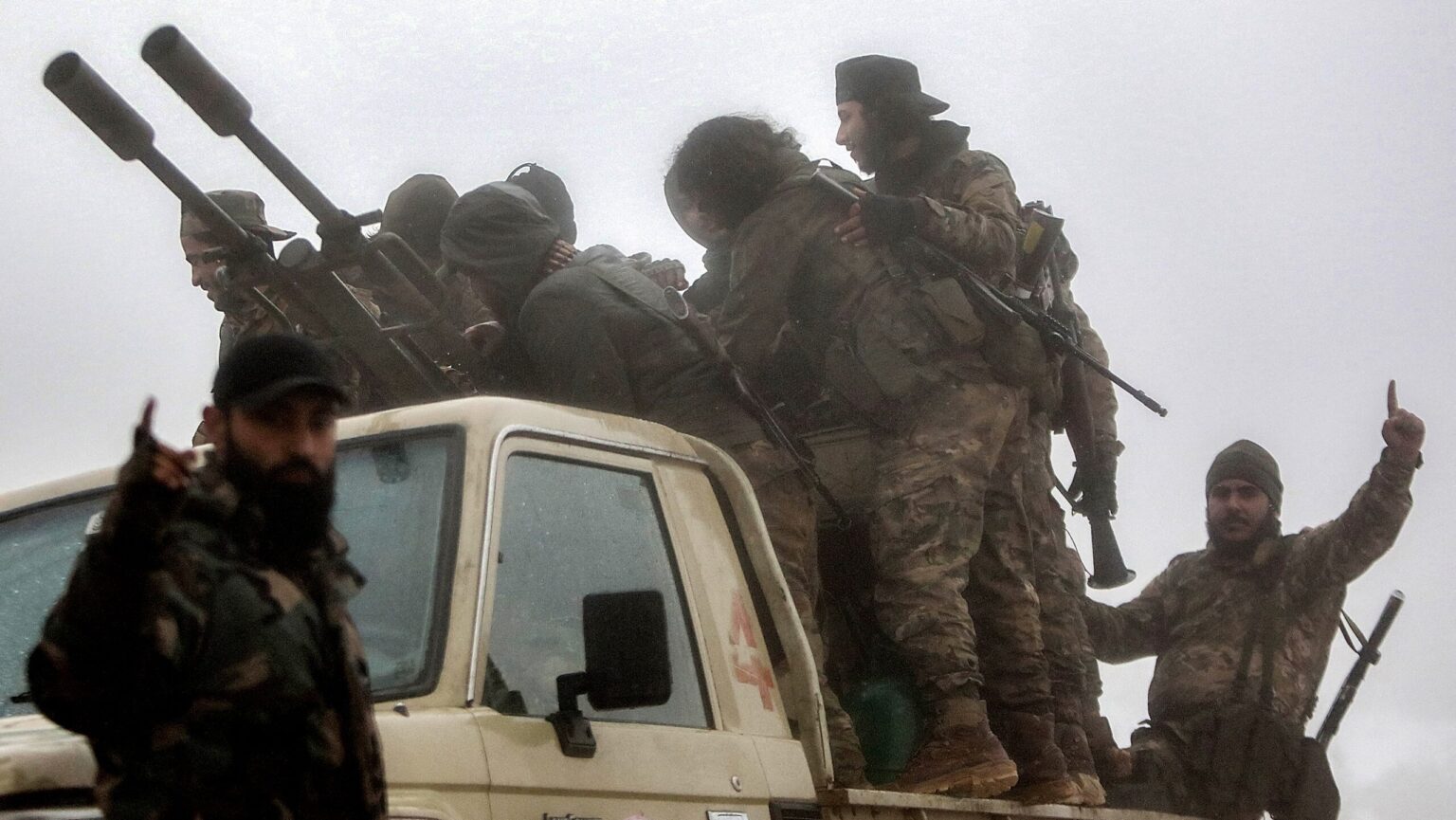
Syrian and Lebanese crackdowns on crossings, tunnels, and financing squeeze Hezbollah’s ability to move weapons and personnel across the region
[DAMASCUS] For years, Hezbollah moved through Syria like a second army: thousands of fighters, open supply lines, and bases visible on satellite imagery. The group helped keep Bashar Assad in power and made no effort to hide it.
Now Syrian authorities say what Hezbollah left behind looks different: a small group operating near Damascus with drones, Katyusha rockets, and, according to officials, confessions that the weapons came from Lebanon.
On February 1, Syria’s new government announced it had dismantled a cell it accused of launching rockets at the Mezzeh district and the nearby military airport. Hezbollah’s media relations office rejected the claims, saying the group “has no presence or activity on Syrian soil” and denying any links to armed movements in Syria.
That episode shows how the post-Assad era is reshaping Hezbollah’s role. The group once helped sustain Assad’s war machine; now it stands accused of running deniable operations with cheap hardware.
For Hezbollah, Syria was the land corridor to Iran’s supply networks. That corridor is now being cut from multiple directions.
In early February, the Lebanese army uncovered a second large Hezbollah tunnel in the south in two months—used for storing ammunition, missiles, and drones. A senior American official said US intelligence helped locate the site. Admiral Brad Cooper, commander of the US Central Command, praised the find.
Around the same time, the Lebanese army closed illegal crossings on the Syrian border in the northern Beqaa Valley, a corridor long used for weapons and drug smuggling. In a statement, the army said it had shut additional crossings as part of a broader crackdown along the roughly 233-mile border.
Separately, the US Treasury sanctioned a Turkey-based company involved in shipping Iranian fertilizer through Oman and targeted a gold trading firm established by Al-Qard Al-Hasan, Hezbollah’s financial arm, to convert the organization’s reserves into cash for reconstruction.
Brig. Gen. Fayez al-Asmar, a member of the Syrian military’s media staff, said the new state faces pressure from all sides.
“There is no doubt that since the fall of the former Assad regime, the Syrian state has been facing overlapping security challenges from multiple directions that include Israel, ISIS, remnants of the former regime, and armed groups operating outside state control,” al-Asmar told The Media Line.
David Des Roches, a US defense and strategic expert, said losing unimpeded land access across Syria is one of the most damaging blows Hezbollah has absorbed in the post-Assad period.
Hezbollah has long operated as a ‘state within a state,’ and losing unimpeded land access across Syria is a major strategic blow
“Hezbollah has long operated as a ‘state within a state,’ and losing unimpeded land access across Syria is a major strategic blow,” Des Roches told The Media Line. “Without Syria as an open corridor, Hezbollah shifts from being an organized military force with reliable supply routes into something closer to a network dependent on smuggling and limited access.”
Such a shift changes Hezbollah’s footprint even if it does not eliminate it. Influence once measured in visible deployments and known routes now runs through facilitators, small cells, and informal border crossings—easier to deny and harder to prove.
Brig. Gen. (res.) Yossi Kuperwasser, head of the Jerusalem Institute for Strategy and Security and a former senior Israeli intelligence official, said Hezbollah is trying to recover from multiple blows at once and that Syria remains part of that effort.
“Hezbollah is trying to recover from the damage it has suffered—not only because of what is happening in Iran and Lebanon, but also because of what happened in Syria,” Kuperwasser told The Media Line. “They are trying to rebuild a presence, especially in the south, through smaller cells. But their achievements are limited, because Israel’s presence and readiness to act make it difficult for them.”
Kuperwasser said Hezbollah has maintained some activity near the Lebanese border and continues to rely on smuggling networks to move weapons. Syrian authorities may disrupt some routes, he said, but not all.
“Hezbollah still manages activity in Syria near the Lebanese border,” he said. “They have been able to build cells that help smuggle weapons. Syrian authorities have tried to stop some of these efforts, but not all, and some smuggling continues successfully. It is not the strategic infrastructure it once was, but the network has not been fully dismantled.”
Those assessments help explain Israel’s posture in southern Syria, where Israeli activity has expanded in recent months. Israeli officials describe their presence near the Golan Heights and Mount Hermon as preventive—aimed, they say, at blocking Hezbollah and other Iranian-aligned elements from entrenching near the border. Critics view the expanded footprint less as a temporary security measure than as an effort to shape the post-Assad landscape to Israel’s advantage.
“Israel believes it needs a military presence to prevent Hezbollah and Iranian-backed cells from deploying in southern Syria,” Kuperwasser said. “Even if Syria’s new leadership appears pragmatic, Israel is cautious because many of its figures come from jihadist backgrounds. The US would prefer a solution that makes Israel’s presence unnecessary, but for now it understands Israel’s logic.”
Damascus is trying to rebuild a centralized state after years of fragmentation, militia rule, and competing armed networks.
Al-Asmar described the Mezzeh case as one front in a broader struggle over who controls Syria’s security space.
“In this environment, security agencies are watching closely for cells tied to external agendas that are trying to exploit Syria’s transition.”
A security source at the Syrian Interior Ministry said no new Hezbollah cell activity had been discovered or disrupted after the Mezzeh announcement.
“If any such activity is uncovered, it will be officially announced through statements issued by the Syrian Interior Ministry,” the security official said.
The source did not rule out sleeper cells that could remain inactive while awaiting shifts in regional dynamics. Such networks, the source added, could seek to destabilize the situation in the event of a US strike against Iran.
Al-Asmar said the danger lies in networks that mix politics with smuggling and criminal finance, allowing external actors to retain leverage even as the state tries to reassert control.
“By announcing this operation now, the Syrian state is sending a message domestically and internationally that it is regaining its capacity,” al-Asmar said. “The point is not only to stop a single cell, but to show that Damascus will not allow anyone—whoever they may be—to undermine national security, threaten neighboring countries, or destabilize social peace.”
Hezbollah has little incentive to confirm any of it. Admitting to a presence in Syria could draw the new authorities into a public confrontation and give Israel additional justification for strikes. Inside Lebanon, any acknowledgment would create complications at a time when the group is already under pressure.
No official comment followed in Beirut. Writing in An-Nahar, the Lebanese daily, columnist Rosanna Bou Mounsef noted that the party denied any connection, saying its name had been “dragged in arbitrarily.” Critics, she wrote, see ongoing cross-border activity as either network rebuilding or a pretext used by opponents to cast Hezbollah as destabilizing.
Even analysts close to Hezbollah argue the group’s priorities have narrowed. Rabih Ghosn, a Lebanese political analyst, said Hezbollah’s primary interest in Syria is now stability.
What matters to Hezbollah in Syria today is political and military stability
“What matters to Hezbollah in Syria today is political and military stability,” Ghosn told The Media Line. “Hezbollah sees Syria’s unity under a centralized authority in Damascus as a priority at this stage, and believes that stability in Syria reflects positively on Lebanon.”
Ghosn insisted the immediate danger from Hezbollah’s perspective is not Damascus asserting sovereignty but Israel expanding its military posture in the south.
“The main threat Hezbollah faces in Syria today is Israeli military expansion and the construction of bases, which we have seen in Mount Hermon and in areas adjacent to Daraa,” he said. “Political differences exist, but they do not amount to hostility.”
Still, not all observers accept that framing. A report in Al Joumhouria, the Beirut daily, said Hezbollah was maneuvering to buy time—using concealment and delay until conditions improved, in coordination with Iran. The strategy reportedly included floating the idea of placing weapons under a supervisory mechanism and elevating figures with a more political profile, moves aimed at heading off Israeli military action and postponing plans to restrict arms north of the Litani River.
Des Roches said Hezbollah’s constraints are also internal, shaped by strain inside Lebanon and the long-term cost of conflict.
“The loss of freedom of movement in Syria is extremely valuable for Israel, and extremely damaging for Hezbollah, because it limits how easily the group can move material across the region,” he said. Meanwhile, the US Treasury Department announced measures to disrupt what it described as two key mechanisms Hezbollah uses to maintain economic stability: generating revenue in coordination with Iran and exploiting Lebanon’s informal financial sector.
Inside Lebanon, those pressures are concrete. Nearly 100,000 housing units were destroyed during the fighting with Israel. Hezbollah’s secretary general said the organization would cover three months’ rent for displaced families—but the shift from annual to quarterly disbursements signals diminished capacity.
Residents in Shia areas complained about unequal payments and a lack of longer-term guarantees. One resident of Beirut’s southern suburbs said he received $2,000 for four months, while a neighbor received $3,000 for six months, with no explanation for the disparity. In Dahieh, rents now run $300 to $600—often above the official minimum wage of about $312.
In Taybeh, a south Lebanon border town about 4 miles from the Israeli frontier, graffiti appeared on the municipality building demanding housing assistance “without favoritism.”
The risk in Syria’s south is that each side’s preventive steps become the other’s provocation. Syria frames a security operation as restoring sovereignty; Hezbollah reads it as political targeting. Israel frames military activity as deterrence; Damascus reads it as infringement. When Hezbollah moves to preserve a smuggling channel, Israel treats it as confirmation that the threat remains.
In the past, Hezbollah and the Islamic Revolutionary Guard Corps operated depots, missile infrastructure, and networks inside Syria with little interference. That access is no longer guaranteed.
Hezbollah’s influence is neither fully gone nor fully restored. What remains is quieter: facilitators rather than battalions, smuggling runs rather than convoys, small cells rather than bases. The old corridor may be disrupted, but the incentive to maintain networks has not gone away.
It forces Hezbollah to adapt to a much more limited and risky environment
“It forces Hezbollah to adapt to a much more limited and risky environment,” Des Roches said. “But history shows that tactical victories can create long-term consequences.”