
For me, the two most important elections globally this year will be the midterms in the US in November and the elections in Hungary on April 12.
The first will likely shape the course of democracy in the US, and the latter democracy both in Hungary, but perhaps wider than that, the outcome of the war in Ukraine, and democracy in Europe itself.
Follow our coverage of the war on the @Kyivpost_official.
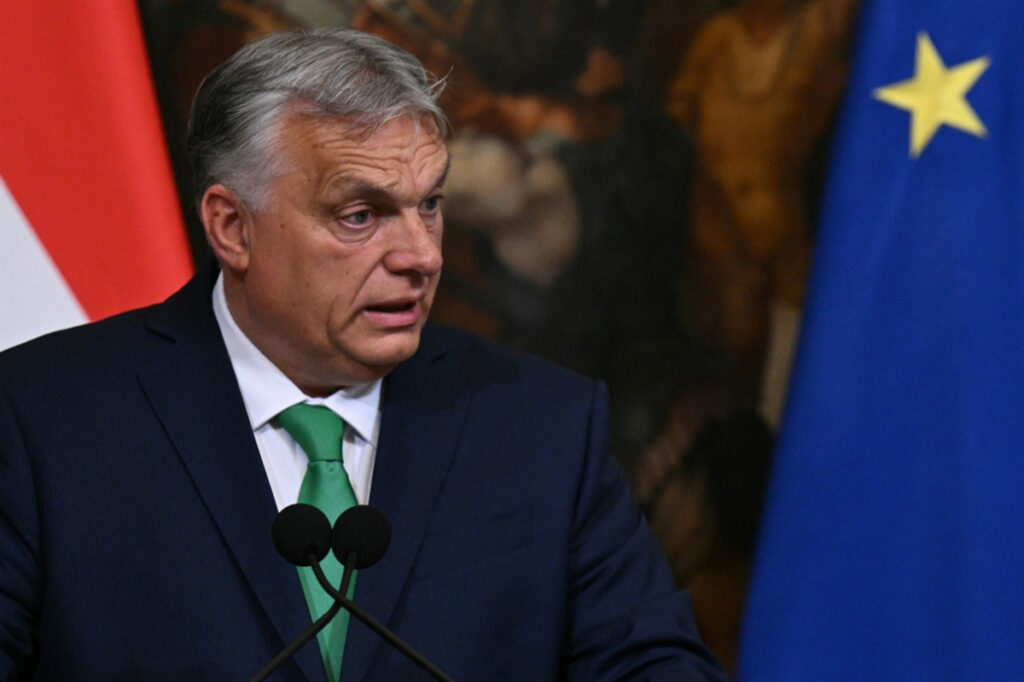
Orban has an ally of US President Donald Trump, pitching a socially conservative agenda at home, and trying to counter what he views as a woke EU agenda. He is an arch Eurosceptic and has railed against the EU emerging as a European superstate, trampling on the nation state within Europe. This messaging certainly strikes a chord with the MAGA crowd, and Trump has pinned his colors to Orban’s mast in these elections, making it clear that Hungarian Prime Minister Viktor Orban is his favored choice, even sending Secretary of State Marco Rubio, direct from the Munich Security Conference, to press the flesh with Orban and give him a PR win – or so Trump and Orban think.
Orban is also a key ally in Europe for Russian President Vladimir Putin and has consistently opposed EU support for Ukraine – culminating this week in Orban refusing to sign off on the latest (20th) EU sanctions package on Russia, and the planned €90 billion ($106 billion) EU funding facility for Ukraine. For both Trump and Putin, Orban acts as a Trojan Horse within Europe, helping to weaken, divide, and stall key policy initiatives, and particularly around the EU’s support for Ukraine.
Other Topics of Interest
US Abstains as UN Backs Ukraine on Invasion Anniversary, Draws Fire at Home
Under Trump, Washington has largely brushed aside Ukrainian calls to intensify economic and military pressure on Russia, arguing that tougher measures could derail fragile diplomatic efforts.
An Orban defeat in April would make EU decision-making around Ukraine easier – it would isolate Slovak leader Robert Fico, and make it more difficult for him to block efforts to support Ukraine. And I think it would also send a message to GOP/MAGA and the far right in Europe that electorates might not be that comfortable with parties pushing socially illiberal agendas when backed by increasingly autocratic means/tendencies, and shades of kleptocracy.
In Europe, this also comes after wins for more pro-European forces in recent elections in Romania and Moldova, but with critical elections looming in 2027 in France, where the choice will likely be for a far-right, Eurosceptic party (FN) versus something more liberal and European mainstream.
In Hungary, the elections are shaping up to be the most serious challenge to incumbent Viktor Orban in his more than 20 years in power, or at least since the last time he actually lost an election, in 2007. The opposition Tisza movement, led by a former Orban ally, Peter Magyar (Peter “Hungary”), has had a consistent 8–10-point lead in opinion polls. Orban secured a two-thirds constitutional majority in the last elections in 2022, and changed the electoral system significantly towards a UK-style, first-past-the-post constituency system, gerrymandering electoral districts to ensure overrepresentation for his Fidesz party. Political analysts suggest this means that Tisza and Magyar would need a 5-6% poll lead to end up winning a majority. That said, a recent Median poll gave Magyar and Tisza a 20-point lead.
The Median poll is just one poll and showed an eight-point swing against Orban and Fidesz. But what is interesting is that it came after the Rubio visit to Budapest and after Orban made clear that his campaign would be shaped around picking fights with the European Union and Ukraine. The Median poll might just suggest that Orban is misreading the electorate, or that in Magyar, he has a more difficult opponent, as he has been more nuanced in his support for Ukraine, opposing early EU accession. Despite that, the big advantage of hope for Europe with Magyar is that he will not be as close an ally of Putin as Orban has, and will be more willing to work/compromise in/with the European mainstream (his party is a member of the EPP, unlike Fidesz, which was thrown out).
Tensions between Orban and the EU, and Ukraine have come to a head over the past week over Russian attacks on the Druzhba oil pipeline, which supplies Hungary and Slovakia with Russian oil – the irony should not be lost here that while Trump criticizes Europe for buying Russian energy still, amongst the largest recipients of this energy are MAGA stalwarts Hungary and Slovakia. A Russian attack in late January on a pumping station halted supplies. Orban and Fico argue that Ukraine has been slow to repair the damage and get the oil flows back online. As a result, and as noted above, both are vetoing any EU support for Ukraine – and critically that much-needed €90 billion financing package which will go some way to covering the estimated €140 billion ($165 billion) financing shortfall for Ukraine in 2026-2027.
One senses here that a big fight over the Druzhba pipeline suits plenty of actors.
Russia attacked the pipeline, supplying oil to its allies in Europe, Hungary and Slovakia. Why would it do that, unless there was some desire to create a crisis in Hungary – EU relations?
Orban, I think, thinks he can play Hungary as the victim here, and Ukraine as the threat to the Hungarian economy, and the price of fuel to consumers at the pump. He can also blame the EU for stalling EU structural and SAFE fund flows to Hungary. The latter have stalled over rule-of-law related issues, but the impact of the loss of these funds has been countered by Hungary’s continued ability to tap the Eurobond market cheaply – we saw that again last night with a $1.2 billion tap of the 2035 Eurobond. Markets are currently offering cheap funding to Hungary, as they are now pricing in a Magyar win and the release then of over €20 billion ($24 billion) in EU funds to Hungary, log-jammed as noted above. The irony here that foreign investors assuming a Magyar win could actually help fund an Orban win – ESG failing.
The Median poll, though, might suggest this Orban strategy is not really working. Indeed, Magyar has actually been effective in countering it by highlighting that while Hungary gets a significant discount on Russian energy imports, Hungarian consumers appear to see no benefit of this at the gas pumps, as they pay prices higher than most of their Central European peers.
This has left Orban open to criticism that someone in the Fidesz regime is actually creaming off the billions of bucks in discount from Russian oil and gas. Or at least, it raises questions as to where this money goes. The Orban regime’s discomfort over the Druzhba pipeline is also made worse by the fact that recent weeks have laid bare that there are alternatives. Indeed, for years, Budapest has argued that the southern route via Croatia lacks capacity, but Croatia has made clear that they are able and willing to pump enough oil to supply Hungary, only not Russian oil. But it seems that the Orban regime prefers to buy Russian oil, at a discount, even though few Hungarians appear to be benefiting from that discount. Again, the question is who is benefiting from that discount?
Sensing that relations with Europe – at least the stalled €20 billion plus in EU funding – and Orban’s close ties with Putin are a vulnerability for Orban, I think Ukraine likely is in no rush to get Druzhba supplies online. The delay in getting sign-off for the €90 billion in EU funding could be an issue for Ukraine, but given prefinancing and existing cash buffers, not likely for Ukraine until after April 12. The defeat of Orban would be a huge win for Ukraine, and hence delaying a bit, seeing Orban struggle with the narrative over Druzhba might be seen as no bad thing. The irony again is that the Russian strike against Druzhba might have gifted Ukraine a potentially big win by ultimately weakening Orban, and perhaps even compounding his looming election challenges. Notable that Ukraine hit oil supplies upstream to Druzhba in Tatarstan this week.
All the above said, Orban can still play dirty tricks in this election – using his two-thirds parliamentary majority to change election rules, or switch jobs and become president, thereby ensuring his stay in power. The recent Eurobond tap also suggests that
Orban can fund a big pre-election spending spree, blowing the budget, but leaving others to clean up the mess/pay the price post-election. He might not even accept the election result, and then we would be in uncharted territory of a contested election with the potential for the EU to side with Magyar and the opposition, and Trump and Putin with Orban, and autocracy. If that comes to pass, Hungary could turn out to be the next major crisis in Transatlantic relations. And Trump might see Orban’s efforts to pull literally all stops out to win the elections in Hungary as a trial run for what he might try himself in the US midterms.
Reprinted from the author’s tashecon blog. See the original here.
The views expressed in this opinion article are the author’s and not necessarily those of Kyiv Post.