
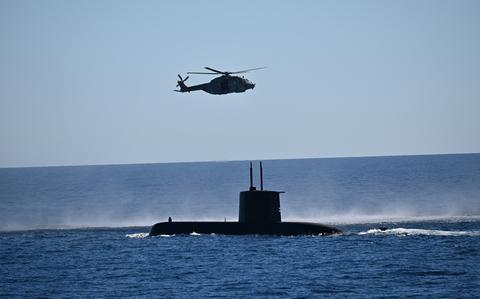

An Italian maritime patrol helicopter hovers above one of four submarines participating in exercise Dynamic Manta in the Ionian Sea off the coast of Sicily on Feb. 23, 2026. The exercise offers the 11 participating navies a chance to hone their submarine-hunting skills. (Alison Bath/Stars and Stripes)
ABOARD ITS VIRGINIO FASAN — NATO submarine deterrence from the Arctic to the Mediterranean Sea is unmatched and only stands to get better, but allies can’t afford to let up, an American commander in Europe said this week.
Rear Adm. Bret Grabbe and two Italian navy counterparts were aboard this Italian frigate Monday to view the start of NATO’s Dynamic Manta, an exercise that showcases allied submarine warfare capabilities. The exercise kicked off in the Ionian Sea near the coast of Sicily.
“We’re just really good at what we do,” said Grabbe, commander of NATO submarines. He added that detecting, tracking and potentially neutralizing submarines is “not an easy game” and that adversaries can get lucky.
The exercise is part of NATO’s effort to “take luck out of the game” for enemies through repeated training and exercises.
NATO can’t rest on its laurels, Grabbe said, adding that “now is not the time to take our foot off the gas.”
The exercise is the southern counterpart to Dynamic Mongoose in the north Atlantic Ocean. It offers participating navies the chance to hone their skills in the deeper, saltier Mediterranean Sea, where sound travels differently through water than it does in the north.
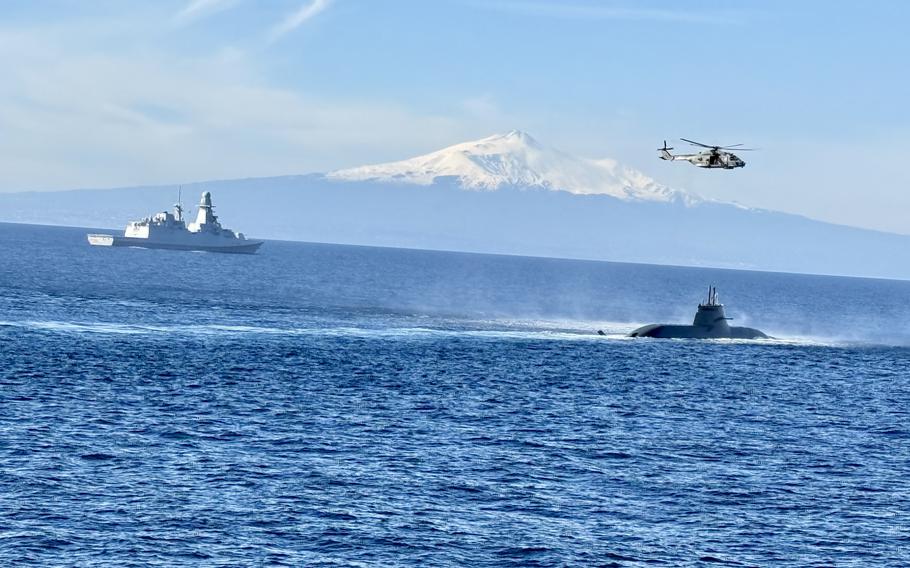
An Italian patrol helicopter hovers above one of four submarines participating in NATO’s Dynamic Manta submarine warfare exercise in the Ionian Sea off the coast of Sicily on Feb. 23, 2026. The exercise involves 11 NATO submarine countries, including the U.S., Italy, Greece and Turkey. (Alison Bath/Stars and Stripes)

An Italian sailor assigned to the frigate ITS Virginio Fasan sights the distance between the ship and a submarine in the Ionian Sea off the coast of Sicily on Feb. 23, 2026. NATO’s Dynamic Manta exercise is giving participating navies the chance to hone their submarine hunting skills. (Alison Bath/Stars and Stripes)

An Italian maritime patrol helicopter hovers above the Ionian Sea off the coast of Sicily on Feb. 23, 2026. Beneath it is one of four submarines participating in NATO’s Dynamic Manta exercise. (Alison Bath/Stars and Stripes)
This year’s Dynamic Manta includes surface ships, patrol aircraft, helicopters from various countries along with submarines from Turkey, Greece and Italy. Other participants include Canada, Germany, France, Norway, Portugal, Spain, the U.K. and the U.S.
Grabbe joined Rear Adm. Francesco Milazzo, head of the Italian navy’s submarines and underwater dimension department, and Italian Rear Adm. Cristian Nardone, commander of NATO Standing Maritime Group 2, for the start of the exercise and a news conference.
NATO submarine countries — such as Italy, Germany, Greece and the U.S. — have built, are building or have committed to build more submarines.
Plus, the alliance is experimenting with new technology, such as the first-ever underwater deployment of an aerial drone from a U.S. submarine in September during an exercise off the coast of Portugal.
Those investments, including sophisticated surface ships, aircraft and drones along with continued technological advancement, point to NATO’s efforts to revolutionize submarine warfare, Grabbe said.
They also are behind his confidence in the alliance’s ability to maintain undersea superiority. Military officials have repeatedly warned in recent years that Russian submarine activity in the High North is increasing.

U.S. Navy Rear Adm. Bret Grabbe, right, watches the Dynamic Manta submarine warfare exercise from the bridge of the Italian frigate ITS Virginio Fasan in the Ionian Sea off the coast of Sicily on Feb. 23, 2026. The exercise offers 11 NATO navies the opportunity to hone their submarine-hunting skills. (Alison Bath/Stars and Stripes)
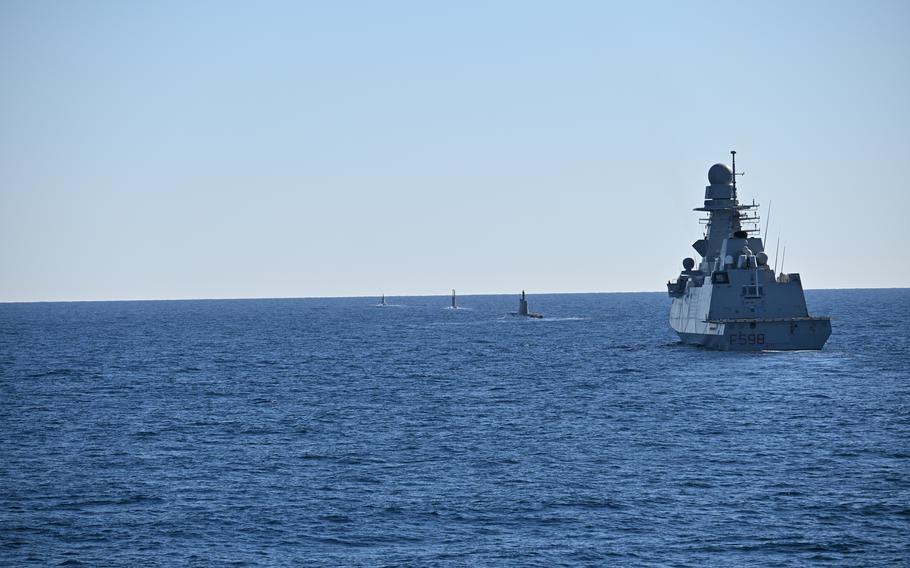
Greek, Italian and Turkish submarines are followed by an Italian frigate as part of NATO’s Dynamic Manta submarine warfare exercise in the Ionian Sea off the coast of Sicily on Feb. 23, 2026. The exercise involves 11 NATO countries. (Alison Bath/Stars and Stripes)

A sailor aboard the Turkish submarine TCG Inonu demonstrates operation of one of the vessel’s two periscopes in Catania, Italy, on Feb. 22, 2026. Inonu is one of four submarines participating in NATO’s Dynamic Manta warfare exercise which started on Feb 23, 2026. (Alison Bath/Stars and Stripes)
And cooperation between Moscow and Beijing is expanding, particularly in the Arctic, Gen. Alexus Grynkewich, NATO supreme allied commander Europe, cautioned last month.
They are “trying to figure out how they can counter NATO capabilities on and under the sea,” Grynkewich said at a security conference. The partnership could “grow very quickly, and we need to be mindful of it and ready for it,” he added.
In addition, the Baltic Sea has seen suspected sabotage events in recent years, such as the destruction of undersea communication cables.
NATO countries accuse Russia of carrying out such gray-zone warfare in Europe because of Western military support for Ukraine.
Nardone noted that the Mediterranean has many of the same vulnerabilities to its infrastructure as the Baltic Sea, but with the added worry of exported terrorism.
Protecting undersea cables and energy pipelines, along with monitoring sea traffic and other duties in a body of water with critical chokepoints such as the Suez Canal and Strait of Gibraltar poses considerable challenges, Nardone said.
“It’s what we call maritime awareness, and it’s not that easy,” Nardone said.
The effort includes watching for “weird behaviors,” such as ships stopping for no reason, and being on the lookout for vessels attempting to avoid sanctions, he said.
Nardone and other officials acknowledge that Russia’s maritime presence in the region has fallen significantly following the overthrow of longtime Syrian leader Bashar Assad in December 2024. Assad was a staunch ally of Moscow.
The Kremlin’s loss of a key port in the Syrian city of Tartus has left Russia with limited capabilities in the region to supply, refuel and repair its ships and submarines.
Even so, Russian navy vessels, including submarines, still make regular appearances in the Mediterranean. That means vigilance is still required, the officials said.
In January, for example, Virginio Fasan shadowed the Russian Kilo-class submarine Krasnodar and its escorts, including a destroyer, as the group traveled in the Mediterranean, NATO Maritime Command said in a Jan. 26 post on X.
The wider, deeper expanse of the sea at NATO’s southern flank offers plentiful places for submarines to hide, officials said.
Practicing techniques and experimenting with new technology, such as an unmanned surface vehicle capable of deploying sonar, gives Dynamic Manta participants an understanding of the characteristics and challenges of the Mediterranean, they said.
“We are trained, we are integrated, and we walk together with common goals,” Nardone said. “And (if) anything happens, we are ready to react.”