
Scientists have recently observed a bearded vulture chick hatch in the wild in northern Spain after more than a century without successful breeding in that mountain range.
That single hatchling restores the species to a landscape where it had vanished and tests whether decades of recovery work can now sustain a new generation.
First hatch in a century

On the cliffs of the Moncayo massif in northeastern Spain, a guarded nest finally produced a living vulture chick after years of silence.
Field teams from the Bearded Vulture Conservation Foundation (FCQ) tracked the parents through the winter and confirmed that the egg, laid by the female known as Ezka, hatched in mid-February.
Earlier attempts by the same pair in 2020 and 2021 had failed, leaving this season as the first successful natural reproduction of the species in the Iberian System.
With the vulture chick now alive but still dependent on its parents, the long absence has ended, yet the harder test of survival has only just begun.
Tagging the vulture chick
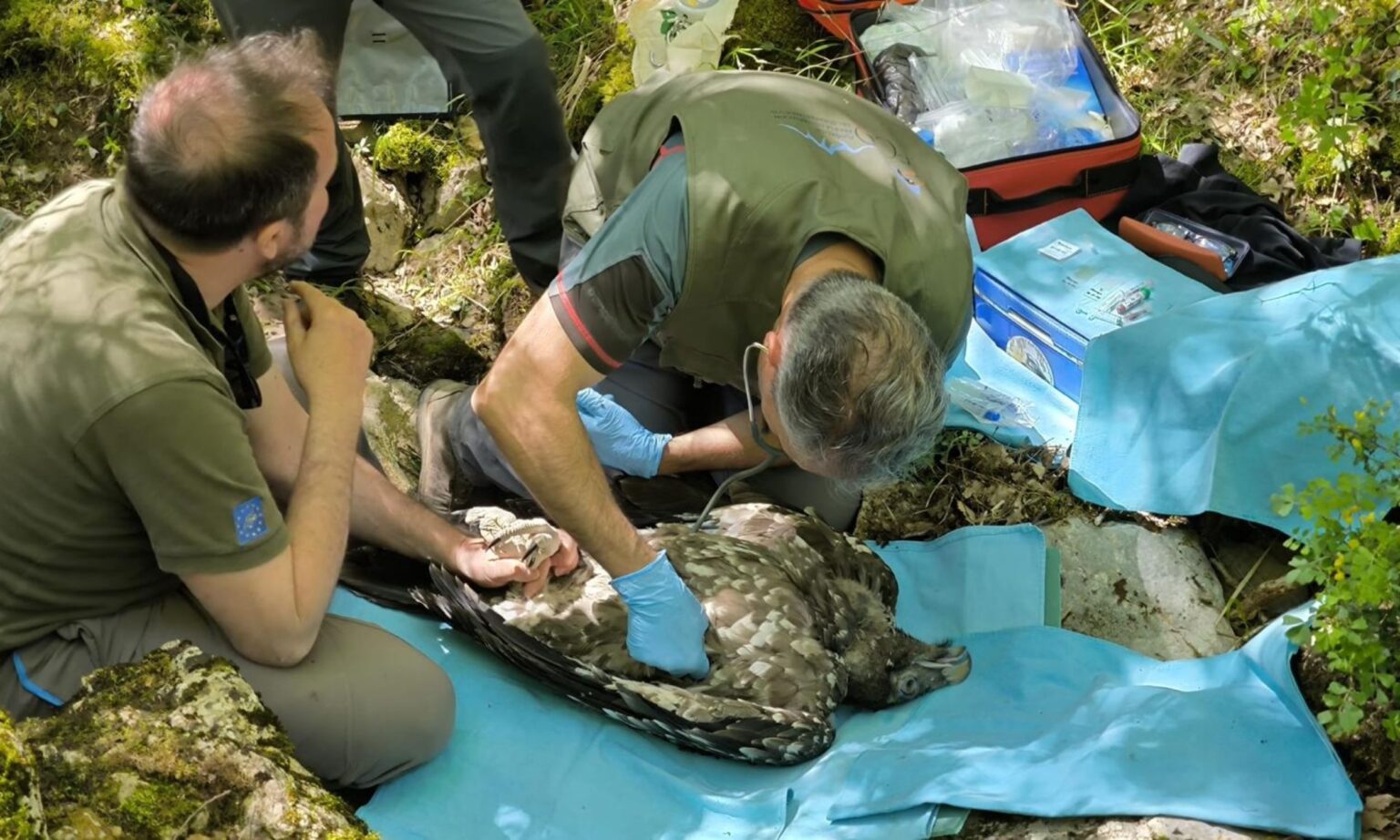
Weeks later, a high-altitude crew reached the nest and kept the cliff visit short while the chick was brought down.
With a veterinarian present, FCQ technicians recorded body weight and took biological samples to confirm the chick stayed healthy.
“During this monitoring process, the chick was successfully captured for identification, tagging, and the attachment of a GPS transmitter,” the Regional Government of Castile and León announced.
If the vulture chick’s tracker stops moving, agents can react quickly, while steady signals will reveal where young birds find food and shelter.
Diet built on bone
Bone scraps drive the bearded vulture’s routine, because adults haul marrow-rich pieces back to nestlings.
Inside its stomach, strong acid breaks down bone and releases fats that many scavengers cannot use.
Most meals come from ungulates – hoofed mammals like sheep, goats, and deer – whose remains stay reachable on open slopes.
When carcasses disappear because of cleanup rules or low grazing, breeding pairs lose the steady bone supply that chicks need.
Bearded vulture’s protection
Across Spain, official inventory records the bearded vulture as endangered, a label that triggers strict protection rules.
Once a species earns that status, authorities can limit disturbance near nesting cliffs and coordinate recovery plans across regions.
On that scale, the Iberian population ranks as vulnerable, while the global assessment places the species one step lower.
One vulture chick will not erase the risk, because long-lived birds rebuild slowly and each loss echoes for years.
Gene flow across Spain
Mountain chains can act as an ecological corridor, a natural route that connects wildlife groups, and the Iberian System fits that role.
Using GPS tracking data, a 2013 analysis followed young birds moving between the Pyrenees and vulture reintroduction sites.
Those trips let unrelated vultures meet, pair up, and swap genes, which helps small populations avoid inbreeding – mating among close relatives over generations.
When safe cliffs or feeding zones vanish along that route, the corridor weakens and new breeding outposts become rarer.
Mapping future colonies
Long before the chick hatched, maps of suitable habitat pointed toward northeastern Spain as a place where pairs could return.
In a 2025 paper, researchers linked breeding success to landscape suitability, using sheep numbers as an indicator.
By treating cliffs, open ground, and carcass supply as a package, such models flag where natural colonization can stick.
However, even a high score on a map cannot protect a nest from disturbance, storms, or a lean season.
Building multiple populations
Outside the Pyrenees, where most breeding pairs still live, managers have been moving chicks and watching them settle on new cliffs.
A human-isolation breeding center raised chicks that later moved from Ordesa y Monte Perdido in the Pyrenees to the Sierra de Gredos.
Programs in Picos de Europa and the Baetic mountains in southern Spain have helped birds spread, rather than stay boxed in.
Every new population raises the stakes for safer food, safer power lines, and steady oversight where birds now roam.
Ongoing survival risks
Poisoned bait and lead fragments can turn a shared carcass into a lethal meal for scavenging birds.
Because vultures eat dead animals, they also ingest hidden toxins, and their slow breeding rate makes losses hard to replace.
Collisions with power lines and some wind turbines add another hazard, especially for wide-ranging young birds that are learning the routes.
Since bearded vultures take years to start breeding, deaths among young birds can slow recovery for whole regions.
People and policy
Daily restraint mattered as much as effort, because rangers had to protect the nest by keeping people away.
“Environmental agents have been monitoring the breeding success of the pair since December,” the Castile and León government stated.
For now, the chick carries the name MONCAYO, honoring a mountain in northeastern Spain that lies along the border between two Spanish regions, Castile and León, and Aragón.
If officials extend park status on the Soria side, matching Aragón’s designation, calmer cliffs could help, but hazard controls still matter.
A test of survival
The Moncayo chick links hands-on guarding, modern tracking, and decades of habitat work into one living proof of return.
Over the next few years, its GPS points will guide patrols, power-line fixes, and feeding decisions along the Iberian ridges.
Information from a press release by the Vulture Conservation Foundation.
—–
Like what you read? Subscribe to our newsletter for engaging articles, exclusive content, and the latest updates.
Check us out on EarthSnap, a free app brought to you by Eric Ralls and Earth.com.
—–