
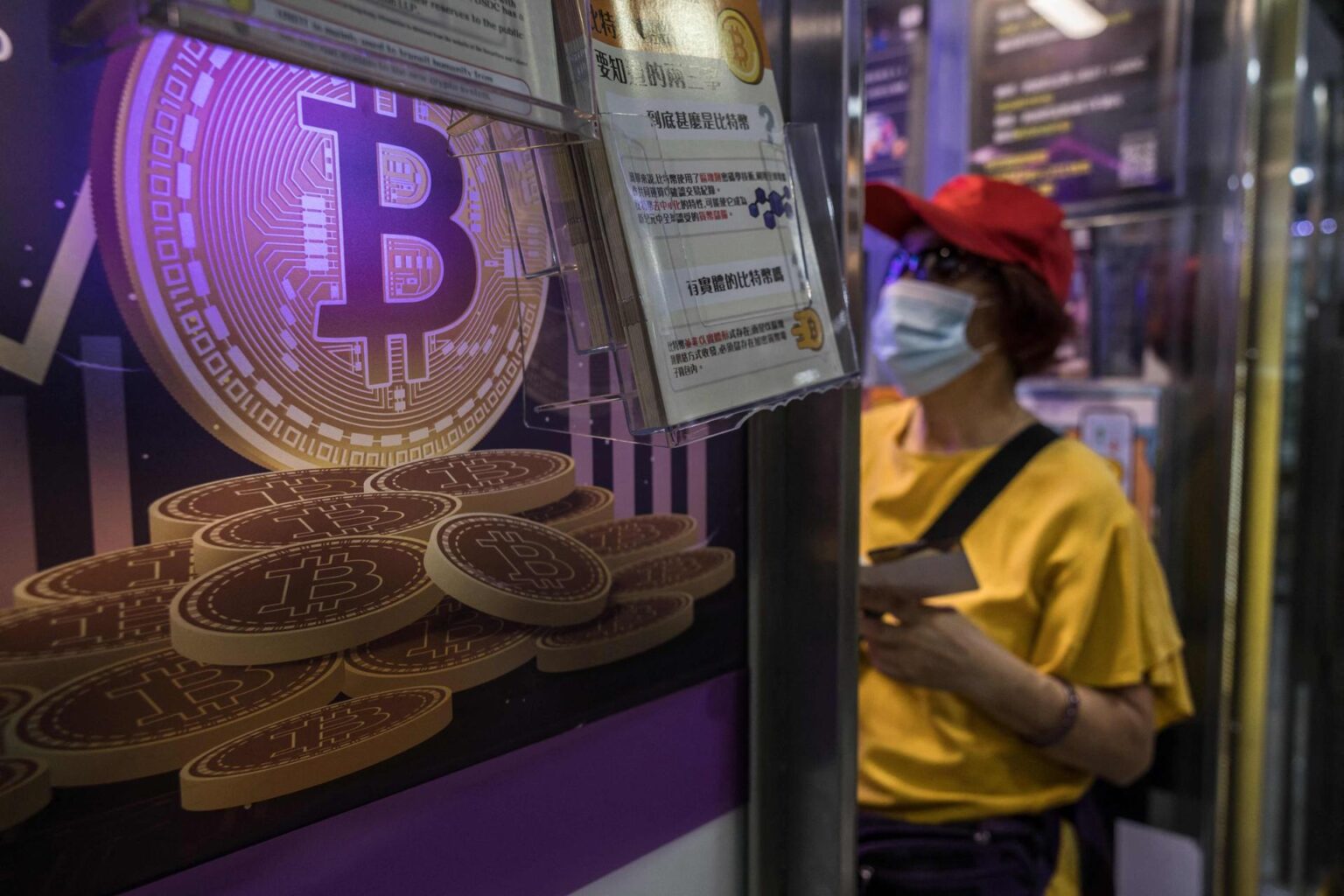
A woman speaks with a worker at a cryptocurrency exchange in Hong Kong, April 2024. AFP-Yonhap

During the 1920s, the U.S. had a dream: that one day, anyone could become rich through investment in the stock market, and no one believed in that dream more than Charles Edwin Mitchell, a celebrated financial genius who, in his advocacy for the democratization of investing in the stock market to the masses, also subsequently singlehandedly triggered the Great Depression.
“It became fashionable to invest in the stock market — a fad — and a new generation of unsophisticated investors entered the market eager to make their fortunes,” Frederick Lewis Allen said of the decade, often nicknamed the Roaring ’20s.
Fast-forward a century later to the 2020s, and cryptocurrency has arrived as a global phenomenon proclaiming a future where wealth, once locked behind banking gates, would be open and democratized for all. Crypto advocates painted blockchain as not mere technologies, but instruments of “financial freedom.” No more gatekeepers, no more intermediaries, just the retail masses empowered to control trade and multiply wealth at the fingertips of their smartphones.
“Blockchain technology is a way to truly democratize power and wealth,” Laura Shin said.
History tells us that Mitchell’s 1929 liquidity gambit, meant to democratize wealth, ultimately unleashed a cascading contagion that devastated millions. Unsophisticated retail masses who had mortgaged their homes to buy stock became homeless, suicides skyrocketed and, instead of democratizing finance, it was destitution that was democratized in the end.
Illusion of infinite growth
It is human nature to cling on to narratives of never-ending ascent which led to repeats of economic cycles. In the run-up to the Great Depression, Mitchell’s Wall Street operated on a gospel: markets only go up. The result: loans for stock purchases exploded, fueled by a margin scheme to allow the everyday Joe to buy with just a 10 percent down payment, borrowing the rest.
Advertising in the 1920s promised the moon, with rags-to-riches stories making the news of the day. Yet, the professionals know, when shoe shiners gave investment tips, wives pawned jewelry and even children traded, market fever signals are alarmed. And beneath the surface (where markets reach all-time highs), fundamentals soured: factories slowed, car sales dropped, construction projects waned and institutional investors exited as economic data deteriorated.
The above description of the ’20s can be a verbatim representation of the 1920s and 2020s, equally applicable.
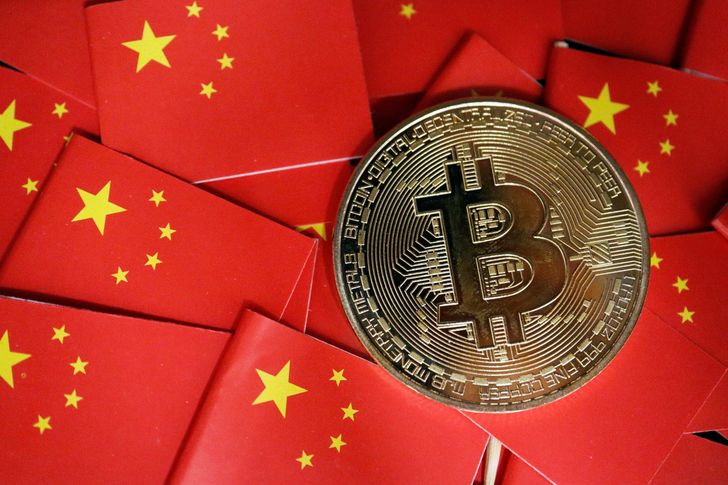
A representation of Bitcoin is seen amid China’s flags in this photo illustration created in September 2021. Reuters-Yonhap
China’s parental firewall
Beijing studied the lessons of the Great Depression. The game is stacked against those unprepared for risk, especially the unsophisticated masses. The Chinese Communist Party’s parental style of governance is predicated on denying retail the rope on which others have historically hung themselves. Chinese policy after all underlines stability, not speculative excess. Thus, the Great Firewall against private crypto trade is not arbitrary, but algorithmic risk containment engineered with social consequences in mind.
With this in mind, it is readily apparent that Hong Kong’s elevation by Beijing as the region’s crypto hub is not a contradiction, nor is it meant to be a backdoor for the mainland retail market, but a calibration.
The Securities and Futures Commission from the outset has reminded “all virtual asset trading platforms (VATPs) and their ultimate owners to comply with all applicable laws and regulations, including but without limitation, preventing mainland Chinese residents from accessing any of their virtual asset-related services, and to take all necessary measures to procure the VATPs’ controlling entities and related parties to do the same.”
Beijing effective reroutes global liquidity, not as a passive observer, but a master tactician, with Hong Kong being designed to filter the chaos and absorb new crypto wealth and innovation from overseas, thus acting as a buffer state for the mainland. Recent crackdowns, including jail terms for mainlanders who flouted China’s crypto ban, are not mere footnotes, but are reminders that the “Great Crypto Firewall” is here to stay, built on law and hard experience. After all, in Beijing’s view, crypto’s “democratize investing” mantra ignores the mathematics of catastrophe.
Beijing’s position is that the democratization of risk without democratizing understanding is no act of justice and a dereliction of the state’s parental duties. The unsophisticated masses who are least able to afford losing will lose the most, as margin calls and forced liquidation cascade. Thus, the only way, in the Chinese view, to protect their retail citizenry, is to legislate prudence.
Korea’s civil law firewall
Like China, Korea is a civil law jurisdiction with modern legal codes built on continental European models, namely German law. Korea’s civil code and judicial structure reflect the Roman‑Germanic tradition: a strong emphasis on codification, detailed statutory rules and active administrative oversight.
That same legal DNA is highlighted in Seoul’s approach towards regulating digital assets. The Act on the Protection of Virtual Asset Users, which took effect in July 2024, explicitly aims to “establish a sound order in the virtual asset market and ensure protection for users.”

Lawmakers from the ruling Democratic Party of Korea speak during a digital asset task force meeting at the National Assembly in Seoul, Jan. 28. Yonhap
It requires virtual asset service providers to segregate client money, hold a significant portion of customer assets in cold storage, carry insurance or similar protection and keep extensive records, treating crypto as another financial product subject to civil law-style prudential controls rather than a freedom of contract void.
Just as Beijing channels its civil law heritage to preemptively control risk, Seoul has transplanted its capital markets and consumer protection codes into the digital assets space. The Korean statute includes market abuse provisions that mirror traditional securities law, banning insider dealing, price manipulation and other unfair practices, with clear sanctions and supervisory powers for regulators.
The common message, consistent with continental legal thinking, is that retail access must be structured under parental style of supervision and intermediaries must internalize the risks of the products they sell.
Hong Kong: Sandbox or shield?
Alas, we turn to Hong Kong, a common law island existing under China’s “One Country, Two Systems” regime. It is pertinent to note that, contrary to much speculation, Hong Kong is not a loophole for mainlanders to invest in crypto.
While Beijing recognizes the potential of blockchain, Hong Kong is Beijing’s strategic answer to foreign liquidity, not an avenue for mainlanders to speculate. The Great Crypto Firewall function not just as a technological metaphor, but as clear market boundaries set by Beijing.
Beijing enables Hong Kong to trade, innovate and experiment, with full awareness and oversight, while keeping systemic exposure isolated. China’s evidentiary approach is shaped by modern financial history’s harshest teacher, the lessons of Charles Mitchell, the trigger man of the Great Depression.
Democratization without discipline is an invitation to near-universal loss. After all, when the next downturn hits, who will be left standing?
Joshua Chu is a Hong Kong lawyer, a law lecturer and co-chair of the Hong Kong Web3 Association. He specializes in blockchain law, cryptocurrency litigation, VATP licensing and emerging technology cases.