
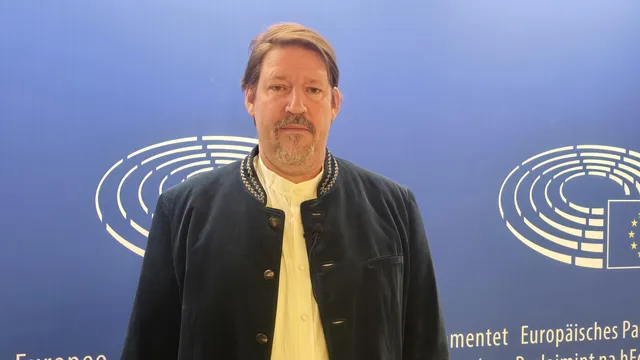
Waitz further stressed that rule of law is crucial for economic development and foreign investment.
North Macedonia must fulfill the requirement for constitutional amendments in order to move forward on its EU integration path, as these are part of the 2022 EU Council conclusions and the country’s Negotiating Framework.
This was underlined by rapporteur Thomas Waitz during the presentation of his draft 2025 report on the country before the European Parliament’s Committee on Foreign Affairs (AFET), BGNES reported.
Regarding constitutional amendments, it is clear that minority rights, including cultural expression and self-determination, are core European values and therefore part of the negotiating framework and Council conclusions. The requirement to include additional minority communities present in the country in the Constitution must be fulfilled, he said.
He added that this should also be seen in light of what he described as one of North Macedonia’s success stories: inclusion and power-sharing among different ethnic groups.
“This has been a key element of peaceful and positive development. Given the history of the region, the ability to share governance and power remains a particularly high value and one of the essential ingredients for continued progress,” Waitz noted.
AFET Chair David McAllister emphasized that the country has not advanced in recent years precisely because it has not implemented the constitutional changes stemming from the 2022 Council conclusions.
Waitz also referred to the strategic importance of Corridors 8 and 10, highlighting developments related to both infrastructure projects.
Turning to reforms, he delivered a clear message to Skopje.
“In the coming year, at least as announced by the government, institutions are expected to step up their efforts in this direction. When it comes to rule of law reforms, much remains to be done. Unfortunately, the progress we have seen over the past year has not been substantial, which may also be linked to it being another election year.
It is positive that no elections are scheduled for the upcoming year. The government has also designated it as the ‘Year of Reforms.’ This should not only concern the opening or closing of negotiating chapters, but also fulfilling the criteria necessary to eventually close them, particularly in the area of rule of law.
Beyond this formal requirement, reforms are also essential under the broader reform agenda. The country must significantly intensify its efforts to meet the goals by June. Approximately 47 million euros in budget support are at stake and could be redirected to other countries in the region if the necessary reforms are not completed by then.”
Waitz further stressed that rule of law is crucial for economic development and foreign investment.
“The country urgently needs foreign investment for economic development in many sectors, particularly in energy transition and renewable energy investments to reduce reliance on fossil fuels. A significant share of energy demand is still met through fossil fuels, creating serious pollution problems.
Rule of law is crucial for attracting foreign investment. Legal certainty is the main prerequisite for investor confidence.
In the environmental field, there has been progress in waste management, though much remains to be done, especially in wastewater management.”
The rapporteur described the draft as balanced and called for constructive engagement.
“Colleagues, we have attempted to prepare a balanced report addressing the key issues. After reviewing your amendments, we will move into negotiations. I encourage you to submit all amendments you wish to see reflected in the report.
I look forward to a constructive debate with the shadow rapporteurs and to working toward a common proposal that can secure a strong pro-European majority in this committee and later in plenary. Our aim is to support the country on its path toward European Union membership.
As mentioned, the application is more than 20 years old. It is time to move forward. There is currently a significant window of opportunity for the entire region, and particularly for North Macedonia, to advance toward EU accession. From what I see in the Council, the Commission, and the European Parliament, there is broad support.
This is a real opportunity, and I sincerely hope the North Macedonian government will not miss it.
Let us work together to contribute to that objective. I look forward to constructive discussions and a constructive outcome.”
Bulgarian MEP Ivaylo Valchev (ITN/ECR) said the authorities in North Macedonia continue to seek an external enemy to cover domestic political problems. He voiced concern over the rhetoric of Prime Minister Hristijan Mickoski against the European Union, neighboring countries and critical media, arguing that it undermines the EU’s core principle of good neighborly relations and reflects Skopje’s attitude toward the Union.
A representative of the European Commission noted that progress ultimately depends on the political will of the country’s leadership.
“The objective is to open Cluster 1 ‘Fundamentals’ as soon as possible once the Council criteria are met, which means constitutional changes,” said Sigrid Brettel, Head of Unit for Albania and North Macedonia at the Directorate-General for Neighbourhood and Enlargement Negotiations (DG ENEST). | BGNES