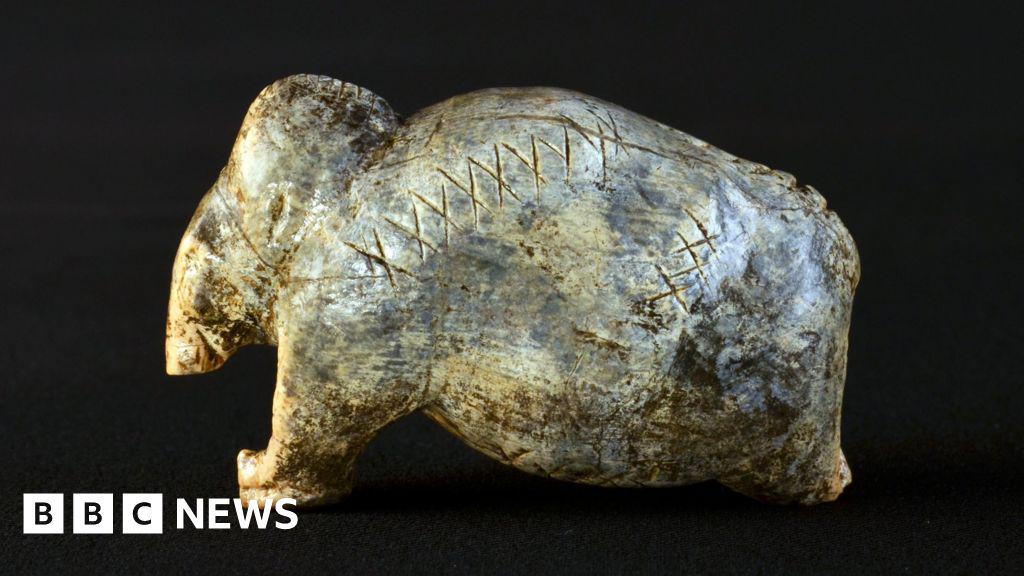
Humans have carved visual signs into the surfaces of mobile artifacts and cave walls since several hundred thousand years. We here analyze a 40,000 y old assemblage of mobile artifacts bearing sequences of intentionally engraved geometric signs. These sign sequences have a complexity comparable to the earliest protocuneiform and were selectively applied to yield higher information density on figurines than on tools.
This proves that the first hunter-gatherers arriving in Europe already developed a system of intentional and conventional signs on mobile artifacts. Our study more broadly relates to research into statistical properties of human language and writing compared to other sign systems.
This is absolutely fascinating. As someone interested in linguistics and the origins of human language, it makes me think about all the thousands of years of languages that were never chronicled; there could have been several major families in sequence before the emergence of Indo-European, for example. So much history we might never know.
I would not be surprised if writing appear and disapeared several times before the proto-cuneiform, but almost 10x older than them, and not only that but by a different specy even… it is a bit strange. At least from my uninformed point of view.
How do we know it isn’t some kind of drawing like the cave paintings ?
—
^(and now that I think about it I am also wondering how do we do the difference between rock art and proto-writing)
HeirophantGreen on
I read the article but have a question.
Does writing have to be conveyed to, understood by, and used by other people in a similar way to elevate it above ‘drawing’? Or does a single individual’s scratchrngs count even if no one understands?
Fascinating discovery either way.
ImSleepBro on
The objects are from just before Homo sapiens moved to Europe from Africa where they interacted with Neanderthals.
Potential_Airport_71 on
Carvings in the mammoth look like a way to count, maybe days (menstrual / moon cycle)…or maybe mammoth kills? Debt?
pxr555 on
Well… Writing is not so much about being first, but being useful and communicating information. Just using symbols hardly anyone understood isn’t worth much. It’s hardly more than secret symbols then.
Noting down “I received so many bushels of wheat and owe you this and that for it”, THIS is writing. But yes, it had to start somewhere and probably started much earlier than we think.
FudgeAtron on
This isn’t writing. What we call writing conveys linguistic information.
As far as I can see nothing here is evidence of that.
They’ve found consistent symbols on objects. But nothing that indicates language.
If anything from what I can see these seem to be repetitive and basic which hints more at numeracy. The symbols seem to be more of a counting aid than anything resembling writing.

9 Comments
Humans have carved visual signs into the surfaces of mobile artifacts and cave walls since several hundred thousand years. We here analyze a 40,000 y old assemblage of mobile artifacts bearing sequences of intentionally engraved geometric signs. These sign sequences have a complexity comparable to the earliest protocuneiform and were selectively applied to yield higher information density on figurines than on tools.
This proves that the first hunter-gatherers arriving in Europe already developed a system of intentional and conventional signs on mobile artifacts. Our study more broadly relates to research into statistical properties of human language and writing compared to other sign systems.
https://www.pnas.org/doi/10.1073/pnas.2520385123
This is absolutely fascinating. As someone interested in linguistics and the origins of human language, it makes me think about all the thousands of years of languages that were never chronicled; there could have been several major families in sequence before the emergence of Indo-European, for example. So much history we might never know.
https://en.wikipedia.org/wiki/Paleo-European_languages
Creationists hate this one trick
I would not be surprised if writing appear and disapeared several times before the proto-cuneiform, but almost 10x older than them, and not only that but by a different specy even… it is a bit strange. At least from my uninformed point of view.
How do we know it isn’t some kind of drawing like the cave paintings ?
—
^(and now that I think about it I am also wondering how do we do the difference between rock art and proto-writing)
I read the article but have a question.
Does writing have to be conveyed to, understood by, and used by other people in a similar way to elevate it above ‘drawing’? Or does a single individual’s scratchrngs count even if no one understands?
Fascinating discovery either way.
The objects are from just before Homo sapiens moved to Europe from Africa where they interacted with Neanderthals.
Carvings in the mammoth look like a way to count, maybe days (menstrual / moon cycle)…or maybe mammoth kills? Debt?
Well… Writing is not so much about being first, but being useful and communicating information. Just using symbols hardly anyone understood isn’t worth much. It’s hardly more than secret symbols then.
Noting down “I received so many bushels of wheat and owe you this and that for it”, THIS is writing. But yes, it had to start somewhere and probably started much earlier than we think.
This isn’t writing. What we call writing conveys linguistic information.
As far as I can see nothing here is evidence of that.
They’ve found consistent symbols on objects. But nothing that indicates language.
If anything from what I can see these seem to be repetitive and basic which hints more at numeracy. The symbols seem to be more of a counting aid than anything resembling writing.