
Market Overview
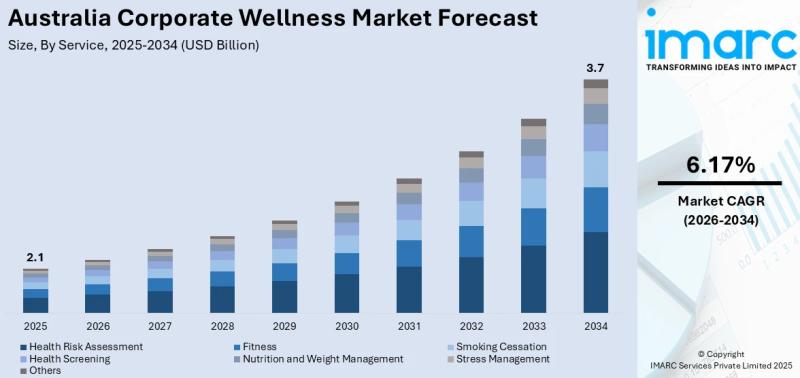
The Australia corporate wellness market size reached USD 2.1 Billion in 2025 and is expected to grow to USD 3.7 Billion by 2034, exhibiting a compound annual growth rate (CAGR) of approximately 6.17% during 2026-2034. The market is experiencing sustained momentum as Australian employers increasingly recognise that workforce health directly influences productivity, retention, and absenteeism costs. A 2024 report by the Australian Institute of Health and Welfare estimated that work-related mental health conditions alone cost Australian businesses over AUD 10 billion annually in lost productivity, reinforcing the business case for proactive corporate wellness investment.
View Full Report : https://www.imarcgroup.com/australia-corporate-wellness-market
How AI is Reshaping the Future of the Australia Corporate Wellness Market
• AI-powered mental health platforms are enabling Australian employers to provide personalised, always-available psychological support at scale. Tools such as Unmind and Sonder – both operating in Australia – use machine learning to assess employee wellbeing through validated surveys and engagement data, then tailor content recommendations and escalation pathways to individual risk profiles, improving programme engagement rates by 30-45% compared to generic EAP offerings.
• Predictive health analytics are allowing corporate wellness providers to identify at-risk employee populations before health events occur. By integrating anonymised data from wearables, platform engagement metrics, and absenteeism records, AI systems can flag early indicators of burnout, musculoskeletal risk, or chronic disease progression, enabling targeted early intervention that reduces downstream healthcare costs by an estimated 15-25% for participating Australian employers.
• AI-driven personalisation engines are transforming fitness and nutrition programmes from generic content libraries into adaptive wellness journeys. Platforms including Wellhub (formerly Gympass) and Virgin Pulse use behavioural AI to dynamically adjust exercise recommendations, meal plans, and challenge incentives based on individual progress data, device integration, and stated health goals, increasing sustained programme participation beyond 90 days by over 35%.
• Natural language processing (NLP) chatbots are expanding access to mental health and wellness coaching outside business hours, addressing a critical gap in traditional EAP models where support is limited to appointment availability. Australian corporate wellness providers are embedding AI coaching assistants capable of delivering evidence-based cognitive behavioural therapy (CBT) techniques, stress management exercises, and sleep hygiene guidance, reducing the burden on human counsellors while extending 24/7 support coverage.
• AI-integrated reporting dashboards are enabling HR and People & Culture leaders to measure wellness programme ROI with granularity previously unavailable. Platforms now generate real-time analytics on engagement by team, site, and demographic cohort – linked to absenteeism, turnover, and productivity indicators – allowing data-driven optimisation of programme spend and enabling evidence-based conversations with finance leadership on wellness investment justification.
Grab a sample PDF of this report: https://www.imarcgroup.com/australia-corporate-wellness-market/requestsample
Market Growth Factors
The regulatory strengthening of psychosocial hazard obligations under Australia’s harmonised Work Health and Safety (WHS) laws is creating a non-discretionary compliance imperative for corporate wellness investment. Safe Work Australia’s 2022 model WHS Regulations, adopted progressively across States and Territories, explicitly require employers to identify and manage psychosocial hazards – including excessive workload, low job control, and workplace harassment – with the same rigour applied to physical safety risks. Non-compliance carries significant financial and reputational consequences, including fines of up to AUD 3 million for Category 1 breaches. This regulatory shift is compelling organisations that previously viewed wellness programmes as discretionary benefits to treat them as legally mandated risk management infrastructure, materially expanding the corporate wellness addressable market across the small, medium, and enterprise segments.
Australia’s intensely competitive labour market – characterised by near-record low unemployment rates and a structural skilled worker shortage in sectors including healthcare, technology, engineering, and financial services – is elevating corporate wellness from a retention perk to a strategic talent acquisition tool. Deloitte Australia’s 2024 Workplace Wellness Survey found that 68% of Australian employees consider comprehensive mental health and wellness benefits a primary factor in evaluating job offers, while 54% reported wellness programme quality directly influenced their decision to remain with their current employer. As major Australian corporations including Commonwealth Bank, BHP, and Telstra publicly expand wellness benefit offerings – and report measurable improvements in voluntary turnover metrics – competitive pressure is cascading through their supply chains and industry peers, broadening corporate wellness adoption beyond the top-tier employer segment.
The digital transformation of wellness programme delivery is dramatically expanding the scalability and cost-effectiveness of corporate wellness solutions, enabling market penetration into the Australian SME segment that was historically underserved by high-cost in-person programme models. Cloud-based wellness platforms with per-employee-per-month subscription pricing – typically ranging from AUD 8 to AUD 35 PEPM depending on functionality – allow businesses with 20-500 employees to access comprehensive wellness ecosystems previously affordable only to large enterprises with dedicated HR teams. The COVID-19 pandemic permanently normalised remote programme delivery through mobile applications and video-based coaching, removing the geographic barriers that had limited wellness programme reach for Australian employees in regional and remote locations. This structural shift in delivery economics is the primary driver of the market’s accelerating SME segment growth.
Market Segmentation
Service Type Insights:
• Mental Health and Employee Assistance Programmes (EAP)
• Physical Fitness and Activity Programmes
• Nutrition and Weight Management
• Financial Wellness and Coaching
• Smoking Cessation and Substance Abuse Programmes
• Health Risk Assessments and Biometric Screening
Delivery Mode Insights:
• Digital and Mobile Wellness Platforms
• On-Site Wellness Programmes and Facilities
• Hybrid (Digital and In-Person) Programmes
Organisation Size Insights:
• Large Enterprises (1,000+ Employees)
• Medium Enterprises (100-1,000 Employees)
• Small Enterprises and SMEs (Under 100 Employees)
End-Use Industry Insights:
• Banking, Financial Services and Insurance (BFSI)
• Information Technology and Telecommunications
• Healthcare and Life Sciences
• Mining, Resources and Energy
• Government and Public Sector
• Retail, Hospitality and Consumer Services
Regional Insights:
• New South Wales & Australian Capital Territory
• Victoria & Tasmania
• Queensland
• Western Australia
• South Australia & Northern Territory
Key Players
• Sonder (Australia)
• Wellhub (formerly Gympass)
• Unmind
• Converge International
• Bupa Australia
• Medibank Health Solutions
• Virgin Pulse
• ComPsych Corporation
Recent Developement & News
• March 2025: Sonder, Australia’s leading safety and wellbeing platform, announced the expansion of its AI-powered triage and real-time support service to cover financial wellness and legal assistance alongside its existing mental health and physical safety capabilities. The expanded platform – now serving over 450 Australian employer clients covering more than 750,000 employees – integrates AI-driven need assessment with human specialist escalation across five wellbeing domains in a single mobile application. The launch directly responds to growing employer demand for consolidated wellness platforms that replace multiple point-solution vendors with a single contract and reporting ecosystem. Analysts estimate that platform consolidation is reducing corporate wellness administration costs for large Australian employers by 20-30%, accelerating adoption of comprehensive multi-service wellness programmes across the financial services and mining sectors.
• October 2024: Medibank Health Solutions announced a strategic partnership with Microsoft Australia to integrate Microsoft Viva Insights – an AI-powered employee experience platform embedded within Microsoft 365 – with Medibank’s corporate health and EAP programmes. The integration enables Australian employers using Microsoft 365 to surface anonymised team wellbeing signals – including collaboration overload, after-hours work patterns, and meeting density indicators – directly within their existing productivity tools, triggering contextual wellness resource recommendations without requiring employees to switch applications. The partnership is strategically significant because it embeds corporate wellness into the daily digital work environment rather than requiring deliberate platform engagement, addressing the chronic participation gap in traditional EAP models where fewer than 10% of eligible employees access services in any given year.
• May 2024: Safe Work Australia released updated enforcement guidelines for psychosocial hazard compliance under the harmonised WHS Regulations, confirming that workplace regulators across all participating jurisdictions would commence proactive audit programmes targeting medium and large employers in high-risk industries including healthcare, emergency services, and financial services from January 2025. The guidelines explicitly reference structured wellness programmes, regular mental health check-ins, and documented psychosocial risk registers as evidence of compliance due diligence. The announcement triggered a significant acceleration in corporate wellness platform procurement across Australian enterprises seeking to demonstrate compliance readiness ahead of the audit commencement date. Industry consultants reported a 40% increase in corporate wellness RFP activity in the six months following the guideline release, with EAP providers and digital mental health platforms the primary beneficiaries of accelerated purchasing decisions.
If you require any specific information that is not covered currently within the scope of the report, we will provide the same as a part of the customization.
Request Customization : https://www.imarcgroup.com/request?type=report&id=31626&flag=E
Contact Us
IMARC Group
134 N 4th St. Brooklyn, NY 11249, USA
Email: sales@imarcgroup.com
Tel No: (D) +91 120 433 0800
United States: +1-201-971-6302
About Us
IMARC Group is a global management consulting firm that helps the world’s most ambitious changemakers to create a lasting impact. The company provides a comprehensive suite of market entry and expansion services including market assessment, feasibility studies, company incorporation assistance, factory setup support, regulatory approvals and licensing navigation, branding, marketing and sales strategies, competitive landscape and benchmarking analyses, pricing and cost research, and procurement research.
This release was published on openPR.