
Facebook
Twitter
LinkedIn
Pinterest
Reddit
Email
Print
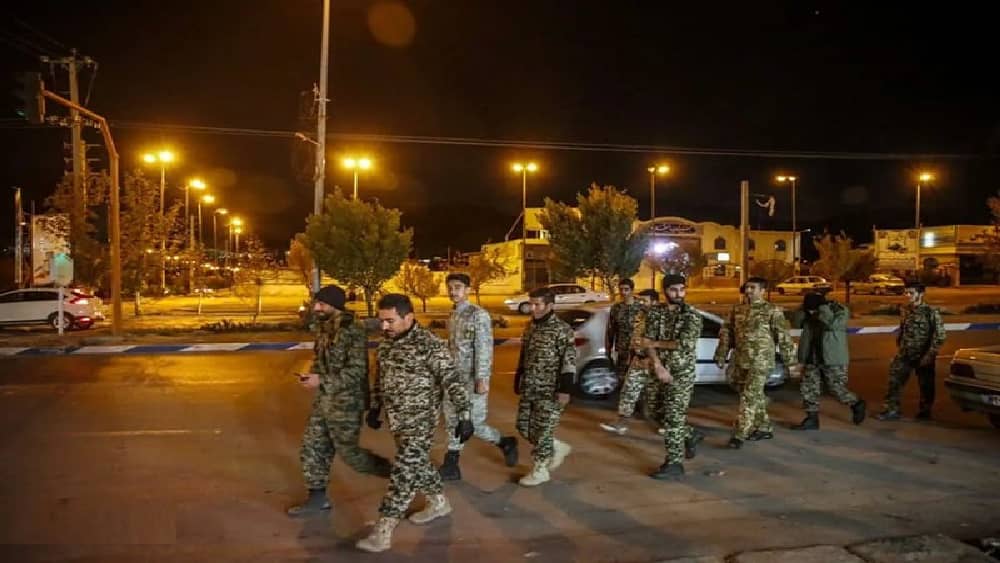 Basij paramilitary forces patrol the streets at night amid heightened security crackdowns across Iranian cities – July 2025
Three-minute read
Faced with an irreversible wave of popular uprisings and a crumbling economy, the clerical regime in Tehran has intensified its campaign of repression, blending transparent lies with direct threats of imprisonment. On February 26, 2026, high-ranking officials, including the regime’s president Masoud Pezeshkian and the notorious Chief Justice Gholam-Hossein Mohseni-Ejei, signaled a “no-mercy” policy toward the ongoing January 2026 uprising, even as the international community issued stinging rebukes in Geneva.
Pezeshkian’s Failed Deception: “We Are Victims of Terrorism”
In a speech delivered in Sari on February 26, Masoud Pezeshkian, acting as the mouthpiece for Supreme Leader Ali Khamenei, attempted to flip the narrative of state-sponsored violence by labeling the Iranian people as “terrorists.” In remarks broadcast by state television, Pezeshkian claimed the regime has suffered more than 28,000 casualties from “street terrorism” since the early days of the revolution. Distorting the reality of the recent protests, Pezeshkian stated that those with Molotov cocktails and weapons are killing the police and security forces, asserting that the regime itself is the victim.
In a desperate bid to deflect international pressure regarding the regime’s nuclear ambitions, Pezeshkian leaned on religious rhetoric to defend Khamenei’s purported stance against nuclear weapons. He claimed that a religious leader of a society cannot lie, and that when Khamenei declares the regime will not have nuclear weapons, it is an absolute truth. Pezeshkian added that from a religious standpoint, he does not even have the right to think about acquiring such weapons.
The #Iranian regime’s recent saber-rattling—missile program “non-negotiable,” high readiness, IAEA/UN “biased”—masks setbacks. It’s deception to deter foes, rally a shrinking base, & manage perceptions, not alter reality. Regime projecting strength amid strain. via @shahriarkia…
— NCRI-FAC (@iran_policy) December 25, 2025
The Gallows Judge Strikes at Universities
Simultaneously, the regime’s Judiciary Chief, Mohseni-Ejei, issued a chilling warning to the student movement, which has become the vanguard of the current uprising. On February 25 and 26, Ejei threatened that the judiciary would personally intervene if university officials failed to silence protesters. He noted that in recent days, slogans were shouted in several universities that were not in keeping with the dignity of the academic environment. He warned that disciplinary committees are being activated and that the judiciary will move with urgency to finalize cases against those he termed “terrorist elements.”
The Minister of Science, Simaei-Sarraf, echoed this hardline stance on February 24, labeling the student protests as “chaos.” State-run media confirmed that at least 180 students have already been summoned for participating in demonstrations across various campuses, including Khajeh Nasir University. In response to these pressures, elite students have reportedly told state media outlets like Etemad that they intend to migrate, as there is no longer any room for progress or meritocracy in a country where the regime prioritizes suppression over the basic needs of its youth.
Iranian students mark fifth day of uprising, vow to avenge January martyrs https://t.co/rlSuiyOBB3
— People’s Mojahedin Organization of Iran (PMOI/MEK) (@Mojahedineng) February 25, 2026
Global Condemnation of Human Rights Violations
While the mullahs threaten their own youth, the international community has voiced unprecedented outrage. During the UN Human Rights Council session in Geneva on February 26, foreign ministers from across Europe condemned the regime’s war against its own people. The Danish Foreign Minister stated that authorities have once again brutally suppressed protests, leading to thousands of civilians being killed, wounded, and arrested. The Latvian Foreign Minister added that the Iranian people, exhausted by suppression and economic deprivation, are demanding basic rights and human dignity, which are met only with violence and censorship. Ministers from Croatia and Monaco also expressed serious concern regarding the use of the death penalty and the arbitrary detention of those seeking democracy and political change.
Despite the threats, the Iranian people continue to honor those killed by security forces. Memorial services for the martyrs of the January uprising turned into scenes of defiance in Tehran, Nahavand, and Anbarabad. In Tehran on February 23, the brother of Saeid Heydari, a young man killed during the protests, delivered a fiery eulogy. He declared that he had inherited his brother’s courage and swore by his blood to take revenge on those who shot the people’s children. His mother, standing beside him, stated she was ready to give all four of her sons for the freedom of the people. Similar scenes were reported at the memorial for Marziyeh Kamali, a 21-year-old medical student in Kerman, and Behnam Darvishi in Nahavand, where participants chanted that Iranians would rather die than accept humiliation.
#Breaking Today at Tehran University
Students were heard chanting: “Down with the oppressor, be it the Shah or the mullahs,” and “No to monarchy, no to the Supreme Leader; Yes to democracy and equality.”#IranProtests2026 #No2ShahNo2Mullah pic.twitter.com/z8Q8svIf3R— SIMAY AZADI TV (@en_simayazadi) February 22, 2026
Economic Implosion: The Dollar at 163,000 Tomans
The regime’s political crisis is mirrored by a total economic standstill. According to the state-run news agency ISNA, the dollar has surged to 163,000 tomans, a massive jump from the 136,000 toman rate just two months ago. This surge has wiped out the purchasing power of the middle class and pushed the population further down the poverty line. State-affiliated economists warn that the anarchy seen in the streets is a direct result of this economic hopelessness. The newspaper Jahan-e Sanat admitted that the regime is raiding the pockets of its citizens through increased taxes to fund its survival, while oil revenues are lost to black-market middlemen.
The convergence of a broken economy, an outraged society, and a violent state response that has officially acknowledged over 3,000 deaths since January has created an irreversible rift. The current landscape in Iran is no longer one of manageable unrest, but a profound systemic crisis where the regime’s reliance on calibrated coercion is struggling to contain a nation that is both economically depleted and politically radicalized.