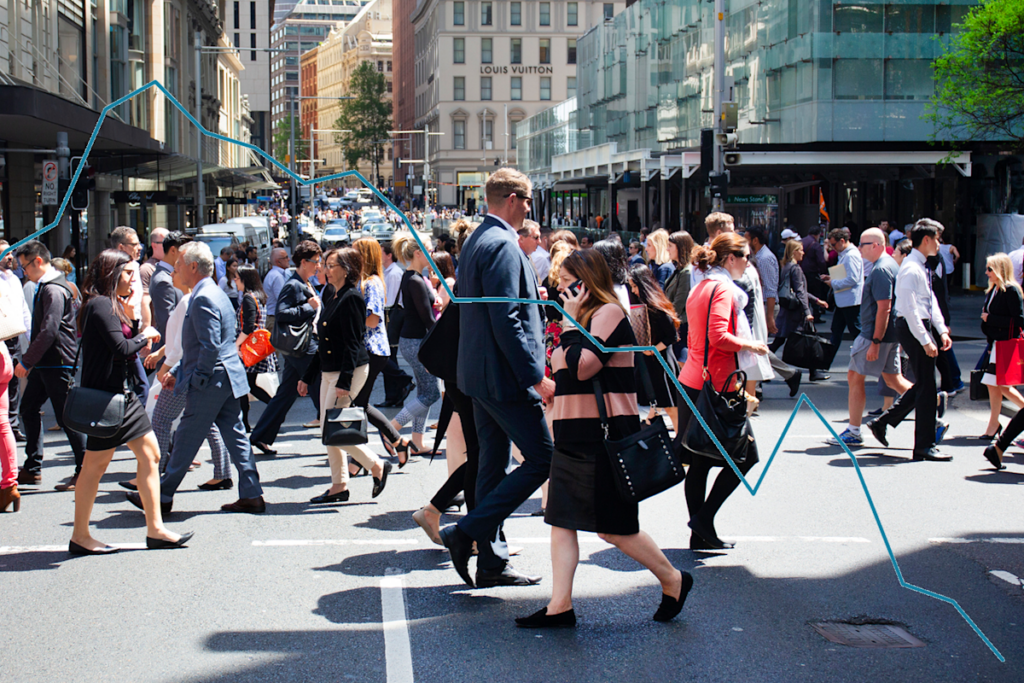
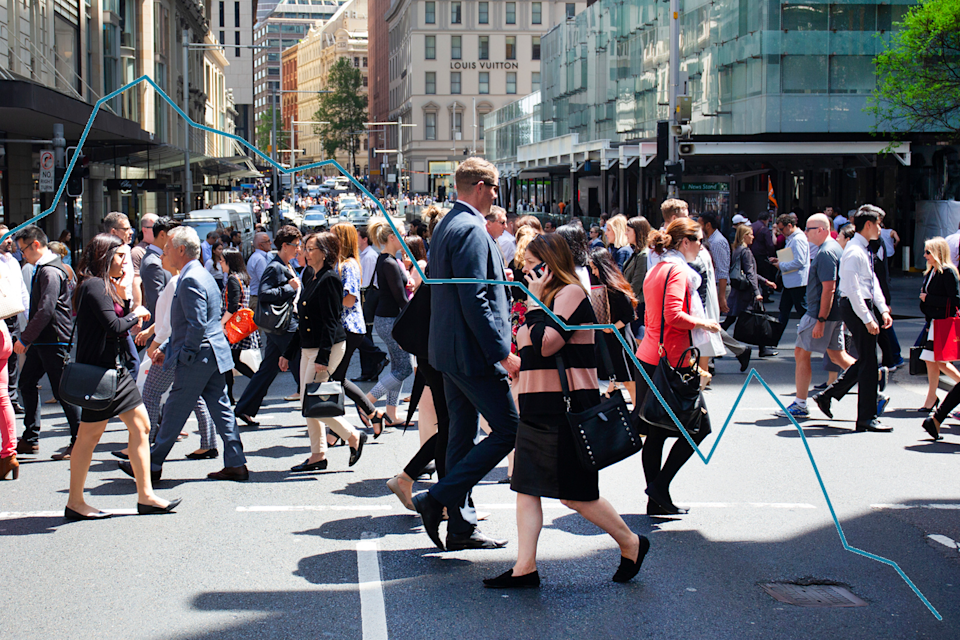
What does the baby deficit mean for Australia’s bottom line? (Source: Getty/ABS)
When the federal government’s Centre for Population released its latest forward projections in January, it held within a deeply concerning outlook for the nation’s fertility rate.
It was forecast that the total fertility rate (TFR) would fall to 1.42 babies per woman in 2026, down from an expected 1.45 in 2025 and 1.481 in 2024.
To put this figure into perspective, if that comes to pass, it would be below that of Japan’s in 2017.
RELATED
By that time alarm bells had been ringing in Tokyo for well over a decade, warning of the demographic, economic and cultural impact of a society with fewer and fewer children – and by extension, a larger and larger proportion of the population being made up by the elderly.
For Japan, this set of circumstances was not breaking new ground, with fertility rates in dramatic decline since the mid-1970s.
While there was a fair degree of relative success boosting fertility rates between the mid-2000s and the mid-2010s, over time the effort to arrest and reverse the fall in fertility rates provide rather futile.
(Source: AvidCommentator/Yahoo Finance)
The most recent peak in Australia’s fertility rate occurred in 2008, hitting 2.023 babies per woman, the strongest result since 1976 and within striking distance of the 2.1 required for replacement.
Since then it has been stuck in a downtrend. In particular, the years since the pandemic have surprised to the downside of analyst and government projections on several occasions.
That begs the question: Why is it that Australia had such success in boosting its fertility rate to a multi-decade high, only for it to come crashing down to a record low lately?
Naturally this is a complex issue to quantify, with all manner of factors, from cultural to economic, impacting the choices of Australia’s prospective parents.
For the purpose of this analysis, we will focus on elements of the fertility issue that we can more accurately quantify, such as household formation and economic outcomes.
One of the markers of the relative health of a household is growth in their inflation adjusted spending.
Between 2003-04 and 2007-08, real household spending per capita (excluding housing costs) for the 25 to 34 age demographic rose robustly, rising by 11.3 per cent in just four years.
This period of rising disposable income also marked a rise in the nation’s fertility rate from 1.782 in 2004, to 2.023 in 2008 – a relative rise of 12 per cent.
Between 2008 and the conclusion of the ABS dataset in 2022, real household spending per capita in the 25 to 34 demographic fell by 12.4 per cent.
Across the same time fertility rates dropped from 2.023 in 2008 to 1.63 in 2022.
When charting the deterioration in real household spending against fertility rates, there is an interesting degree of correlation.
(Source: AvidCommentator/Yahoo Finance)
Relying on data from CommBank iQ for the years after 2022, we see that between March 2022 and March 2025, real consumer per capita spending (ex-housing) for the 25 to 29 demographic fell by over 13%, with spending for the 30 to 34 demographic down by almost 10%.
(Source: AvidCommentator/Yahoo Finance)
This constitutes what is arguably by some academic definitions a depression (a contraction of 10% or more) in the real per capita spending of Australians aged 25 to 34.
When combined with the already challenging deterioration witnessed in the ABS data, it arguably presents a deeply challenging environment for young Australians to bring a child into the world.
Despite Australia being one of the most successful home building nations in the world in terms of the number of dwellings completed each year relative to the size of our population, household formation rates as expressed by the number of households per capita have not been nearly as favourable.
Since the peak level of households per 100,000 people in the 25 to 34 age demographic peaked in 2003-04, the ratio has continued to decline with each passing snapshot.
If the rate of households per 100,000 people held in 2003-04 had of been maintained, as of the latest snapshot which was in 2020, there would have been over 300,000 more households stemming from the 25 to 34 age demographic.
(Source: AvidCommentator/Yahoo Finance)
It is not a stretch to suggest that the stunted nature of household formation in this demographic has played a role, likely on a lagged basis, in the decline of fertility rates in Australia.
The factors explored here represent just a small snapshot of the elements driving the downward trend in Australian fertility rates.
There is unfortunately a rather extensive list of other quantifiable factors.
For example, first home buyers are now eight years older than they were in 2008 (27.9 in 2008 vs 36 today), or that shortly after the turn of the millennium a mortgage on the median house could be serviced for less than half what it costs as a proportion of household income today.
While falling fertility rates presents an issue for the nation’s demographics and ultimately the economy, people not being able to have the children they want because of their circumstances also presents a significant social issue.
Domestic polling and studies from aboard indicate issues like housing costs and the cost-of-living are impacting fertility rates, and it should be ringing alarm bells in the halls of power, as it was in Japan decades ago.
The problem for Australia is that we are now effectively Japan in the one way that matters when assessing our nation through this lens.
As has been shown in South Korea, which now has the lowest fertility rate of any major nation in the world, arresting this fall is immensely challenging.
Ultimately, Australians owe it to the nation’s future children and prospective to at least try our best to address the issue, making the sacrifices necessary so that our nation can prosper in the long term, like other generations have before us.
Get the latest Yahoo Finance news – follow us on Facebook, LinkedIn and Instagram.