
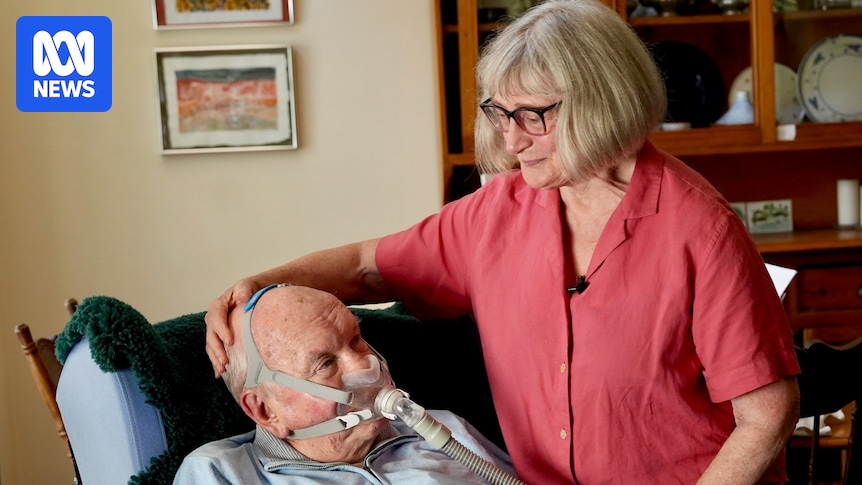
Each morning Gaynor Crossan lovingly prepares her husband of 57 years for the day ahead.
It’s a complicated process that takes nearly an hour.
Graham is 80 years old and has advanced Motor Neurone Disease.
He can no longer walk.
He eats mainly through a feeding tube and can’t breathe without a ventilator.

Graham Crossan’s MND has progressed to an advanced stage but he’s too old to qualify for the NDIS. (ABC News: Kyle Harley)
Caring for him is a 24-hour job, and there is little respite.
“Life, actually, it’s changed dramatically, especially in the last seven years, simply because Graham, he no longer moves,” Gaynor explains.
“We used to go to movies, to plays, to concerts, but we don’t do any of that anymore. Basically we’re housebound.”
Gaynor, 79, can’t move Graham on her own and has injured herself repeatedly trying to do so.
She needs the help of a carer to get Graham out of bed each day.
“It’s both our safety that is at risk.”

Gaynor Crossan says she’s struggling to give her husband the care he needs. (ABC News: Kyle Harley)
Because he is over the aged of 65, Graham can’t access support through the NDIS, but he receives some funding through My Aged Care.
Last November, the federal government changed the way it assessed aged care supports, as part of reforms aimed at making the aged care system more sustainable and equitable.
Graham was told he’d need to be re-assessed and expected to receive the highest level of at-home care.
The couple was astonished by the department’s response.
“I received this letter and it basically told me that after careful consideration, a decision had been made that Graham wasn’t eligible to access additional home support,” Gaynor says.
“At first, I just didn’t believe it.”
Gaynor says the payments used to cover a bare minimum of 14 hours with a carer each week, enough to get him into and out of bed each day.
With increased costs, they now only cover nine-and-a-half hours a week.
After a visit to his home from an assessor, Graham’s level of need was determined using an algorithm, called the Integrated Assessment Tool (IAT).
Once the tool makes an assessment, it can’t be over-ridden by humans.
Geoff Rowe from Aged and Disability Advocacy Australia says the new system simply isn’t working.
“This has the look and feel of the robodebt experience,” Mr Rowe says.

Aged and Disability Advocacy Australia’s Geoff Rowe fears the situation could mirror the Robodebt experience. (ABC News: Mark Leonardi)
He’s hearing stories like Graham’s every day.
“We’re now more than 100 days into this new assessment tool and the stories are continuing and increasing,” he says.
“We’re getting calls from people who have had a package for a while, sometimes a long while.
“And when they’ve gone for a reassessment to increase the package, they’ve actually had it reduced, and reduced to a point where they cannot survive.”
Mr Rowe says an algorithm is simply inadequate for assessing levels of care.
“The algorithm is just not picking up the urgency of people’s situation or the complexity of their situation,” he says.
Challenging an assessment by the IAT can only be done by sending a letter via the post to the System Governor at the Department of Health, Disability and Ageing in South Australia within 28 days of receiving the assessment outcome letter.
The System Governor aims to respond within 90 days.
Jo Whitehouse from MND Victoria says that’s too long.
“A 90-day wait can mean the difference between them being alive and being dead,” she says bluntly.
“That sounds really horrific, doesn’t it, for me to say it in that way?
“It is just not working well for most people over the age of 65, but for people with a progressive neurological condition like motor neurone disease, it’s just not meeting their needs.”
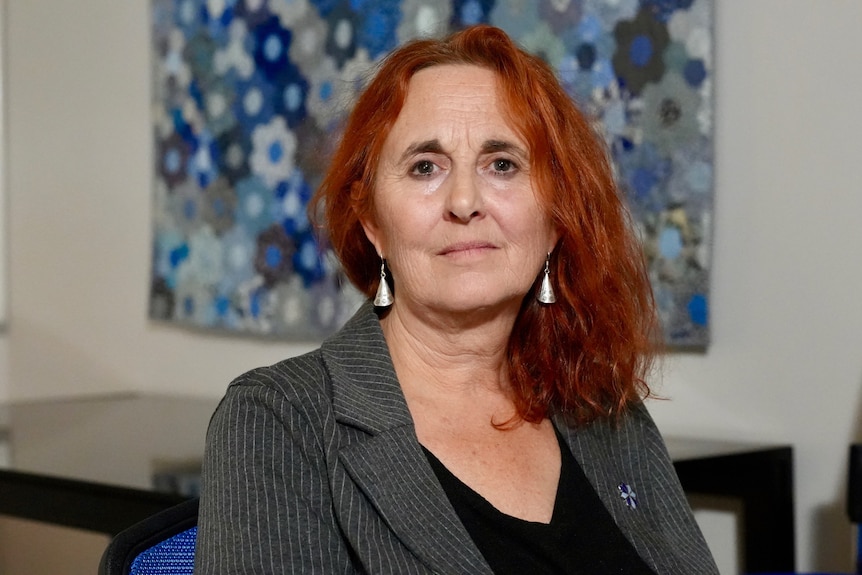
MND Victoria’s Jo Whitehouse says the algorithm is unsuitable for determining individual needs and must be scrapped. (ABC News: Kyle Harley)
MND Victoria is calling for a complete overhaul of the system, and has asked the federal government to fast-track MND cases.
They are yet to receive a response.
“The algorithm is something that needs to go, in our opinion,” Ms Whitehouse says.
The ABC asked the Federal Minister for Aged Care Sam Rae whether the government was aware of complaints around the IAT and if it intended to make changes.
In a statement, a spokesperson for the minister said: “The assessment process is based on assessor input and relies on clinical advice to obtain the most accurate and consistent outcomes.”
The spokesperson went on to say that feedback from older Australians is critical, and the government is “actively monitoring the operation of both the assessment and pricing processes and intends to refine them as the system matures”.
Geoff Rowe hopes the government is looking at the issue closely, and quickly.
“If we’re listening to algorithms rather than listening to assessors and listening to older people, then we’ve really got it wrong,” he says.
“We’re seeing and hearing of people who are being admitted to hospital to get the support they need, or people are being fast-tracked to residential aged care when that’s not the outcome that they would prefer, let alone as taxpayers it’s a very expensive option.”
Gaynor Crossan believes the system is biased against the elderly.
“It’s so unfair on so many fronts,” she says.
“I wrote a letter to the system’s governor asking them to reconsider the decision, and I explained everything,” she says.
“Then we received a letter back a month later saying that the request had been received for a review of the decision.
“But when I read (it) it doesn’t tell me that they will review it. It just says that they’ve actually received the letter.
“It’s quite inhumane.”
For information or support regarding aged care, please call the Aged Care Advocacy Line on 1800 700 600 or visit opan.org.au.