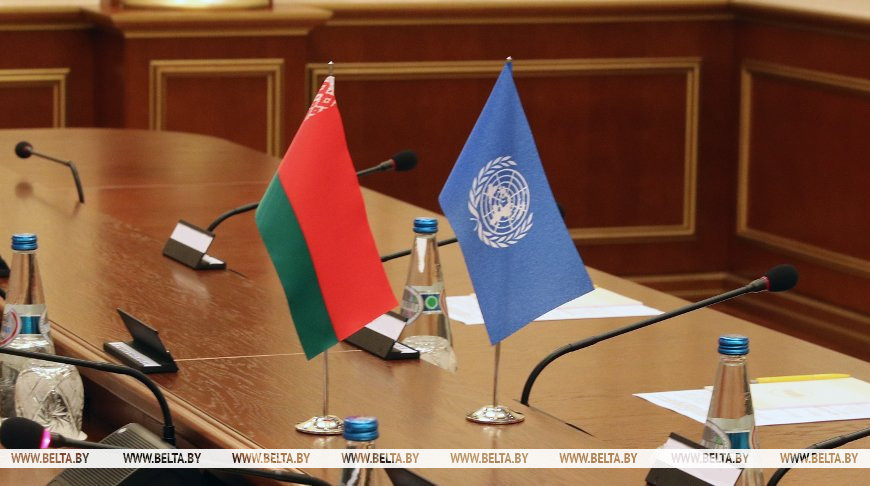
MINSK, 28 February (BelTA) – Belarus views the Eurasian Charter as a tool for implementing UN principles at the regional level, Belarus’ Deputy Minister of Foreign Affairs Igor Sekreta said in an interview with BelTA.
When asked about whether the Eurasian Charter could affect the UN Charter and whether any contradictions might arise between the global document and the emerging regional one, the deputy minister stressed: “There can be no doubts or ambiguities here: the UN Charter is and will remain the primary legal document in international relations. Through the charter, we do not intend to create a system parallel to the UN system. Nor do we envision any mechanism that would allow regional norms to prevail over international ones.”
He went on saying: “Instead, we view the Eurasian Charter as a tool for implementing UN principles at the regional level. Chapter VIII of the UN Charter clearly provides for and encourages regional mechanisms for maintaining peace and security, provided they align with UN goals and principles. This is our solid legal and political foundation. Our goal is that, in an increasingly fragmented world, regional cooperation strengthens the global UN architecture rather than weakens it. The Eurasian Charter is our contribution to enhancing the resilience, effectiveness, and relevance of the UN system.”
“Our general approach is that the charter should be both a motivating and a practical document,” Igor Sekreta emphasized. “First and foremost, it is conceived as a framework political document. Its main function is to establish the fundamental principles of Eurasian cooperation, such as sovereign equality, non-interference, and the indivisibility of security. Think of it as, in a sense, a constitution for our shared space, setting the rules of the game. However, we do not believe the charter should be merely declarative. To ensure long-term impact, we expect it to include practical mechanisms.”
“In the security sphere, it could set principles for conflict prevention and confidence-building measures, creating a consultation mechanism to de-escalate tensions before they become critical, essentially forming a Eurasian security architecture,” he said. “In the economic sphere, it could provide a mandate for ‘integration of integrations’, fostering dialogue among the EAEU, EU, SCO, and other structures to remove trade and investment barriers across the continent. In the humanitarian sphere, it could support cultural events, academic exchanges, and civil-society dialogue.”
As for the legal dimension, the charter itself will likely be a political commitment, Igor Sekreta said. “However, through this document, participating states may task relevant bodies and structures with developing specific legally binding agreements in certain areas. In other words, the key point in drafting the charter is to begin with a strong political consensus that can then be translated into practical action.”
The Eurasian Charter of Diversity and Multipolarity is an international document proposed by Belarus and Russia. It is intended to support the creation of a stable architecture of security and cooperation across the Eurasian space, based on the principles of equality, indivisible security, and the independent, solidarity-based resolution of regional issues by Eurasian states without destructive external interference. Work on the charter is open and inclusive, focused on strengthening cooperation in four key areas: security, economy, humanitarian agenda, and civilizational exchange.