
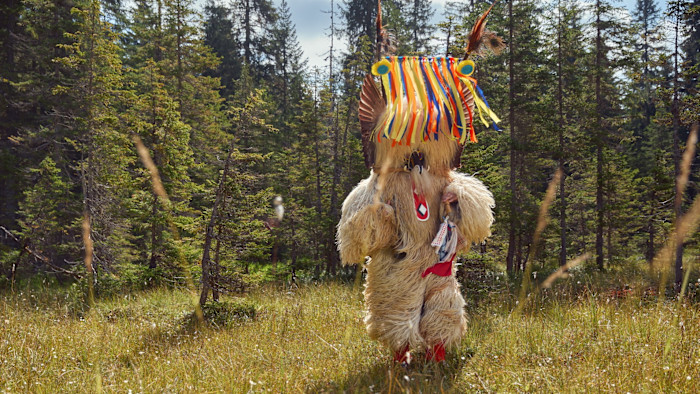
The little village of Tržec isn’t much to look at. Like much of eastern Slovenia, this is farming country. Winter crops of kale, wheat and barley sprout from the furrowed fields alongside chicken pens and tumbledown wooden barns. For as long as anyone can remember, life in Tržec has run to an agricultural rhythm — the chug of the tractor and the scrape of the plough — but today, a different soundtrack jangles in the winter air.
A flatbed truck rumbles into the village, grinding its gears as it shudders to a stop. The driver gets out and lowers the ramp. At first glance, it looks like it’s filled with sheep fleeces destined for the farmers’ market. But then the fleeces start to move. They stand up on two legs, dust themselves down, and, one by one, climb out of the truck.
They are a bizarre sight: half comical, half nightmarish, like a cross between the Wombles and Maurice Sendak’s Where The Wild Things Are. Each stands eight feet high. Mottled horns curl from their temples. Snaggletooth grins leer under straw moustaches and snouts pierced with noserings. Beady eyes peek from fleecy faces and a grotesquely long tongue lolls out down to their waist. On their legs, they sport green woollen socks; on their feet, stout boots tied with green laces. Around their midriffs hang cowbells which clang every time they move. And each carries a jezevka club, with a head covered in hedgehog spikes.
Winter is waning. The kurents have returned for another year.
 Kurents dancing in the streets of Ptuj during the annual carnival © Borut Zivulovic/Reuters
 A phalanx of kurents; each carries three or five cowbells around their waist © Alamy
No one is sure exactly where the kurents come from. Masks and costumes are a common feature of springtime carnivals around the world, but the kurents are found only here, in Slovenia’s northeastern corner — specifically, in the plains and hills around Ptuj, a medieval town close to the Croatian/Hungarian border.
The first recorded mention of the figures appears in 1830 but academics believe they existed long before that, perhaps as far back as the shamanic societies who dwelt here before the Romans arrived.

“The kurents are ancient things,” explains Marija Hernja, a local historian and scholar of Slovenia’s pust (carnival) traditions. “But we don’t exactly know when or how they began. They are spirits of nature, linked with ideas that were important to our ancestors: rebirth, fertility, the circle of life.”
I’ve travelled to Slovenia to join the kurents for their biggest celebration: Kurentovanje, an 11-day bacchanalia culminating in a series of grand street parades in the run-up to Shrove Tuesday. The first “modern” version of the festival was organised in 1960 by the ethnographer Drago Hasl, who was concerned that local carnival traditions were being lost under the tripartite weights of communism, Catholicism and postwar economic upheaval. It’s now attended by nearly 100,000 spectators every year.
 A photo from the 1961 carnival in Ptuj shows costumed kurents in the town square © Alamy
 The kurents dance outside the town hall in 1961 © Alamy
Before I head for the party, I’ve been invited to join the kurents on their most sacred duty: their door-to-door rounds. Every year, between Candlemas and Ash Wednesday, the kurents roam the region’s villages to visit houses, bless the fields, and bring luck and fertility for the year ahead. Though the kurents’ origins are undoubtedly pagan, the church seems to have decided to tolerate the tradition rather than trying to stamp it out — and gradually, over time, the pagan and Christian calendars have merged. In 2017, the practice was added to Unesco’s Representative List of the Intangible Cultural Heritage of Humanity, affording it the same significance as Chinese calligraphy, Balinese dance and Mexico’s Day of the Dead.
“The kurents are the heralds of spring,” Marija Hernja says. “Their role is to scare away the winter and wake up the land, ready for another year of growing and cultivation. So of course, to do their job properly, they must be as terrifying as possible.”
On the backstreets of Tržec, about 6km south of Ptuj, the kurents split into groups and begin their rounds. In front of them runs a pitchfork-carrying devil and a pokači, or whip-cracker, whose strokes ring out like pistol shots to announce their arrival.
When they reach a front door, they twist their arms and shimmy their hips. The bell-tinkles become a clamour. Each kurent wears three or five on their belt (always an odd number). Traditionally, only unmarried men were permitted to join but these days everyone is welcome, including children.
The door opens and a bemused family emerges, smiling as they shake each kurent’s hand. A tray of drinks appears; the kurents expect hospitality in exchange for their visit. Customarily, they are served sparkling wine watered down with soda (spirits are frowned upon lest the jollity spirals out of hand). Their favourite snack, apparently, is sausages. Appropriately greeted, they remove their kapas, or hoods, sipping drinks and chatting with the homeowners. Despite the chill, they are sweating heavily inside their fleeces. Unmasked, they look like Vikings on a post-pillage pub crawl.
 Luka Vidovič and his kurent companions make their door-to-door rounds in Tržec © Oliver Berry
 Kurents get ready for a night’s work in Tržec © Oliver Berry
 Traditionally only unmarried men could be kurents but today everyone is welcome, including children © Oliver Berry
Among them is Luka Vidovic. Now in his thirties, he grew up in the nearby village of Lancova Vas, and has been a kurent since his teens. By day, he works in an auto-parts store but for two weeks every spring, his job plays second fiddle to his kurent duties. Like his companions, he isn’t paid a penny for his time. “When we are kids, we all grow up wanting to be kurents,” he says. “It’s an honour to be a part of it. We bring joy and good luck for the year ahead. I think everyone needs more of that these days.”
They down drinks, don hoods and jog onwards up the lane. They’ll carry on until it’s too dark to see. And tomorrow, they’ll move on to the next village and do it all over again.
In previous centuries, each man would stitch his kurentija, or suit, himself, using whatever materials he had to hand — scraps of leather, worn-out fleeces, discarded bones or animal parts: a patchwork of organic offcuts worthy of Frankenstein’s monster.
 Primož Klinc working on a costume repair. He has recently inherited the workshop from his father Marko © Oliver Berry
 A completed kurent mask hangs outside the Klincs’ workshop © Oliver Berry
 ‘Jezevka’ clubs, each topped with hedgehog skins © Oliver Berry
These days, however, the kurentija are mostly handmade by a master craftsman. Keen to understand the work that goes into them, I pay a visit to Marko Klinc, who is acknowledged as the finest maker not just in Ptuj, but in the whole of Slovenia. His workshop is on a nondescript industrial estate about 10 minutes from Ptuj, where he works with his son, Primož. Between December and February, they are booked solid with kurentija commissions. For the rest of the year, they run an upholstery and sofa repair business.
His family has been making kurentija for three generations, Marko explains. There are two types; which is worn depends on which side of the Drava River you come from. The horned korents originate from the Haloze hills, on the river’s right bank. Their cousins from the Ptuj plain, on the river’s left bank, wear headdresses of goose feathers fringed with coloured ribbons.
Each suit takes three days and at least ten sheepskins to complete. Masks are made of leather and painted by hand. The basic outfit starts from around €2,000, plus another €600 or so for the accoutrements: bells, belts, socks and staffs. By tradition, the suits are passed down from one generation to the next, but eventually they wear out and need to be repaired or replaced. Inevitably, many clients add some extra bling — an engraved leather tongue, a more richly coloured sheepskin, fancier feathers or boar tusks.
“Every suit is made for its owner,” Marko says, as Primož puts the finishing touches to their latest suit. “The design is similar, but they are unique. People come with ideas about what they want . . . it’s a collaboration between the wearer and the maker. I have probably made 1,500 in my career, but every one has been a surprise in some way. They have a kind of life of their own.”
 Kurents assemble for the carnival outside Ptuj © Alamy
 Checking messages during the festival © ZUMA Press Wire via Reuters Connect
The kurents may be the ringmasters of Ptuj’s springtime celebrations, but they are only one member of the carnival cast. Following Marija’s advice, I head up to Ptuj’s imposing hilltop castle where, inside an old stone hall, a collection of historic costumes stands, frozen in motion like a snapshot of carnival day. Among them are log-haulers, fairies, old men and women, ploughmen, hens, cockerels, spearmen, bears and a frankly alarming pantomime horse.
Each plays its allotted role on carnival day. Their wonky features and rustic craftsmanship have the naivety of a child’s drawing. Like the kurents, individually they seem faintly comical but in a group, their animalistic features and expressionless faces become unsettling.
Customarily, the carnival ends with a ritual: the sacrifice of pust, typically symbolised by a puppet or straw dummy. To mark the end of the festivities, the people’s sins, worries and fears are symbolically transferred to the dummy, who is then hung, stabbed, hacked, beaten, spat upon, buried or burned (sometimes all of the above). Once pust is dead, the carnival is over, the privations of Lent begin, and the costumes are put away for another year.
While the kurents’ door-to-door rounds are not intended as a public spectacle, the carnival is another matter. Everyone is heartily welcomed, locals and tourists alike, and throughout the eleven days of Kurentovanje, Ptuj’s town council arranges a rolling programme of events. There are kurent dress-up sessions for kids, guided town tours and nightly parades. There is even a special wine that’s produced for carnival week — Mistik, a crisp young white made by Ptujska klet, the town’s oldest winemaker (which offers guided tours and tasting sessions inside its century-old cellars).
 The kurents dance in Mestni Trg, Ptuj’s main square, on February 11, 2026 © Oliver Berry
 Kurents prepare for the parade in a side street of Ptuj © Oliver Berry
For the kurents, the biggest day of all is the Wednesday before Shrove Tuesday. This is Dan Kurentovih in Korantovih Skupin, the Day of Kurents and Korents, and people travel from all over Slovenia to attend. This year, it’s estimated there may be 800 kurents in town, perhaps as many as a thousand.
I head back to Ptuj as the sun is sinking over the rooftops. Afternoon bleeds into dusk and the kurents muster. They assemble on the tangle of streets leading to the main square of Mestni Trg: first one, then pairs, then by the score. The town’s lanterns flicker on. Stars spot the sky. Ptuj’s medieval clock tower chimes six, and the stampede begins.
Across town, thousands of cowbells clang in unison. The din of stamping feet echoes around the rooftops. Horns blare, accordions drone, drums beat. The kurents are on the march. They thunder towards the square, preceded by whipcrackers and bands of devils who lunge at the crowds. The square becomes a sea of sheepskinned monsters, jumping, twirling and shimmying their way through the crowds.
They shake onlookers’ hands, and give out krofi doughnuts stuffed with apricot jam. They join hands, form circles, dance jigs. Wave after wave passes through the square, bowing their heads, brandishing their horns, ringing merry hell from their bells. The demented spectacle lasts for an hour. When it’s over, my brain tries its best to assimilate it, but it feels like trying to remember a dream. The images are just too peculiar, too strange to slot into any kind of logical order.
After the procession, I find the mass of kurents chilling out on a nearby square, seated at tables stacked with wine, burgers, platters of cheese and cold meats. Their heads have been arranged on the edge of the square, like hunting trophies. Over a glass of Mistik wine, I get talking with Karl Šayperl, whose troupe comes from a village up in the Haloze hills. After a while, our conversation takes a turn for the mystical.
“Honestly, wearing the mask can really be weird sometimes,” says Karl. “When you are inside it, you feel this intense heat. You struggle to breathe. You get bursts of energy, a feeling of heat shock. And sometimes, something happens. You are not really yourself. It becomes impossible to stop dancing, like you could keep going forever.”
He looks at me and smiles. “It is almost like the kurent takes you over.”
Oliver Berry was a guest of the Slovenian Tourist Board (slovenia.info). Direct flights to Ljubljana from London Gatwick start around £70 one-way with EasyJet (easyjet.com). In Ptuj, Oliver stayed at the Hotel Ptuj, the town’s oldest hotel (eh.si; doubles from about €90). In Ljubljana, he stayed at the AS Boutique Hotel (ashotel.si; doubles from about €245), where the restaurants include Jaz by Ana Ros, Slovenia’s top chef. Guided tours and wine tastings can be arranged through Ptujska klet (ptujska-klet.si) or Visit Ptuj (visitptuj.eu). For information on next year’s festival, visit kurentovanje.net
Find out about our latest stories first — follow FT Weekend on Instagram, Bluesky and X, and sign up to receive the FT Weekend newsletter every Saturday morning