
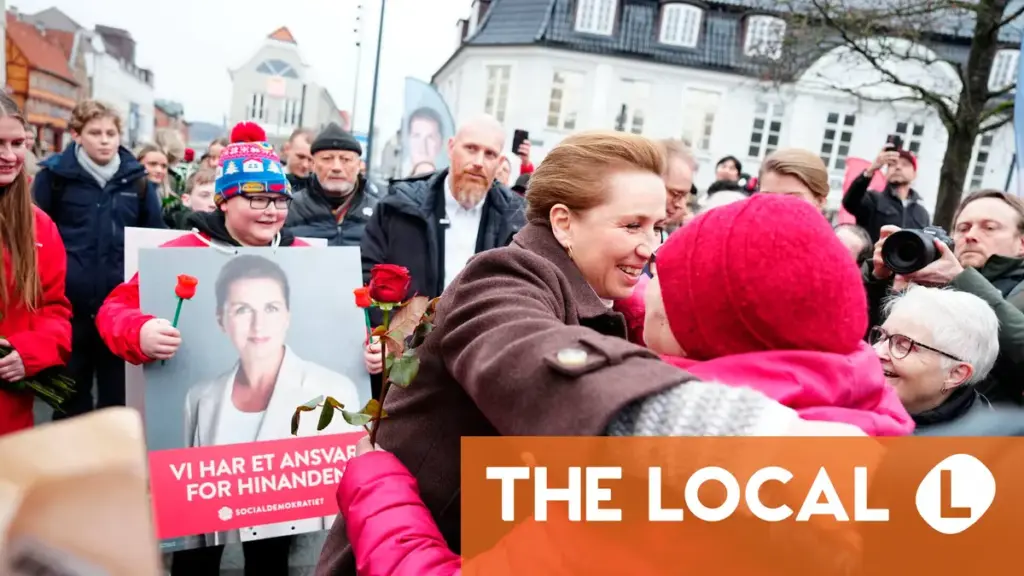
Our column Inside Denmark takes a closer look at the stories we’ve been talking about over the last seven days. This week, the emergence of wealth tax as a major election issue.
Campaigning for Denmark’s parliamentary elections, which take place on March 24th, is now underway after Prime Minister Mette Frederiksen called the election on Thursday.
“It will now be up to you, the voters, to decide which direction will be set for Denmark for the next four years, and I am really looking forward to it,” Frederiksen said.
Several issues could prove key in the campaigning which will take place in the current weeks. Defence spending, the strained relationship with the United States, immigration and the cost of living including VAT on food could all prove to be crucial talking points for Denmark’s current eleven parliamentary parties.
READ ALSO: What issues could decide the 2026 election in Denmark?
One issue which has already become a major talking point for the election – and which nobody would have been likely to predict three days ago – is wealth tax, which incidentally was one of the decisive factors in last year’s Norwegian general election.
At the same time as announcing the Danish election, Frederiksen said she was proposing a new wealth tax.
“When the wealthiest one percent of the population owns around a quarter of Danes’ total net wealth, the imbalance has become too great,” she said, striking a distinctly left-wing tone.
Advertisement
“We are therefore proposing a wealth tax. Denmark did not become a rich and strong society because of inequality. Quite the opposite. We became what we are today by rolling up our sleeves and because we are not too different from one another,” she said.
The idea was immediately rejected by Foreign Minister Lars Løkke Rasmussen, leader of the Moderate party, in comments reported by news wire Ritzau.
“We are categorically against it,” the foreign minister said.
“We need to create a better climate for businesses, and you don’t do that by introducing a wealth tax,” he said.
The third partner in the current coalition government, the Liberal (Venstre) party, sounded a similar note, with leader Troels Lund Poulsen telling broadcaster TV2 “I will not be part of a government that introduces a wealth tax.”
“It would make Denmark poorer and undermine the strong economy,” Poulsen said.
READ ALSO: Danish Liberal leader Poulsen declares prime minister candidacy
Advertisement
Neither Frederiksen nor Poulsen have definitively stated they no longer want to govern together.
“I’m aiming for a conservative government. What is crucial for the Liberals is the content [of a government platform, ed.] but I’m not going to close any doors,” Poulsen said during a televised debate between party leaders on Thursday evening.
The incumbent PM was also leaving all options open as she called the election.
“Could it be another government spanning the political centre? Yes. Could it be a government based on the left side of parliament? Yes, if it’s manoeuvrable and capable of working with many parties,” she said in parliament.
“I’m not ruling anything out in advance. In the times we live in, I will refrain from making non-negotiable demands,” she said.
However, the issue of wealth tax alone has already drawn clear lines between the right- and left-leaning sides of the coalition.
This was quickly picked up on by the Danish newspapers as they commented on Frederiksen’s wealth tax proposal.
Tabloid Ekstra Bladet was particularly scathing, saying that Frederiksen “suddenly wants to be deep red again,” meaning socialist, by proposing the wealth tax.
“It is deeply unconvincing. Her sudden pirouettes are solely the result of a series of poor decisions” that have forced the PM to move the the left, where opposition parties are gaining popularity, the paper wrote.
Right-leaning daily Kristeligt Dagblad’s opinion piece said “it does not seem like an obvious choice for Mette Frederiksen to apparently be courting the left wing for her best chance of survival as prime minister.”
“That runs counter to everything she has built her ideology on in recent years,” the newspaper’s op-ed read, in reference with Frederiksen’s willingness to work with parties to the right of the Social Democrats on a range of issues.
Time will tell whether the wealth tax play proves to be a vote winner for the Social Democrats.