
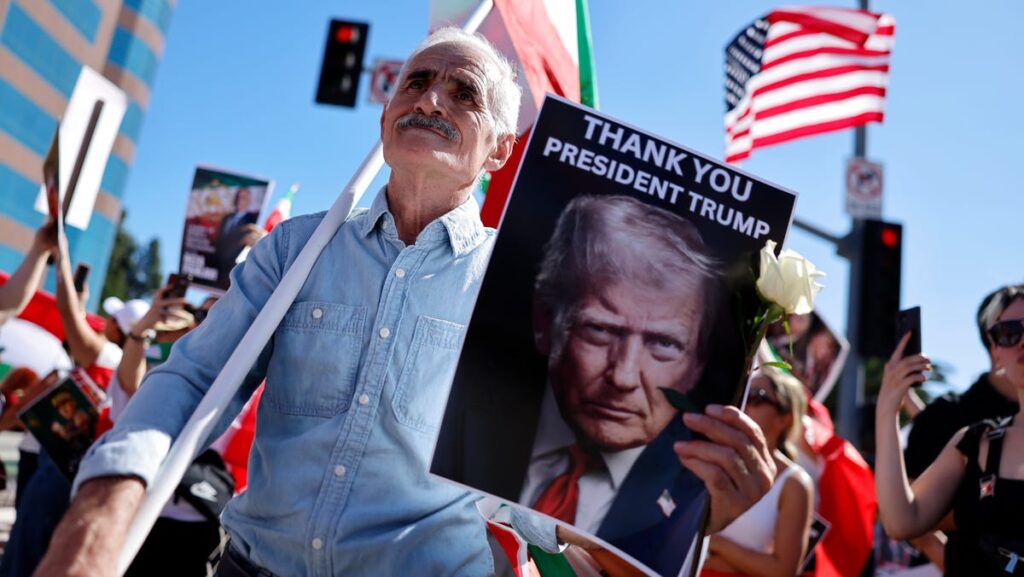
WASHINGTON – President Donald Trump and members of his administration repeatedly made the case for military strikes against Iran by arguing that the Middle Eastern country posed a serious threat to the United States.
Iran, they said, was on the verge of developing a nuclear weapon and ballistic missiles capable of striking the United States.
But national security analysts and experts on Iran and its ruling regime say those claims are based on assumptions that are wrong or greatly exaggerated.
“It’s not true,” Matthew Bunn, an arms control expert at Harvard’s Kennedy School, said of the assertion that Iran is close to developing a nuclear weapon.
The United States and Israel launched military strikes and “major combat operations” against Iran on Saturday, Feb. 28, targeting the country’s missile capabilities and its leaders.
Iran’s Supreme Leader Ayatollah Ali Khamenei was killed in the joint strikes, an Israeli source confirmed to USA TODAY. Trump also announced Khamenei’s death. But Iran’s Foreign Ministry insisted earlier in the day that he and President Masoud Pezeshkian remained “safe and sound.”
Reuters reported that 201 people were killed and 747 were wounded in the attacks, according to Iranian media that cited Red Crescent, a humanitarian group working in the region. Official estimates of fatalities and injuries haven’t been confirmed by American or international authorities.
Senior Trump administration officials, briefing reporters after the attacks on the condition of anonymity, insisted the strikes were necessary to protect Americans from what they said was “an intolerable risk” to the United States from Iran’s development of long-range missiles.
What has Trump said about Iran’s weapons development?
Trump said during his State of the Union address last week that Iran was close to developing a nuclear weapon and ballistic missiles that could soon reach the United States. He repeated those claims in a video posted on social media after the joint U.S.-Israeli attacks.
The U.S. had been negotiating with Iran in the hope of striking a deal that would avoid a military confrontation. A third round of indirect talks ended Feb. 26 without a major breakthrough, but negotiators for both countries had been expected to meet again next week.
In their briefing with reporters, a senior administration official said Iran refused to even discuss its ballistic missile program inside or outside of mediated talks with the United States. That was unacceptable to the Trump administration, the official said.
Another U.S. official said the United States had intelligence showing Iran was in the throes of rebuilding three nuclear sites that the U.S. military bombed last summer.
The officials said they determined in the course of talks that Iran was seeking to preserve its ability to enrich uranium so that over time they could use it to make a nuclear bomb. Iran has said it seeks to use enriched uranium for non-weapon purposes, such as energy production. One official said the administration offered to give Iran free fuel in perpetuity. But Iran declined, saying it needed to enrich uranium, the official said.
“The fact that they weren’t willing to take free nuclear fuel was a big tell to us that they were looking to buy time,” the official said.
Iran has a stockpile of nearly 1,000 pounds of uranium enriched at 60% purity, the official said. Uranium enriched at 60% could be converted within a week to 90%, which is the level needed to make a nuclear weapon, the official said.
How quickly could Iran build an atomic bomb?
But national security analysts said Iran doesn’t have the capability to enrich uranium to 90%.
After the United States bombed three Iranian nuclear facilities last June, Trump announced that the sites had been “obliterated.”
Iran had no operating enrichment facilities after those attacks, said Bunn, who has analyzed the long-term risks of Iran obtaining nuclear weapons.
“The major facilities of Iran’s program and a lot of the key experts were destroyed,” he said.
Iran may have been able to rescue some of its enriched uranium stockpile either before or after the June attacks, Bunn said. But in terms of a facility that would make weapons-grade uranium, “none of that is there,” he said.
How long before Iranian missiles can reach the U.S.?
Experts also have cast doubts on the administration’s claim that Iran was close to making ballistic missiles that could reach the United States. U.S. intelligence reports don’t back those assertions, according to Reuters.
Three sources familiar with the assessments told the news agency that Trump’s claims appear to be exaggerated.
Iran has the largest ballistic missile force in the Middle East, and its missiles are able to strike Israel, U.S. bases in the region and parts of Europe. It also has developed so-called space-launch vehicles that have put satellites into orbit and that experts say could be modified into intercontinental ballistic missiles capable of carrying nuclear warheads.

What does the US gain from Iran strike
USA TODAY’s Susan Page explores the risks and rewards of attacking Iran through the lens of important historical context.
But, “it’s not so easy to build a ballistic missile that’s going to reach the United States, when we’ve done so much damage to their program until now,” said Daniel Kurtzer, who was the U.S. ambassador to Israel during George W. Bush’s administration. He also served as U.S. ambassador to Egypt under former President Bill Clinton.
Recent U.S. intelligence assessments suggest Iran was as far as 10 years away from developing a missile capable of striking the United States, said Mona Yacoubian, director and senior adviser of the Middle East Program at the Center for Strategic and International Studies, a Washington-based think tank.
Will Iranians overthrow their government?
In his video remarks following the U.S.-Israeli strikes on Iran, Trump urged the Iranian people to rise up against the Iranian leadership and “take over your government.”
“This will probably be your only chance for generations,” he said.
But Bunn and Yacoubian said it’s unlikely that the strikes would trigger a mass push for regime change in Iran.
Iranians have learned lessons from their 12-day war with Israel last summer and have already put in place succession plans in the event of the death of Khamenei, their supreme leader, Yacoubian said.
“The regime in Iran is probably better placed to manage through chaos than the Iranian people themselves,” she said.
If Khamenei was killed in the latest U.S.-Israeli assault, it’s possible that Iran’s ruling regime might be weakened, Bunn said. But Iranians may be reluctant to rise up against their government after thousands of protesters were slaughtered by Iranian security forces during a crackdown on nationwide demonstrations in January.
“Now,” Bunn said, “the regime is even more desperate. If I were an Iranian protester, I would be extremely nervous about raising up in a situation where I would appear to be acting in concert with a foreign enemy.”
Michael Collins writes about the intersection of politics and culture. A veteran reporter, he has covered the White House and Congress. Follow him on X: @mcollinsNEWS
Francesca Chambers covers the White House. Follow her on X: @fran_chambers