
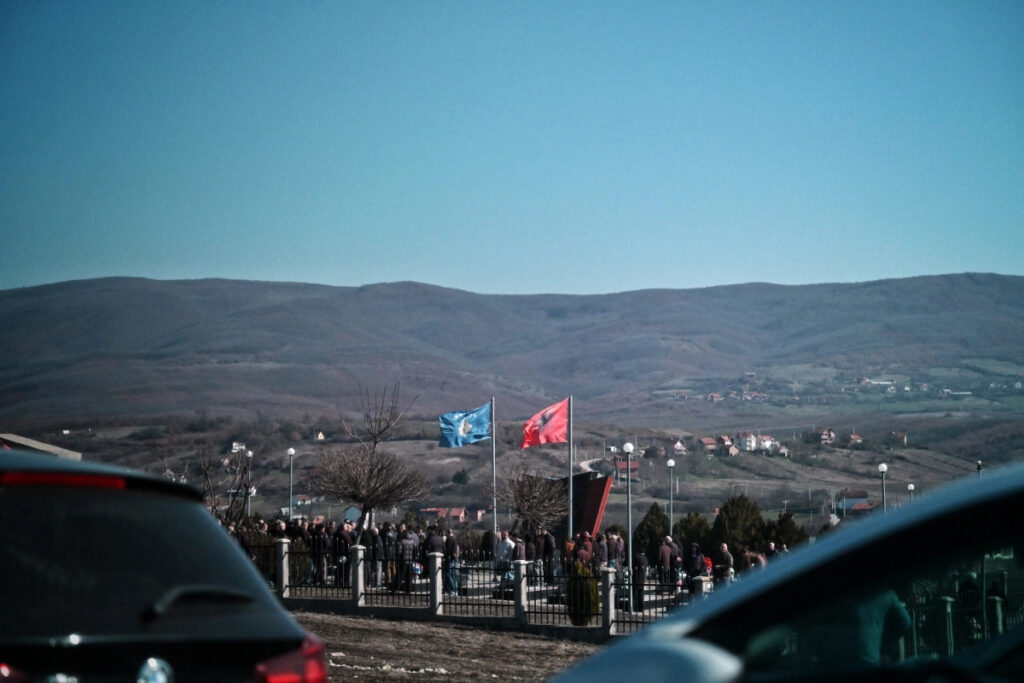
Survivors and witnesses of the massacres still have their memories fresh. They recounted the horror they experienced when Serbian forces executed their loved ones. “That day was a great pain for us, but now we also feel proud that the blood of our family members lies in the foundations of the state of Kosovo and we are also proud of the fact that all that sacrifice was not in vain – in the end it was crowned with the independence of the state of Kosovo, which was the dream of all those who worked for this day,” said Xhevdet Ahmeti from Likoshani.
Helicopters, tanks and armored vehicles of Serbian forces surrounded the house of Xhevdet Ahmeti, at noon on February 28, 1998, in Likoshan, Skenderaj.
That day, 10 family members were killed, including his father and three brothers.
The Ahmeti family home, which has now been transformed into a museum, still bears the traces of the tragic day as evidence of the massacre that took place.
Xhevdet was not at home when the massacre occurred, but he says that when he returned the day after, he thought he would not find any family members alive.
“I happened to be away from home that day. I was in Pristina and upon returning to Drenas I learned from my uncle that there had been shooting between the KLA and the Serbian police in Likoshane. We went back together to the nearby mountain to see if we could figure out what had happened, but it was almost total darkness. We didn’t notice anything,” Xhevdet recalled this day 28 years ago. “We returned with my uncle in the morning and there we saw that all the entrances and exits of the village were blocked with various military vehicles. There were armored cars, there were other vehicles and a large number of Serbian police. I stayed there until the forces that had surrounded the village withdrew. From what I saw, I had the impression that when I returned home I wouldn’t find anyone alive because there was an iron concentration of the blockade, but a special concentration was on the Ahmeti family.”
He said that he returned home after the Serbian troops left and recounted how he received the news of the massacre that had occurred in his family.
“When I returned home, I met my uncles’ children and younger sisters and brothers, who informed me that at around 12:00, in front of the Ahmeti family, there had been shooting between the KLA and the Serbian police. On this occasion, Rexhep Rexhepi, a member of the KLA, was wounded, whom my father, Ahmet Ahmeti, and uncle Gani Ahmeti had taken in and sheltered with their family,” Ahmeti said.
He says his family became a direct target after harboring KLA members.
“Then the family was attacked with helicopters, armored cars, and various means. They broke the doors, entered, took all the family members out, searched the residential buildings and other auxiliary facilities, and found the wounded man, who had already died… That day, my father Ahmeti, his two brothers, Ganiu and Elmiu, their uncle’s son Hamza, my three brothers: Dritoni, Nami, and Shemsiu, the uncle’s three sons: Lumniu, Bastriu, and Elhamiu, and the guest Behram Fazliu were killed.”
Xhevdet Ahmeti says that as much as it is painful, it is also joyful because the blood of his family members is in the foundations of the state.
“That day was a great pain for us, but now we also feel proud that the blood of our family members lies in the foundations of the state of Kosovo and we are also proud of the fact that all that sacrifice did not go to waste, in the end it was crowned with the independence of the state of Kosovo, which was the dream of all those who worked for this day,” Xhevdet recalled.
Zahir Nehbiu from Qirez, who was 24 years old at the time, also remembers the event.
He said that on that day, his two brothers were killed before his eyes, his pregnant sister-in-law and father were seriously injured, while he himself was beaten to the point of unconsciousness.
“We were at home when Serbian forces from Drenas entered from the Likoshan side. They broke the doors… The house where the family members were killed is Hala’s, that’s where I live. There they killed my brother’s wife who was pregnant. They seriously wounded my father, they killed my brother Xhemshiri, and Ilir was killed at Uncle Sheremet’s house,” Nehbiu says.
He recounts how the house and the room in his yard still bear traces of that day.
On February 28, 1998, 24 Albanians, including children, women, and the elderly, were killed in Likoshan and Qirez. It occurred after Serbian forces retaliated against civilians following a confrontation with KLA units, in which several Serbian police officers were also killed.
The Special Prosecution Office, contacted by KOHA a few days ago, has not responded whether this massacre is being investigated or whether an indictment is expected to be filed.
On the 28th anniversary of the massacres in Qirez and Likoshane, institutional leaders, political representatives, and family members of the 24 victims remembered the crime as a historic turning point for Kosovo.
In the tributes paid, Prime Minister Albin Kurti emphasized that Likoshani and Qirezi were among the first massacres of the war, which also raised great awareness among the people.
“Today we laid fresh flowers, but we remind them, we remind ourselves how high the price has been for the freedom we enjoy and the state we have, and that we have an obligation to increasingly grow the economy, to help the elderly, women, children first and foremost, but also entrepreneurs so that we can have as much development as possible, and first and foremost, above all, to strengthen the army of the Republic of Kosovo, the Kosovo Security Forces, so that no one will ever dare to attack us and kill us like in the past,” Kurti said.
The Mayor of Skenderaj Municipality, Sami Lushtaku, emphasized that after Likoshan and Qirezi, citizens began to become aware that there is no longer any way to live or coexist with Serbia.
“It was a terrible day for me and for many of my compatriots, a very dark day, but since the day the massacre took place here, I think that the awareness of the citizens has begun, I believe that they have understood that with Serbia there is no longer any life, nor any coexistence. And what you all know began, namely the war of the Kosovo Liberation Army and its victory,” said Lushtaku.
And the mayor of Drenas, Ramiz Lladrovci, said that this massacre initiated the great mobilization of the Liberation Army.
“We have many massacres in Drenas, Skenderaj, Drenica and everywhere in Kosovo. This is one of the first massacres, where those who committed this massacre have not yet been punished, and this has shown that this massacre and other massacres have raised the democratic world that has become an ally with us,” he declared.
Part of the tributes were also family members of the martyrs and martyrs, who placed wreaths of flowers near the graves of their loved ones.
Nearly three decades ago, in the place known as “Te Tre Lisat”, the first clashes between the KLA and Serbian forces took place. In these battles, several Serbian policemen were killed. After that, Serbian forces surrounded Likoshan and Qirezi, where they later executed 24 Albanians, in one of the first massacres that marked the beginning of the escalation of the war in Kosovo.
The massacre of Qirezi and Likoshan was among the first during the war in Kosovo. It was followed by the attack on the Jashari family in Prekaz.