
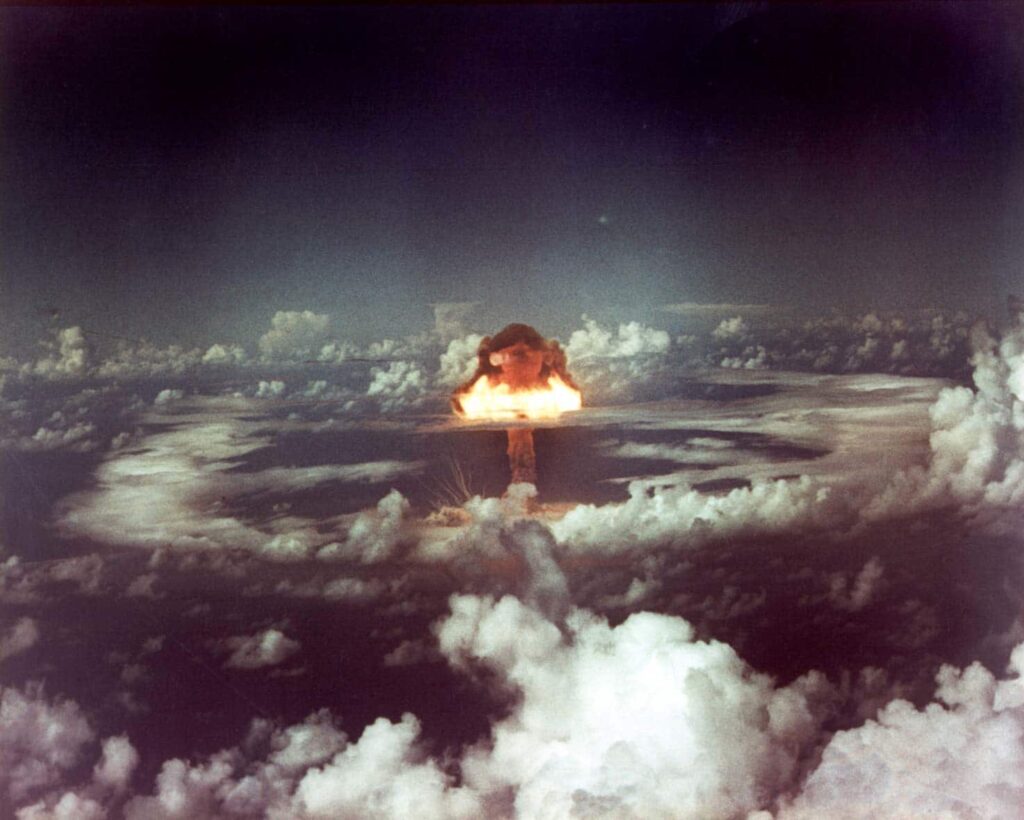
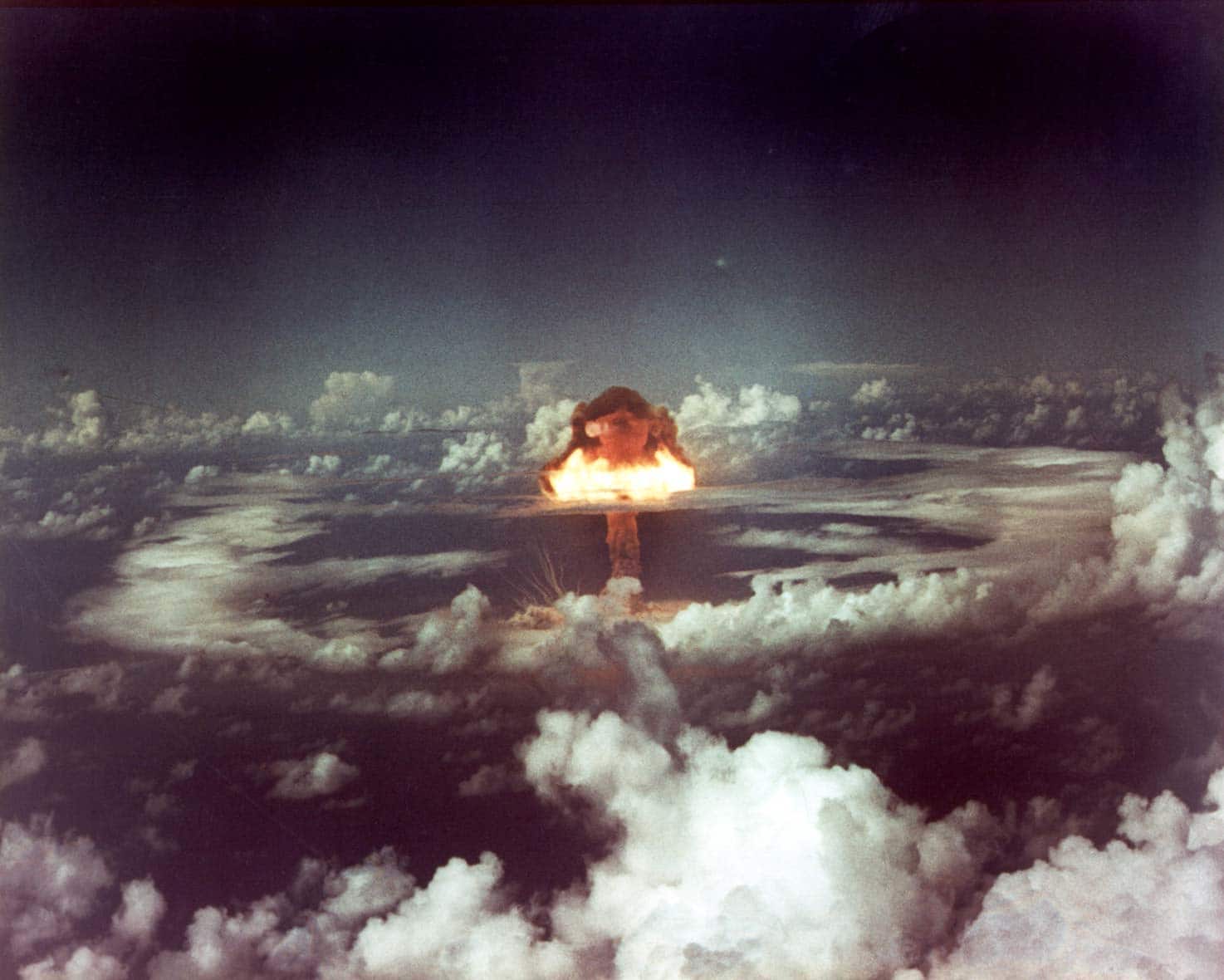
A nuclear device is detonated at Eniwetok Atoll in the Marshall Islands in 1952. Credit: US Government / CC BY NC 2.0
There are only nine countries in the world that have nuclear weapons. They are USA, Russia, France, China, the United Kingdom, India, Pakistan, North Korea, and Israel. The first two nuclear powers, the United States and Russia, have the vast majority of nuclear warheads.
This balance was created as an aftermath of the Cold War, when the Eastern and Western blocs threatened each other but never came to a direct confrontation, precisely because of the balance between the number of warheads held by the two sides.
It should be noted that mutual danger is the point of nuclear weapons’ utility. As the inventor of the atomic bomb, J. Robert Oppenheimer, said, “We may be compared to two scorpions in a bottle, each capable of killing the other, but only at the risk of its own life.”
What distinguishes nuclear weapons?
Nuclear weapons are not all the same, but they differ greatly in their destructive capabilities. The so-called “tactical” nuclear weapons are designed to be used on the battlefield, and then there are the “strategic” ones, which are much more powerful and are designed to be used exclusively as a deterrent.
This is a rough distinction between tactical and strategic weapons, but it is still used in textbooks and by experts today. It is the demarcation point between the two possible ways of understanding and using these weapons.
Apart from Russia and the United States, which kept their nuclear arsenals virtually unchanged after the Cold War arms race, China is the only country rapidly increasing the number of warheads.
Between January 2023 and January 2024, Beijing went from having about 400 nuclear warheads to having 500. At this rate, China could catch up with Russia and the United States in just a few short years.
How much did the nuclear powers spend by 2023?
According to a study by SIPRI, the Stockholm International Peace Research Institute, in 2023 alone, China, France, India, Israel, North Korea, Pakistan, Russia, the United Kingdom, and the United States spent a total of $91.4 billion on their nuclear weapons, $173,884 per minute, or $2,898 per second.
The United States’ share of total spending, $51.5 billion, is larger than all other nuclear-armed countries combined and accounts for 80 percent of the increase in nuclear weapons spending by 2023.
China ranks second with $11.8 billion, while Russia ranks third with $8.3 billion. Spending by the United Kingdom increased significantly for the second consecutive year, rising 17 percent to $8.1 billion.
$387 billion in 5 years
In the last five years, $387 billion has been spent on nuclear weapons, with the yearly spending increasing by 34% from $68.2 billion to $91.4 billion per year, as all nine nuclear-armed states continue to modernize and, in some cases expand, their arsenals.
“The acceleration of spending on these inhumane and destructive weapons over the past five years is not improving global security but posing a global threat,” said Alicia Sanders, co-author of the report.
The question of Iran
Israel has justified its recent attacks on Iranian targets by saying that Tehran is too close to developing a nuclear bomb. Such a development would undoubtedly pose an existential threat to Israel, as the Iranian regime has repeatedly declared its intention to destroy Israel.
While Tehran insists its nuclear program serves only civilian purposes, many members of the international community see military potential in it.
There are two types of nuclear programs: Civilian and military. Civilian programs are focused solely on nuclear power plants to generate electricity, while military programs aim to build nuclear warheads — in other words, atomic bombs.
Although the Iranian regime has consistently claimed its nuclear program is exclusively civilian, Tehran’s uranium enrichment levels may be cause for concern. According to the International Atomic Energy Agency (IAEA), Iran has accumulated more than 400 kilograms (881 pounds) of uranium enriched to 60 percent. That level of enrichment far exceeds what is needed for civilian energy production and is close to weapons-grade material.
At 90 percent enrichment, those 400 kilograms would be weapons-grade, enough for approximately 10 nuclear warheads.