
Note: This text was first published on March 1, 2022.
Half of the alarm clocks in Bosnia and Herzegovina get a little break every March 1, celebrating Independence Day, and part of them ring like every other day, waking up the owners for business.
For example, Ivana Marić, a political analyst from Sarajevo, did not have to go to work this morning.
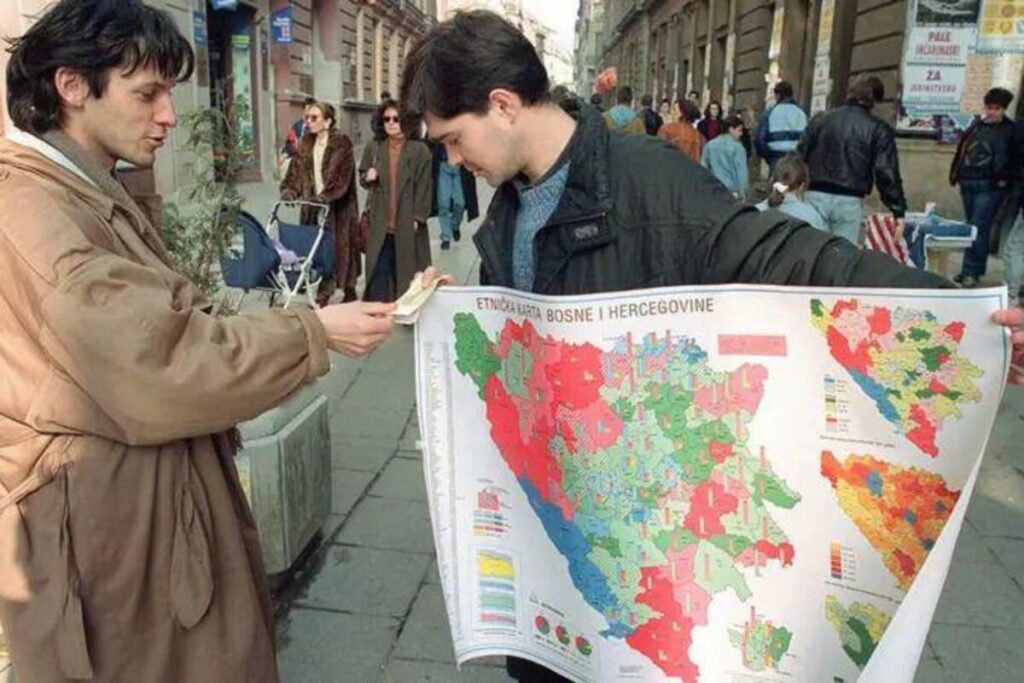
“I went to the referendum with joy on March 1, 1992 and voted for the independence of Bosnia and Herzegovina,” Marić told the BBC in Serbian.
In the same country, only 180 kilometers away, in the town of Mrkonjić, lives Zdravko Milić, an electrical engineer.
“It’s a working day here… People don’t like to remember the referendum here, they don’t remember it and it’s not a holiday for us,” he adds.
In 1992, a referendum was held in Bosnia and Herzegovina on secession from the Socialist Federal Republic of Yugoslavia (SFRY), which was viewed differently in the two entities that make up today’s BiH.
It is celebrated as a national holiday in the Federation, but not in the Republika Srpska, so the issue of the referendum is only one in a series about which disputes and conflicts still exist in Bosnia and Herzegovina today.
“This stumbling block exists because of two different views,” Borislav Đurić, a peace activist from Mrkonjić Grad, who lives in Banja Luka and has been dealing with the conflict in Yugoslavia and the issue of reconciliation for years, tells BBC Serbian.
“For the Serbs, it will never be a holiday because they were outvoted during the announcement, which abolished their constitutional right, and the Bosniaks celebrate it above all because of the acquisition of independence and legitimacy given to it by the international community,” he adds.
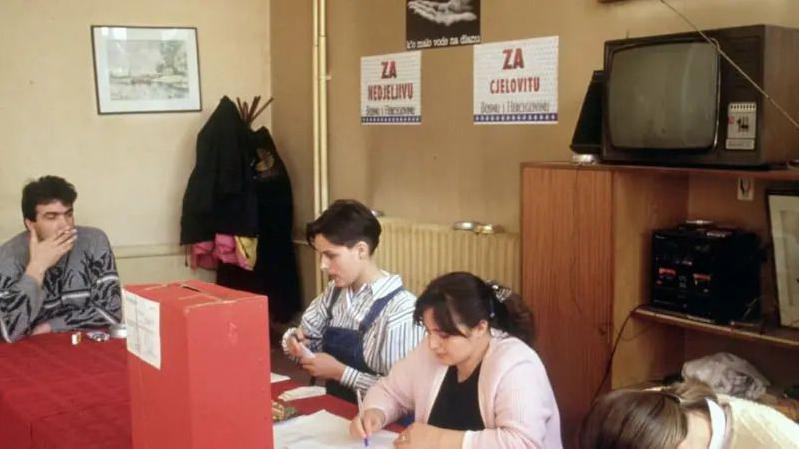
In 1992, Bosniak and Croat representatives invited people to vote, while Serbs boycotted the referendum, and in the end, slightly more than 63 percent of people went to the polls.
“Are you in favor of a sovereign and independent Bosnia and Herzegovina, a state of equal citizens, of the people of Bosnia and Herzegovina – Muslims, Serbs, Croats and members of other nations who live in it”, read the referendum question.
99,7 percent of people answered in the affirmative, and Bosnia and Herzegovina was soon declared independent.
However, the war has already begun.
Introduction to the referendum
In the days immediately before the vote, the seams on the blue-white-red flag with a five-pointed star had long since broken and two large sections were missing.
During the summer of 1991, Slovenia and Croatia declared independence – the war in Slovenia ended after ten days, but that’s why it raged in Croatia.
Many feared that the conflict would be transferred to multi-ethnic Bosnia, where the first parliamentary elections were held a year earlier and where the tension was growing.
In the 1990 elections, three parties with a national character won the most votes – the Party of Democratic Action (SDA) of Alija Izetbegović, the Serbian Democratic Party (SDS) of Radovan Karadžić and the Croatian Democratic Union (HDZ) of Stjepan Kljuić.
Ivana Marić, an analyst from Sarajevo, states that it was a period “when everyone said they would vote for reformists, they were positive, moderate and no one was in favor of national options”.
“A good time, but a period of deception, when we thought that everyone wanted us to continue living together, when in fact they were obviously hiding their true attitudes,” he says.
Ante Marković, the last Prime Minister of the SFRY, was the founder and first president of the reformists – the Alliance of Reform Forces of Yugoslavia, which fought for the preservation and attempted democratic transition of Yugoslavia.
However, they did not achieve a significant impact in the republican elections, and they achieved the best results precisely in Bosnia and Herzegovina and Macedonia.
At the end of 1991, the situation in Bosnia also got complicated.
In October, the representatives of the Croat and Bosniak communities in Bosnia and Herzegovina adopted the “Act on the Reaffirmation of the Sovereignty of the Republic of Bosnia and Herzegovina”.
Thus, it was decided that the representatives of Bosnia and Herzegovina would withdraw from the work of the federal organs of Yugoslavia, until an agreement was reached between the republics that make up the reduced SFRY – without Croatia and Slovenia – to which the representatives of the Serbs did not agree.
Instead, in November, SDS established Serbian Autonomous Regions (SAO), independent of the central government in Sarajevo, and then organized its own referendum.
At it, it was voted that the Serbs in BiH should establish a republic, but the Government in Sarajevo considered that referendum unconstitutional and invalid.
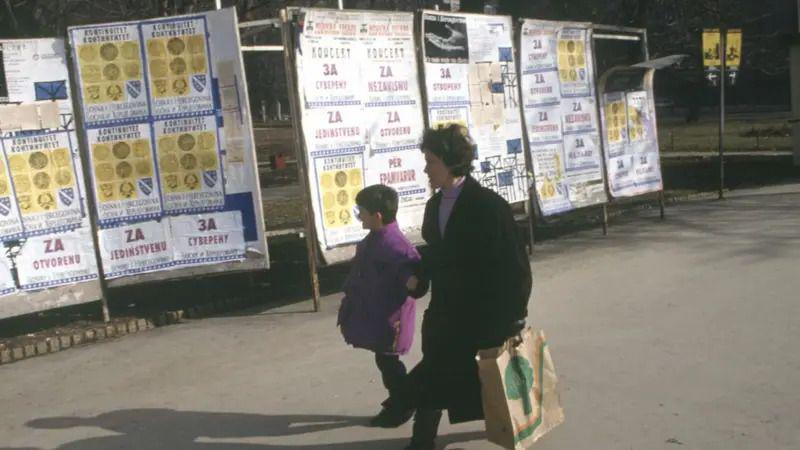
Nevertheless, on January 9, 1992, Serbs from Bosnia proclaimed the Republic of Srpska, and on January 25, the BiH Assembly, in a long and stormy session, announced a referendum on independence.
The statement was supported by SDA and HDZ, but not by SDS representatives, who left the session.
Getty Images
“Serbs in Bosnia continue to deny its legitimacy, stating that it is against the former Constitution of Bosnia and Herzegovina from the period of Yugoslavia,” says Đurić.
“It was announced against the will of the Serbian people, and the Constitution of Bosnia and Herzegovina, as well as the postulates of AVNOJ and ZAVNOBiH, say that no decision can be made without all three entities and that there is no override,” he adds.
Anti-Fascist Council of People’s Liberation of Yugoslavia, i.e. AVNOJ was a political organization of national liberation committees during World War II.
National Anti-Fascist Council of People’s Liberation of Bosnia and Herzegovina, i.e. ZAVNOBiH was the highest representative and legislative body of Bosnia and Herzegovina in Yugoslavia.
During the first session of ZAVNOBiH, in November 1943 in Mrkonjić Grad, a resolution was passed stating that Bosnia and Herzegovina “is neither Serbian, nor Croatian, nor Muslim, but Serbian, Muslim and Croatian” and that “full equality will be ensured” and the equality of all Serbs, Muslims and Croats”.
Đurić calls it a “civilizational asset that found a compromise within three nations, and on whose destruction all three parties worked”.
“But the position of Bosniaks and Croats from Bosnia is also reasonable, because Slovenia and Croatia had already declared independence at that moment, so they didn’t want to stay in SFRY either,” says Đurić.
The holding of the referendum was announced for February 29 and March 1, 1992.
And the tensions were getting higher and higher.
Remembering the referendum
“Una has never divided nations,” it says on a large banner in Bihać above the river, while another on a flag adds: “For an independent and indivisible Bosnia and Herzegovina.”
When the day of the referendum came, Bosnia was divided.
“The turnout in Croat and Muslim settlements is maximum, while not a single voter was recorded at polling stations with an absolute Serb majority,” says journalist Tomislav Dretar in a television report from Bihać.
As he says, 17 percent of voters in Bihać voted by 70 p.m., which indicates that the referendum will be successful.
“I don’t remember much from the referendum, to tell you the truth, I want to forget, because these are traumatic things for me,” says Jasenko Karamehić from Sarajevo, an immunologist.
“I’m sorry that the former Yugoslavia fell apart… I support Partizan, I don’t divide anyone by this or that, it doesn’t matter to me,” he adds.
As he states, he voted for independence in the referendum, because “the country had to fall apart”.
“I remember that the population of Bosnia and Herzegovina mourned for Yugoslavia, if anyone was for Yugoslavia, it was us,” Karamehić believes, adding that his father was a JNA officer.
“But there were also Serbian and Croatian nationalism, and everything later broke through the backs of the weakest and those who were the most Yugoslav – through Bosnia.”
Marić recalls that the atmosphere in the city at that time “was still good”.
“We thought that by voting for independence, we were ensuring a better, safer future and a normal life,” he says.
“We saw how Slovenia moved on, and I hoped that it would be the same for us – that we would be free to do what we want in every respect,” she added.
Aida Feraget, also from Sarajevo, when the referendum is mentioned, the first thing that comes to mind is “how naive we were”.
“I understood him as a guarantor of maintaining the way of life and values that were valid in Yugoslavia, even though Slovenia and Croatia were already seceding,” says 53-year-old Feraget.
“So, keep Bosnia as it was, with all the values of coexistence and neighborhood, which has nothing to do with nation and religion.”
She also voted for independence because “Yugoslavia without Croatia and Slovenia is not Yugoslavia”.
“I was absolutely convinced of the right decision and believed that it would prevent war,” she says.
“And even when they started shelling and shooting at me, I was convinced that the war would last seven days and that anything more than that was impossible,” she adds.
Getty Images
For Zdravko Milić from Mrkonjić Grad, March 1 was nothing special.
“I was working, I was at work… We boycotted, as if there was no referendum,” says the 61-year-old Milić.
As he states, the goal of the referendum was the secession of Bosnia and Herzegovina from Yugoslavia.
“We considered Yugoslavia to be our country, our mother, and they held a referendum to separate us from our mother,” he believes.
“We had our country and they are taking us out of it and making us a minority – there was no way we could agree with that.”
That is why, he says, he does not accept BiH Statehood Day, which to him is a “sad, not a joyful day”.
“I practically forgot about it, if you hadn’t reminded me, I wouldn’t have remembered,” he points out.
After the referendum
On April 6, 1992, based on the outcome of the referendum, the European Community recognized the Republic of Bosnia and Herzegovina as an independent and sovereign state.
However, there were already the first conflicts then.
On the second day of the referendum – March 1, 1992 – in Sarajevo, a wedding guest was killed at a Serbian wedding in the center of Sarajevo.
A man named Ramiz Delalić shot at a wedding procession in Baščaršija and killed the groom’s father, which the Serbs consider the beginning of the war in Bosnia and Herzegovina.
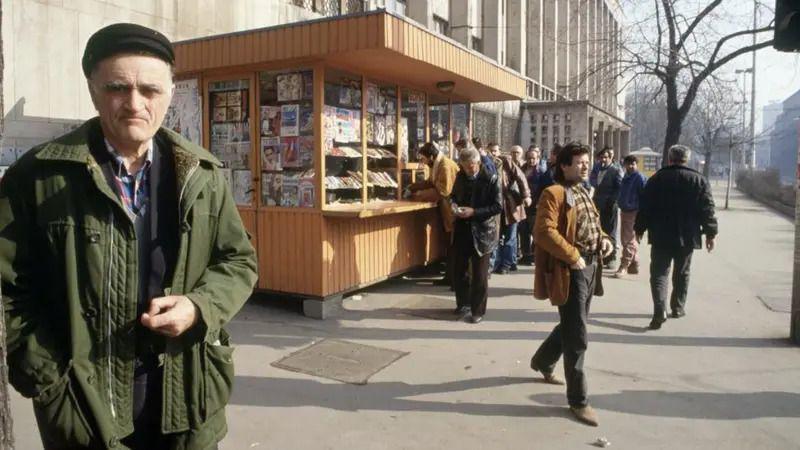
Soon, barricades were erected in Sarajevo, where there were also victims.
The barricades were temporarily removed on March 5 and the next period in Sarajevo will be marked by numerous anti-war protests.
At that time, the Yugoslav People’s Army had already blocked the city, which would be under siege until 1995 – by then more than 10.000 people would have died in Sarajevo.
At one of the protests, Suada Dilberović and Olga Sučić, whom Bosniaks consider to be the first victims of the war, were killed.
Did the referendum contribute to the start of the war?
“It contributed to aggression in the same way that a miniskirt contributes to rape – not at all,” says Marić.
“There was no way to influence those who wanted to implement the plans by force, so there would probably be a war regardless of the outcome of the referendum,” he points out.
Even Zdravko Milić does not believe that the referendum on independence caused the start of the war.
“Even if there was no referendum, those who planned everything would have found a way to go to war,” he says.
Getty Images
The conflict in Bosnia and Herzegovina ended with the Dayton Agreement in 1995, which divided the country into two entities – the Federation and the Republika Srpska.
Estimates are that during the war in Bosnia, around 100.000 people were killed and more than 2,2 million were displaced, making it the bloodiest conflict in Europe since the end of World War II.
Đurić believes it is sad that despite everything, “there was no consensus among people to say no to war.”
“So if it takes a hundred years to negotiate the future of Bosnia, but not to get into a position to go to war,” he says.
“And that war didn’t bring anything good to anyone except the dead, the displaced… Bosnia never healed those wounds again.”
Bosnia and Herzegovina today
Three decades later, the situation in Bosnia is still quite complicated.
Ivana Marić believes that the situation “politically and nationally” is significantly worse than in 1992.
“Then people were much more open, and today BiH is violently divided into three parts – there are three publics and different views on everything,” he says.
“The people in power brought in that propaganda and poisoned the public, although there are many more who think positively about this country.
“There is not as much hatred among ordinary people as the government would like,” he adds.
However, Milić from Mrkonjić Grad states that the situation in Bosnia will be difficult to improve.
“There is no reconciliation, the wounds are deep, it remains in the hearts and is passed on, regardless of the fact that the new generation is not a participant in those times,” Milić believes.
“Something terrible happened and in ten generations it will not be forgotten,” he adds.
During that time, some try to live a completely normal life.
“And the fact that political leaders screw up… That’s another matter,” says Karamehić.
Aida Feraget points out that the composition of people in her house in Sarajevo is the same as in 1991 – there are Serbs, Croats and Bosniaks.
“My entrance and those 15 apartments remained intact, but the entire land… Some evil grandfathers rode in, as Balašević says, and they’ve been riding the land for 30 years,” he says.
“It is they who are using the referendum to make money, and they cannot agree on whether something is a non-working day or not.
“They managed to make a political issue around the holiday, which is crazy.”
What does it take to change that?
Đurić briefly says that “there is no consensus necessary for Bosnia to move forward”.
“I’m afraid we’re in a vicious circle and I don’t see a way out of this situation,” he says.
BBC is in Serbian from now on and on YouTube, follow us HERE.
Follow us on Facebook, Twitter, Instagram, YouTube i Viber. If you have a topic suggestion for us, please contact bbcnasrpskom@bbc.co.uk


News