
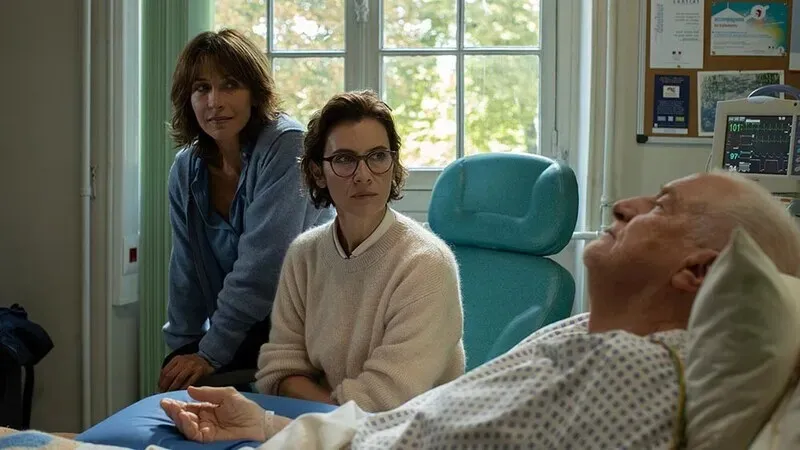
Still from the French film “Everything Went Fine” (2021). (courtesy the Coup Distribution)

By Kim Eun-hyoung, staff culture writer
Before the Lunar New Year holiday, I read a news article that weighed heavily on my heart and stayed with me throughout the long break. The story was of how Korean police stopped an airplane bound for Europe to talk down a man in his 60s who was en route to Switzerland to pursue assisted suicide.
The police eventually persuaded the man to return to his family in Korea. Every sentence of the article appalled me, and the way that the story was described as a rescue operation or as a moving story made my jaw drop.
I do not intend to bore anyone with the ever-so cliché argument that people have the right to determine how and when they die. Every sentence of that article elicited questions from me. So, the family reported him, their own father, to the police for taking a trip for assisted suicide? Were all his family members in the dark about his decision? Did they know, but chose to report him to the police to stop him? If the family truly did not know, why did the father hide such an important and formidable decision from his family? How did the police manage to persuade the man to stay in Korea?
Applying for assisted suicide in Switzerland is famously known to be a considerable process, one that cannot be driven by impulse. The man would have mulled over this for months and confirmed his decision several times, so how did the police manage to convince him to abandon that plan that he would’ve prepared so meticulously for? How was that compelling argument framed?
What conversations did the man and his family have after he returned? How will he be treated for his illness, which was so agonizing that he was ready to end his life voluntarily? Will he not regret his decision to come back home? Will the end of his life be happier without assisted suicide? Last, but not least, I could not help but wonder if he would be given back the likely thousands upon thousands of dollars he spent to go ahead with the procedure.
While mere spectators will never be privy to the sensitive specifics of the case, what details we do know clearly demonstrate how our society and health care system currently think about death. Why was this man unable to discuss his decision to go to Switzerland with his family? Why did he believe that the only option was to leave everything behind, with only a note to explain his decision to his family?
As described in Nam Yu-ha’s “I Wish Today Was Tomorrow,” a collection of essays depicting her mother’s assisted suicide journey, getting one’s family on board with the decision to end one’s own life is not an easy process. Assisted suicide and euthanasia are illegal in Korea and remain somewhat socially taboo. However, specific ways and options for how one might approach ending one’s life are, for the most part, uncharted territory.
Should chronically ill patients continue with grueling treatment, hoping for miracles? Should they pursue life-sustaining treatment knowing that they will inevitably pass, but hoping that they will not leave any regrets? Or should they just give up? The question of how a person is allowed to die is so often left up to their doctors and guardians, without any consideration for the opinion of the person who is suffering.
Guardians mostly opt for whatever will soothe their conscience, while medical staff seek to minimize legal liability as much as possible. What links the patient and their guardian in the interlude between this decision and death is silence, pregnant with meaning that longs to be expressed, but rarely is.
Dr. Park Kawng-woo, a specialist who has treated many patients with terminal cancer, writes of the importance of a cancer counselor system in his book “Studying Death.” This system, implemented in the US, a country infamous for its exorbitant medical fees, aims to reduce any unnecessary medical expenditures and to determine reasonable treatment for individual patients. Not only does this system’s manual mandate detailed documentation of the patient’s condition and provide available treatment options or level of life-sustaining care, but takes note of the patient’s daily living activities, their occupation, educational background, assets, their guardian’s disposable assets and occupation, the number of guardians, and even the emotional relationship between the patient and their guardians.
With this data in hand, the counselor can suggest various and specific treatment methods. An abundance of information is needed for the patient and guardian to understand the situation they are in from various viewpoints, which will provide them with various discussion points to deliberate over. This enables them to have many more conversations about the time the patient has remaining and the inevitability of their death. Through this method, it is possible to avoid a tragic situation in which death becomes something one has to come to terms with in a matter of seconds, despite having been in pain for many years.
Legislation to legalize assisted dying has been in the works for years in South Korea, but to no avail. If we continue to approach this issue as one that someone can either be “for” or “against,” instead of expanding the breadth of information needed to understand and accept death and seeking wider institutional support, we will see more incidents like this tragicomedy in which a plane is halted on the tarmac and an individual decides to reverse their decision to travel to Switzerland.
Please direct questions or comments to [english@hani.co.kr]