
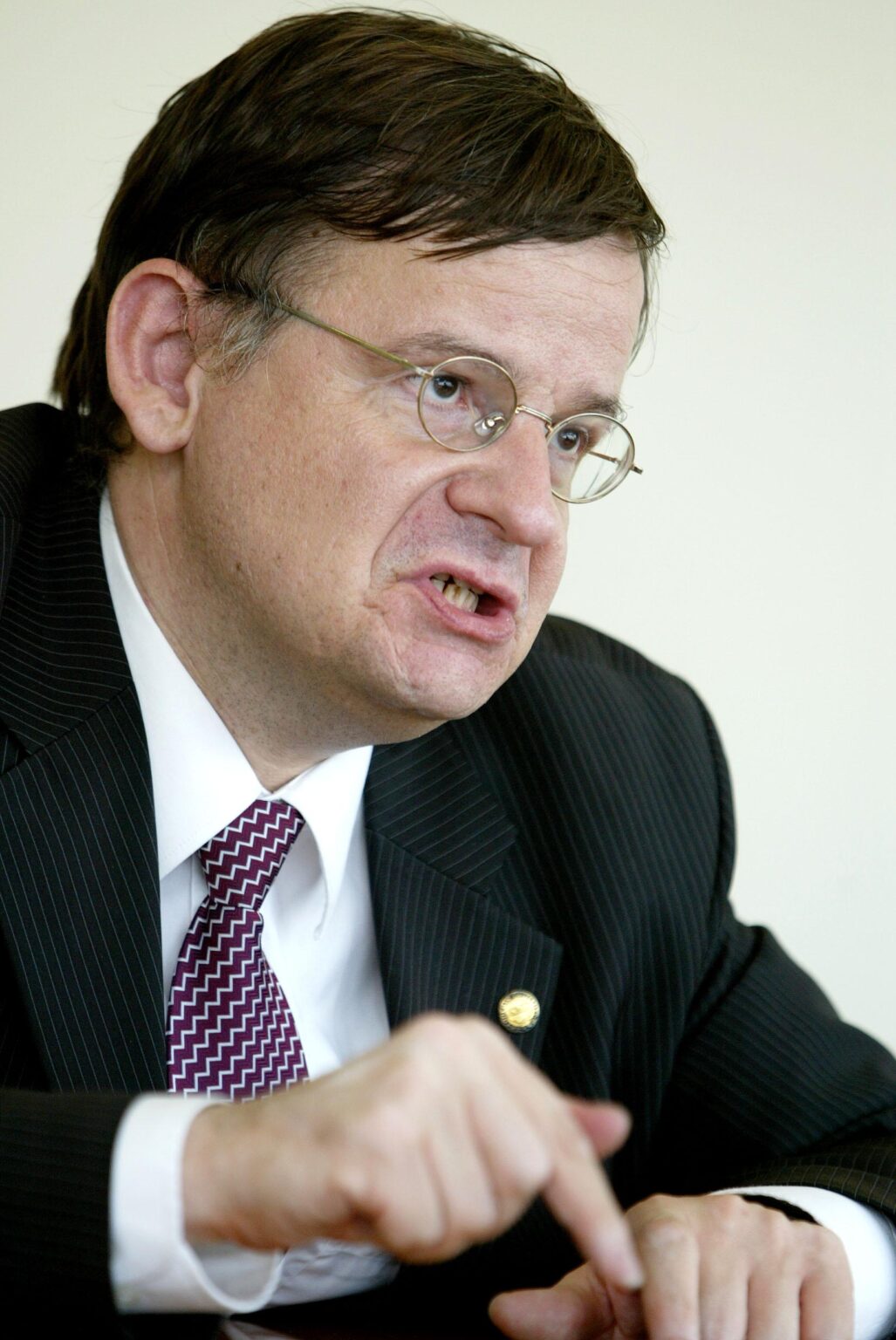
North Korea expert Andrei Lankov / Korea Times file
News that broke last week involving renowned North Korea expert Andrei Lankov has rattled the foreign community in South Korea. The Russian-born scholar was unexpectedly blacklisted by Latvian authorities during a recent trip to the Baltic state.
Lankov, a professor at Kookmin University in Seoul and director of Korea Risk Group, the parent company of NK News, was detained by local police and immigration officers shortly before he was to give a lecture, titled “North Korea: What the Leaders Want and Fear,” in Riga, the Latvian capital. Latvian immigration authorities later deported him to Estonia.
Several Russian media outlets first reported the incident. Korean and English-language news sites subsequently covered the story, citing those reports. The news came as a surprise to many.
Born in Russia, Lankov is a dual citizen of Russia and Australia and is widely regarded as one of the leading North Korea experts, with rare first-hand experience in both Koreas. Before settling in South Korea in 2004 to teach at Kookmin University, he studied at North Korea’s elite Kim Il Sung University in 1985 and later earned a graduate degree in international relations from Leningrad State University. He has long been a frequent, trusted source for Korean and Western media.
A former intelligence official who handled counter-intelligence at South Korea’s National Intelligence Service (NIS) for decades until retiring in the mid-2010s described Lankov’s treatment as “uncommon.”
“For Latvian authorities, arresting an internationally known foreign scholar would not have been an easy decision, given the potential diplomatic fallout,” the former official said on condition of anonymity. “If South Korean security authorities were to arrest a foreigner — say, an American — we would typically consult the U.S. Embassy beforehand because the stakes for bilateral relations are high. The pressure would be even greater when dealing with a figure as influential as Lankov.”
Given the sensitivity of the case, the former NIS official said he believes Latvian authorities were likely tipped off by trusted sources, such as foreign intelligence agencies, or possessed evidence sufficient to view Lankov’s presence as a serious security concern.
Lankov himself attempted to downplay the political implications of the deportation, suggesting Latvian officials had overreacted.
“Their nervousness is somewhat understandable given the current tense circumstances, but what happened to me was nonetheless rather comical,” he told The Korea Times via text message on Feb. 26. He added that he went on to complete his lecture in Estonia and planned to continue his European lecture tour in Portugal.
Latvia, a Baltic country with a population of roughly 1.9 million, borders Russia to the east and Belarus to the south. Russia’s ongoing four-year invasion of Ukraine has intensified security concerns there, prompting heightened security alert levels similar to those seen across much of Europe.
Lankov’s deportation quickly became a topic of discussion in South Korea, with speculation mounting over what may have prompted Latvian authorities to blacklist him.
Chris Monday, a Russia expert and economics professor at Dongseo University in Busan, speculated that Lankov’s connections to Russia may have played a role.
“Lankov has a well-known Russian-language YouTube channel. He may have said something Ukrainians didn’t like,” Monday said. “He’s not especially guarded in expressing his opinions, which is part of why people find him compelling.”
Monday also pointed to Latvia’s stringent counter-intelligence posture. “Latvia is known for enforcing ideological boundaries quite strictly. Even some Russian opposition websites have been shut down for not being sufficiently anti-war,” he said.
Han Seong-jin, a former South Korean ambassador to Latvia, said Lankov’s ethnic background alone would not be a convincing explanation for his treatment.
“Latvia’s relationship with Russia has parallels South Korea’s relationship with Japan,” Han said. “Just as Korea was once colonized by Japan, Latvia was part of the Soviet Union until the early 1990s. It’s natural that historical animosity toward Russia persists.”
However, Han dismissed speculation that Lankov was targeted simply because of his heritage.
“The sense of insecurity in Latvia amid Russia’s invasion of Ukraine is far greater than what Koreans generally feel,” he said. “But it would be overly simplistic to attribute this case solely to Lankov’s ethnic background, especially considering that ethnic Russians and Russian-descended residents make up roughly 20 to 24 percent of Latvia’s population.”
Emphasizing Latvia’s adherence to legal procedures, Han said he believes the deportation was likely based on concrete grounds.
Latvia’s foreign ministry confirmed that Lankov was blacklisted under existing law.
“Based on information available to national security authorities, Latvia’s foreign minister has decided, in accordance with Section 61 of the Immigration Law, to include Russian citizen Andrei Lankov on the list of persona non grata in the Republic of Latvia,” Solvita Martinsone, head of the ministry’s communications group, said in an email response to The Korea Times.
She added that Lankov has been permanently barred from entering the country.
Section 61 of Latvia’s Immigration Law outlines grounds for blacklisting foreign nationals, including ties to anti-state or criminal organizations or activities deemed to pose a threat to national security, public order or public safety.