

Autonomous taxi, London|Photo: Profimedia
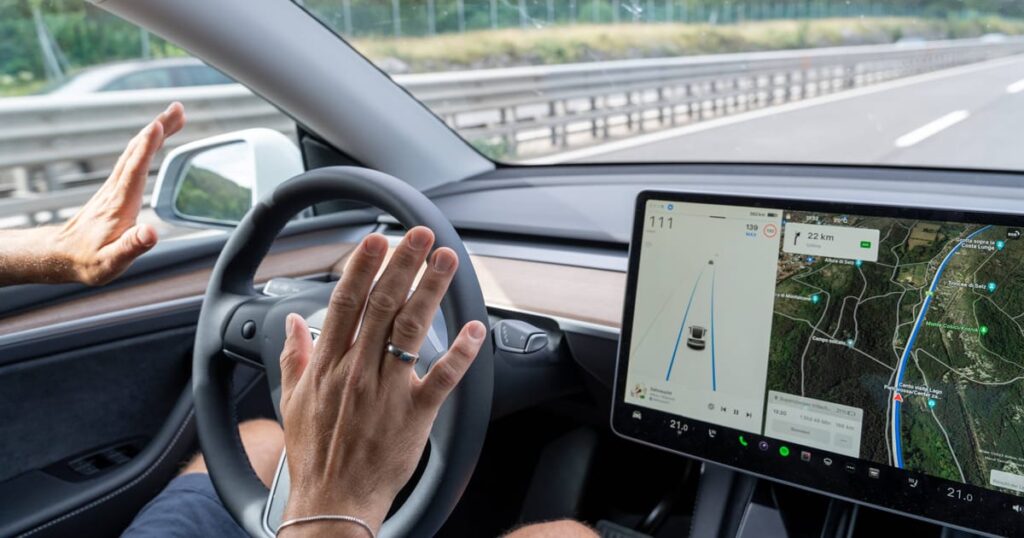
The Czech Republic currently operates under Level 3 of the international scale for autonomous driving. In practice this means that drivers who have the technical support required can drive in semi-autonomous mode only on selected stretches of the country’s motorways. All required vehicle systems must be fully operational.
The car itself recognizes the designated section and notifies the driver that autonomous mode is available. Weather conditions must also be favorable, particularly visibility — meaning no fog, heavy rain, or snowfall. If conditions change, the vehicle alerts the driver, who must immediately resume control.
For the present time, Lever 3, which was introduced at the beginning of this year, is used mainly by German vehicles passing through the country. The ministry does not currently register any fully self-driving cars operating in the Czech Republic.
Moving to more advanced levels — where no driver intervention is required — will depend on further technological and infrastructure development.
The Ministry of Transport is now working on enabling communication between autonomous vehicles, a fundamental prerequisite for completely driverless operation. This will require stable, high-speed data connectivity, to be ensured through expanded 5G network coverage which should be in place by 2030.
Transport Ministry spokesperson Alena Mühl says precision and coordination will be key to success.
“Part of the development also includes modernizing digital maps, ensuring they are up to date and connected with traffic and infrastructure data, so that a reliable and precise geographic database is available,” she told Czech Radio.

Zdeněk Lokaj|Photo: Michal Šafařík, Czech Radio
Experts will need to secure effective communication between vehicles, infrastructure, central systems, and 3D maps to help autonomous vehicles assess traffic situations. Zdeněk Lokaj of the Faculty of Transportation Sciences at the Czech Technical University explains that this involves minute details.
“The fully automated navigation system also involves identifying where a streetlight pole stands, the height of a curb, the location of overhead trolley wires, bus stops, and traffic signs. All of this allows the vehicle to navigate with great precision, which is essential for decision-making,”
Once these systems are in place, a vehicle can run driverless –which corresponds to Level 4 autonomy.
This will completely change the scene on the road. Traditional steering by a human will no longer be possible in fully autonomous vehicles. Driverless cars will operate independently only within designated areas; outside them, they will be remotely controlled. For instance, a truck may enter a motorway, complete its route, and then at the exit or near a logistics center, a remote operator will take over.

Autonomous vehicles|Photo: Shutterstock
In addition to trucks, remote operators may also control public transport vehicles or taxis. The ministry has not yet specified when Level 4 autonomy could come into effect in the Czech Republic or what the overcall cost of the project would be.