
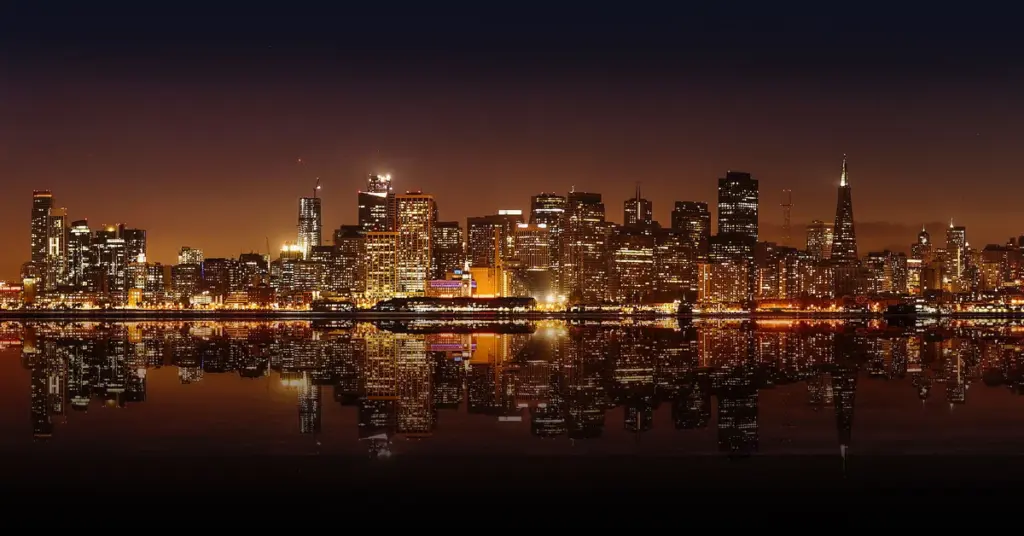
What do you see, when you look up at the night sky? I grew up in a larger Dutch city and thinking back to early childhood memories, I could just point out the North Star and the Big Dipper in a clear night sky, so seeing little stars was my ‘normal’. I knew there to be more visible stars in theory, but I did not consciously notice their absence. I was used to a few scattered stars in an overwhelming darkness dimly lit by the moon. For years to come, my view on the night sky remained unchanged. Until I learned more about light pollution.
Cities and roads being continuously lit at night with bright lights can prevent society from seeing the full night sky. This is referred to as light pollution, artificial lights leaking into the sky. It is estimated that 83% of the worlds’ population currently lives under light-polluted skies, and the Milky Way is hidden from one-third of humanity today (Falchi et al., 2016, p. 4). This pollution is not merely an aesthetic issue that prevents us from seeing stars, it has great consequences for the environment.
Light pollution is for example viewed as one of the leading factors in insect population decline, impacting biodiversity (Grubisic et al., 2018, p. 186). This places light pollution in broader discussions of the environmental humanities, namely the nature-culture divide within the Anthropocene. In this essay, I seek to utilize the case study of the effects of mainly Western nocturnal light pollution on non-human life as a means to explore scholarly viewpoints of the larger nature-culture divide. Through the academic methodology of close reading, I aim to theorize a more sustainable, posthumanist mode of collective thought and argue for a mutualistic relationship between humans and nature.
To do so, I will first explore the case study of nocturnal light pollution, describing its ecological significance to non-human species. Then, this essay will take a broader perspective towards human’s relationship to nature in the ongoing Anthropocene. Subsequently, I intend to historically situate this by illuminating society’s relationship to wilderness. I will conclude with my final argument for a mutualistic ecological worldview through posthumanism, where human life becomes intertwined with and equal to non-human life.
The effects of light pollution
Light pollution is a prevalent and growing issue in densely populated areas (O’Connell & White, 2024, p. 156). As seen in the following world map, industrialized countries are most severely affected. This includes The Netherlands, my home country, neighboring European countries, Japan and the US.
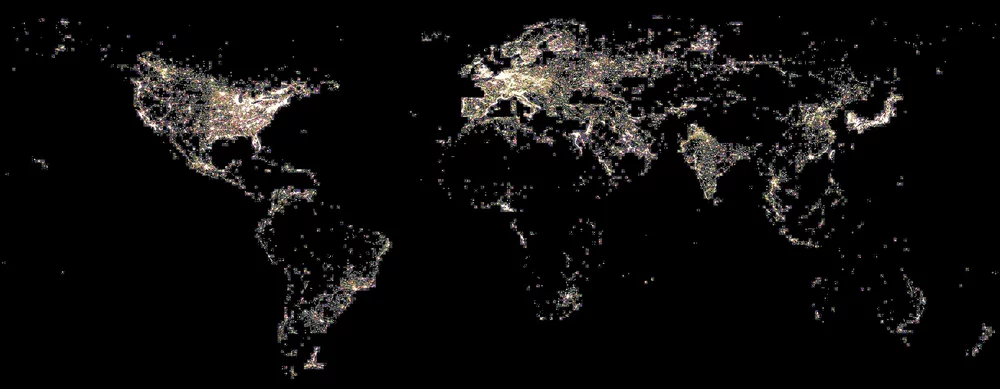
Figure 1. World map showing light pollution (Alves, 2010). Via Wikimedia Commons.
In nearly all locations, the most visible negative effect of light pollution is artificial skyglow, a hazy grey reflection in the night sky (Falchi et al., 2016, p. 1). Skyglow is what makes stars ‘disappear’, and can be measured using the 9-point The Bortle Dark-Sky Scale, which is based on nearly 50 years of observing experience (Bortle, 2001, p. 5). Though the scale and impact of light pollution is vast, experimental studies on the long-term effect of this issue are lacking (Grubisic et al., 2018, p. 183).
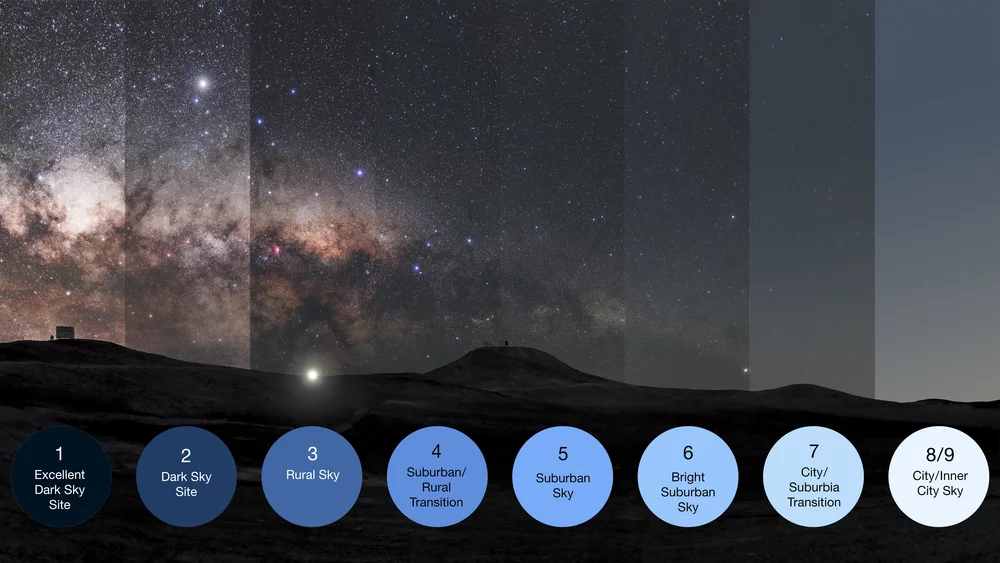
Figure 2. Visual representation of the Bortle Dark-Sky Scale, (Wallner, 2022). Via Wikimedia Commons.
This shortage of research might be attributed the lack of widespread awareness regarding the consequences of artificial light for other species, and in turn, our ecological futures (O’Connell & White, 2024, p. 163). For instance, significant impacts of light pollution are observed on non-human species as bats, birds, turtles, fishes and insects like moths (Rodrigo-Comino et al., 2021, p. 378). It interferes with predator-prey relationships, disorients migrating birds and newly hatched sea turtles and attracts insects to artificial lights, leading them to become easier prey to birds (see IUCN, 2024). Light pollution is even described to be such a substantial causal factor in insect population decline, that scientists refer to it as a part of the ongoing ‘Ecological Armageddon’ (Carrington, 2017) alongside factors as pesticide use, habitat fragmentation and climate change (Grubisic et al., 2018, p. 186).
Wilderness in the Anthropocene
The unprecedented shift in the night-time environment is concurrent with urbanization, escalating in the mid to late 20th century (Davies & Smyth, 2017, p. 878). This situates the issue of light pollution within a broader discussion in the environmental humanities: the Anthropocene. Kyle Powys Whyte views the Anthropocene as the geological time period “when the collective actions of humans began influencing earth systems in marked, unprecedented ways” (2017, p. 207). Environmental markers suggest the said time period began around 1610 with “the irreversible cross-ocean movement of species of the Colombian Exchange that caused a near-permanent change to Earth”. 1964 is also mentioned as a significant moment because of a peak in nuclear fallout particles in the environment (Lewis & Maslin, 2015b, pp. 128, 144).
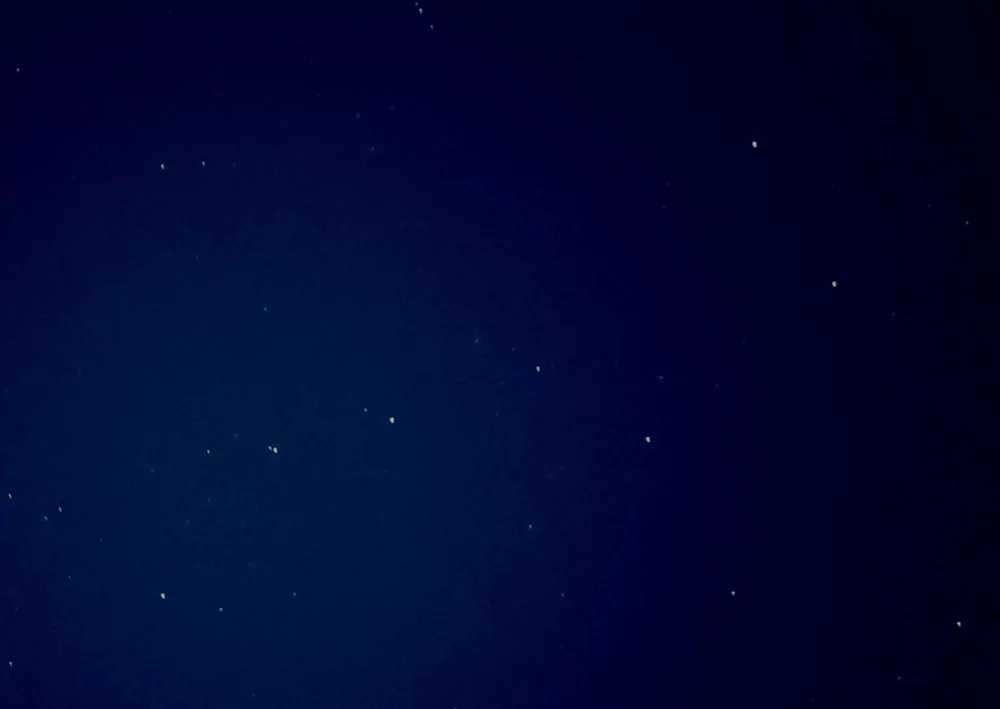
Figure 3. The Big Dipper, as seen from my city garden, Bortle Scale point 7. Image by author.
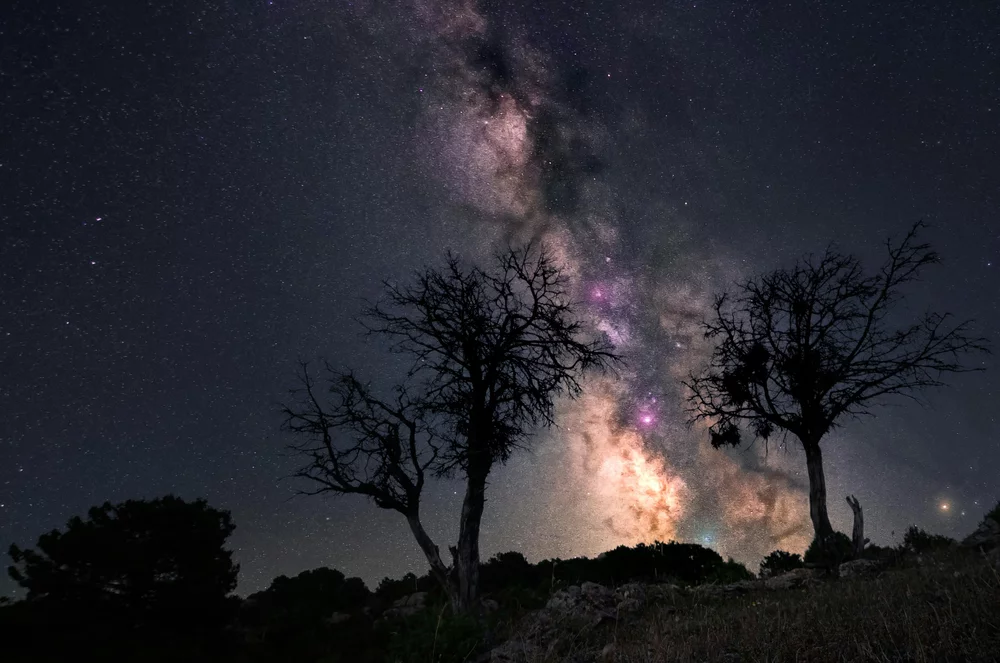
Figure 4. A rural night sky, Bortle Scale point 2, (De Roa, 2024). Via Pexels.
It could thus be argued that global environmental change was spurred by colonialism, global trade and capitalism, showing how unequal power relations have shaped the Earth (Lewis & Maslin, 2015a, p. 177). This inequality is reflected in the view of the relationship between humans and nature. Historically, humans, especially those in power, have separated themselves more and more from the non-human world. This raised a dualism between man and nature, setting ‘wilderness’ and humans at mutually exclusive, opposite poles (Cronon, 1996, p. 17).
“In virtually all of its manifestations, wilderness represents a flight from history. Seen as the original garden, it is a place outside of time, from which human beings had to be ejected before the fallen world of history could properly begin” (Cronon, 1996, p. 17).
For centuries, humans have viewed wilderness as a ‘sacred sublime’, “a savage world at the dawn of civilization, whose transformation represents the very beginning of the national historical epic” (Cronon, 1996, p. 16). American historian William Cronon (1996, p. 17) describes how the concept of wilderness is seen as the polar opposite to humans. If true nature is wild, then human presence in nature represents its downfall. “The place where we are is the place where nature is not” (Cronon, 1996, p. 17). This ‘traditional’ and pessimistic viewpoint cannot offer us any solution to environmental issues. In maintaining a dangerous dualism, setting humans apart from nature, the concept of ‘wilderness’ poses a serious threat to sustainable environmentalism (Cronon 1996, p. 17).
Posthumanism: an interconnected worldview through mutualism
Instead, Cronon argues for the exploration of a middle ground in human’s relationship with nature. “We need to embrace the full continuum of a natural landscape that is also cultural, in which the city, the suburb, the pastoral, and the wild each has its proper place, which we permit ourselves to celebrate without needlessly denigrating the others” (Cronon, 1996, p. 24). The ‘middle ground’ is where people actually live, it is where everyone makes their home (Cronon, 1996, p. 21). This is the place to take responsibility and to think sustainably for future generations (Cronon, 1996, p. 24).
“We exist in a material net in which everything is actually connected and potentially intra-acting” (Ferrando, 2014, p. 168).
Summarizing Cronon, we need to view ourselves within ‘wilderness’ and live in a middle ground with nature. He argues against the concept of dualism, a divide between humans and nature that supports practices of ecological destruction and devastates cultures (Alhinai & Milstein, 2019, p. 1080). Opposed to dualism, is mutualism, a viewpoint that “emphasizes [the] sacredness of the Earth and interrelatedness of all human and non-human life forms” (Alhinai & Milstein, 2019, p. 1080). Through this interrelatedness, mutualism aligns well with the theoretical and empirical framework of posthumanism.
In posthumanism, there is no definitive ‘otherness’. This concept fights histories of problematic features caused by humanist thinking, such as human exceptionalism, the mind-body dualism, the nature-culture divide and the erasure of faith for rationality (Daigle & Hayler, 2023, p. 2).
“Posthumanism will add to your perspective as much as your perspective will add to the posthuman shift. More than an exchange … , it is an intra-change, a fluid entanglement of being, an expansion of material awareness, a fractal movement of energy” (Ferrando, 2014, p. 171).
The call for posthumanism grew in the 1970s, born out of feminism (Ferrando, 2014, p. 169). At that time, it urgently needed to be proven that no human is ‘other’. Individuals who were societally left out based on gender, sexuality and skin tone, were called to be recognized. Moreover, this societal need gave life to the movement of ecofeminism, wherein social and ecological inequalities are viewed as interconnected failings of modern culture, in critical need of rethinking (Plumwood, 2004, p. 44). These original thoughts behind posthumanism can, and arguably should, be extended to the non-human world in the Anthropocene.
How to care for the non-human?
To tackle impactful environmental issues like nocturnal light pollution, we need to collectively change our mindset, dissolving the present nature-culture divide. We need to care for ‘the other’, for the non-human. For the moths who are attracted to street lights and become prey. For the birds whose migration patterns become disrupted. Even for the stars, mostly hidden to us all. To do so, a societal shift in thought should take place towards posthumanist mutualism. Where nature is not viewed as sublime wilderness, distant from us humans, but equal to us. This way of living and thinking might be the only sustainable way forward within the Anthropocene.
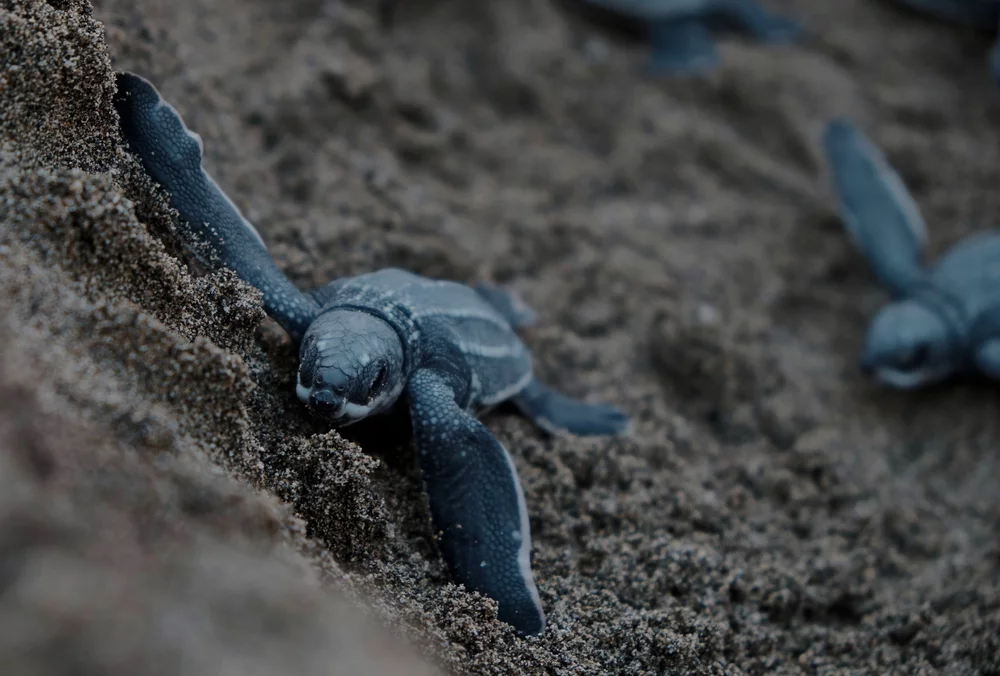
Figure 5. Hatched turtles can be distracted by artificial light in search of the sea, (Diaz, 2020). Via Pexels.
So what steps can individuals take? First and foremost, educate oneself and share knowledge about environmental issues like light pollution. Reach as many others as possible with the message of posthumanistic mutualism, working towards a worldview without a nature-culture divide; an interrelated way of life. Collectively, we can inspire change. This ultimately might lead to a shift in action. Accessible examples are the use of shielded street light, motion sensors and turning lights off in offices at nighttime (see Nacht van de Nacht, 2016). These localized actions can inspire governments and institutions to form new policies to include non-human life, treating other species as equal to our own.
Concluding thoughts
Growing up in the city, it was normal for me to see very few stars at night. Much later I learned that this is an abnormality caused by nocturnal light pollution, artificial light leaking into the night sky, affecting around 83% of the worlds’ population at present. This ‘Ecological Armageddon’ of light pollution has grave implications on non-human life forms, for example causing insect population decline. This issue was caused by humans in the Anthropocene, the time period when collective human actions began to mark the Earth in a unprecedented manner. Society then placed itself outside of the sacred sublime of ‘wilderness’, creating a nature-culture dualism.
Despite the vast scale of the issue of light pollution, long-term research and widespread knowledge is lacking. I would therefore like to call on all readers to spread awareness about light pollution and related environmental issues that impact communities today, contemplating the need and use of artificial light sources, one at a time; low intensity amber or red light for instance is already an improvement from cool bright white and blue. (see Nacht van de Nacht, n.d.) It is essential that as many individuals as possible work together for our connection to nature, fighting historic injustices and bringing equality to ‘the other’. By taking collective action, society can work towards the transformation of the Anthropocene, into a posthumanist era where humans and nature collaborate to build homes in an entangled web of sacred mutualism. We could then create a sustainable world where environmental and animal rights become equal to human ones. This shift in thought may ultimately lead to a shift in action. So we might finally see the sky again.
References
Alhinai, M., & Milstein, T. (2019). From kin to commodity: ecocultural relations in transition in Oman. Local Environment, 24(12). https://doi.org/10.1080/13549839.2019.1672635
Alves, D. (2010, August 21). File:Human presence, light pollution.jpg – Wikimedia Commons. https://commons.wikimedia.org/wiki/File:Human_presence,_light_pollution.jpg#filelinks
Bortle, J. E. (2001). The Bortle Dark-Sky scale. Sky And Telescope, 161(121), 5–6. https://macastro.org.au/wp-content/uploads/2020/08/Article-G-Anon-Unattributed-The-Bortle-Dark-Sky-Scale-Macarthur-Astronomical-Society.pdf
Carrington, D. (2017, October 18). Warning of “ecological Armageddon” after dramatic plunge in insect numbers. The Guardian. https://www.theguardian.com/environment/2017/oct/18/warning-of-ecological-armageddon-after-dramatic-plunge-in-insect-numbers
Cronon, W. (1996). The Trouble with Wilderness: Or, Getting Back to the Wrong Nature. Environmental History, 1(1), 7–28. https://doi.org/10.2307/3985059
Daigle, C., & Hayler, M. (2023). Introduction: Theory into praxis. In Posthumanism in Practice (pp. 1–13). London: Bloomsbury Academic. https://doi.org/10.5040/9781350293830.0005
Davies, T. W., & Smyth, T. (2017). Why artificial light at night should be a focus for global change research in the 21st century. Global Change Biology, 24(3). https://doi.org/10.1111/gcb.13927
De Roa, A. (2024, December 16). [Rural night sky with light pollution]. Pexels. https://www.pexels.com/nl-nl/foto/29809981/
Diaz, J. (2020, February 1). Blauwe Schildpadden Op Bruin Zand. Pexels. https://www.pexels.com/nl-nl/foto/blauwe-schildpadden-op-bruin-zand-3661926/
Falchi, F., Cinzano, P., Duriscoe, D., Kyba, C. C. M., Elvidge, C. D., Baugh, K., Portnov, B. A., Rybnikova, N. A., & Furgoni, R. (2016). The new world atlas of artificial night sky brightness. Science Advances, 2(6), 1–25. https://doi.org/10.1126/sciadv.1600377
Ferrando, F. (2014). Posthumanism. Tidsskrift for Kjønnsforskning, 38(2), 168–172. https://doi.org/10.18261/issn1891-1781-2014-02-05
Grubisic, M., Van Grunsven, R., Kyba, C., Manfrin, A., & Hölker, F. (2018). Insect declines and agroecosystems: does light pollution matter? Annals of Applied Biology, 173(2). https://doi.org/10.1111/aab.12440
IUCN. (2024, April). Light pollution. Retrieved May 5, 2025, from https://iucn.org/resources/issues-brief/light-pollution#:~:text=Light%20pollution%20interferes%20with%20predator,prey%20to%20birds%2C%20and%20more
Lewis, S. L., & Maslin, M. A. (2015a). Defining the Anthropocene. Nature, 519(7542), 171–180. https://doi.org/10.1038/nature14258
Lewis, S. L., & Maslin, M. A. (2015b). A transparent framework for defining the Anthropocene Epoch. The Anthropocene Review, 2(2), 128–146. https://doi.org/10.1177/2053019615588792
Light pollution map. (n.d.). Light pollution map. Retrieved May 10, 2025, from https://www.lightpollutionmap.info/s/lJcBNTJERGGN0ijyfS0sQ
O’Connell, T., & White, N. (2024). A Multispecies Red-Light District for Amsterdam. Cultural Politics an International Journal, 20(1). https://doi.org/10.1215/17432197-10969279
Rodrigo-Comino, J., Seeling, S., Seeger, M. K., & Ries, J. B. (2021). Light pollution: A review of the scientific literature. The Anthropocene Review, 10(2), 367–392. https://doi.org/10.1177/20530196211051209
Unsplash. (n.d.). Glowing City Skyline Illuminated at Night. Freerange Stock. https://freerangestock.com/photos/106921/glowing-city-skyline-illuminated-at-night.html
Wallner, M. (2022, June 21). File:How light pollution affects the dark night skies (dark-skies) (flipped left-right).jpg – Wikimedia Commons. Wikimedia Commons. https://commons.wikimedia.org/wiki/File:How_light_pollution_affects_the_dark_night_skies_%28dark-skies%29_%28flipped_left-right%29.jpg
Whyte, K. P. (2017). Our ancestors’ dystopia now: Indigenous conservation and the Anthropocene. In The Routledge companion to the environmental humanities (pp. 207–216). Routledge, Taylor & Francis Group. https://doi-org.tilburguniversity.idm.oclc.org/10.4324/9781315766355