
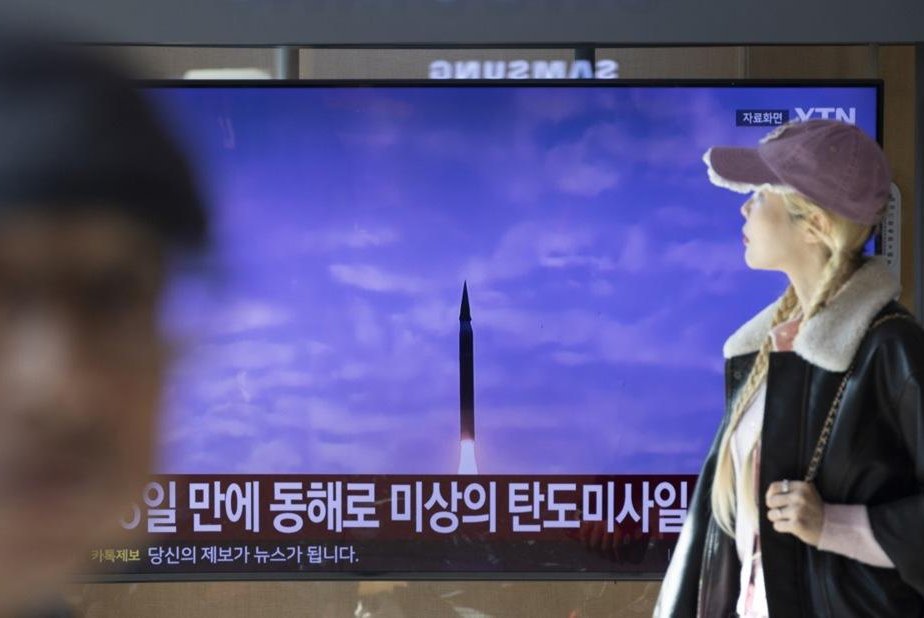
People in Seoul watch on TV North Korea’s launch of a ballistic missile into the East Sea in November. File Photo by Jeon Heon-kyun/EPA
March 2 (UPI) — The author prefers to use the lowercase “n” to challenge the Kim family regime’s legitimacy.
The Republic of Korea often reaches for gestures meant to lower tensions with north Korea. It suspends loudspeaker broadcasts. It curbs leaflet launches. It seeks humanitarian exchanges. It speaks of restraint.
The aim is stability. The method is optics. The problem is that optics do not change the nature of the regime in Pyongyang. They may change headlines. They do not change objectives or strategy.
De-escalation optics assume reciprocity. They assume that visible restraint will be met with visible restraint. That assumption has rarely held. north Korea calibrates pressure to its own political calendar and to its weapons programs, not to Seoul’s tone.
Missile tests rise and fall with development cycles. Nuclear advances track engineering timelines. Cyber operations follow opportunity. None of these drivers are meaningfully altered by whether Seoul broadcasts K-pop across the DMZ.
There is a deeper flaw. Optics concede initiative.
When Seoul acts to reduce visible friction, it signals that friction is the core problem. For Pyongyang, friction is a tool. It creates crises to shape perceptions in Washington and Seoul, to extract concessions, to fracture alliance cohesion, and to validate its internal narrative of encirclement and the “hostile policy” the alliance.
If Seoul treats each spike as a crisis to be dampened through unilateral gestures, it reinforces the utility of brinkmanship, political warfare and blackmail diplomacy.
History offers a pattern. Periods of inter-Korean détente have co-existed with steady advances in north Korea’s strategic capabilities. Engagement did not halt uranium enrichment. Summits did not prevent ICBM development. The regime separates symbolism from substance. It will trade photographs for time and time for capability. The balance of power then shifts quietly beneath the optics.
Supporters of de-escalation argue that even small reductions in tension reduce the risk of miscalculation. That is not trivial. Accidents on the peninsula would be catastrophic.
Yet, risk reduction requires reliable signaling and shared constraints. north Korea’s signaling is often coercive and ambiguous by design. Its constraints are self-defined and reversible. If one side treats gestures as confidence building while the other treats them as cost-free wins, asymmetry grows.
There is also the alliance dimension. The ROK/U.S. alliance rests on deterrence credibility. Deterrence is psychological. It depends on clarity of intent and visible capability.
When Seoul centers de-escalation optics, it can blur the signal of resolve. Adversaries watch for gaps between rhetoric and posture. If optics are not matched by strengthened readiness, expanded civil defense, resilient infrastructure and clear red lines, they invite testing. Testing then produces the very cycles of tension de-escalation optics were meant to avoid.
Optics can also distort domestic debate. They frame peace as a function of tone. They imply that provocation is a reaction to language rather than to the regime’s strategic goals. north Korea’s constitution now embeds nuclear status. Its doctrine emphasizes preemption. Its cyber units operate as revenue engines and instruments of disruption.
These are structural choices. They are not responses to a loudspeaker or a leaflet. If policy treats symptoms as causes, it misdiagnoses the disease.
Some will counter that de-escalation buys diplomatic space. It may. But space for what? Serious diplomacy requires leverage. Leverage comes from unity, capability, and consequences. If gestures are not embedded in a strategy that increases leverage, they become concessions without trade.
A pause in visible friction should be exchanged for verifiable steps. Without verification and enforcement, pauses become platforms for the next advance.
There is a moral hazard, as well. When Seoul curbs civil society activities in the name of reducing tension, it risks narrowing its own democratic space. north Korea’s political warfare thrives on constraining the discourse of free societies.
If de-escalation optics extend to limiting speech or activism, even indirectly, the asymmetry deepens. Democracies should be careful not to internalize the preferences of authoritarian adversaries.
A more durable approach begins with clarity. The core objective is not calm headlines. It is preventing war while shaping conditions for a free, secure, and unified peninsula.
That requires layered deterrence, robust alliance integration, and persistent exposure of malign behavior. It requires economic and cyber resilience. It requires credible extended deterrence backed by integrated planning. It requires steady support for information flows that pierce isolation. Calm may follow. It cannot be the premise.
This does not mean abandoning diplomacy. It means aligning diplomacy with power. Quiet channels can co-exist with firm posture. Humanitarian aid can be conditioned on access and monitoring. But military exercises must never be canceled. Public messaging can be disciplined without being deferential. The point is balance. Optics alone are imbalance.
Consider the strategic questions: What does Pyongyang want Seoul to think? That restraint will be rewarded. What decisions does Pyongyang want Seoul to make? To reduce pressure and to question alliance commitments. What actions does Pyongyang want Seoul to take? To limit exercises, mute criticism and separate from Washington. If de-escalation optics move policy in that direction without reciprocal change, they serve the adversary’s design.
Advocates may reply that public opinion demands visible efforts at peace. True. Leaders must answer to voters. Yet, leadership also involves explaining trade-offs. Peace is not a photo. It is a condition sustained by strength and predictability. Voters can understand that visible calm without structural change is fragile. The duty of strategy is to pursue conditions that endure beyond news cycles.
There is a final test. Does the strategy alter the adversary’s incentives? If the answer is no, the strategy is unlikely to succeed. north Korea’s incentives revolve around regime survival, nuclear leverage, and narrative control.
De-escalation optics do not materially change those incentives. Sanctions relief tied to verifiable dismantlement might. Security guarantees linked to compliance might. Multilateral enforcement of cyber consequences will change the regime’s calculus. Optics without leverage do not.
The ROK deserves stability. It also deserves a strategy that matches the nature of the threat. The peninsula is not stabilized by tone. It is stabilized by credible deterrence, alliance cohesion, resilient society and disciplined diplomacy anchored in power. Optics can support strategy. They cannot substitute for it.
If calm is the goal, the path runs through strength. If reconciliation is the aim, the road runs through verification and reciprocity. If unification is the horizon, the groundwork lies in sustained pressure against coercion and sustained support for freedom. De-escalation optics promise ease. Strategy requires endurance. The latter is harder. It is also more likely to work.
David Maxwell, executive director of the Korea Regional Review, is a retired U.S. Army Special Forces colonel who spent more than 30 years in the Asia-Indo-Pacific region. He specializes in Northeast Asian security affairs and irregular, unconventional and political warfare. He is vice president of the Center for Asia Pacific Strategy and a senior fellow at the Global Peace Foundation, where he works on a free and unified Korea. After he retired, he became associate director of the Security Studies Program at Georgetown University. He is on the board of directors of the Committee for Human Rights in North Korea and the OSS Society and is the editor at large for the Small Wars Journal.