

Published
02/03/2026 às 18:25
New material developed from plant waste combines durability, chemical recyclability, and environmental decomposition without generating harmful waste.
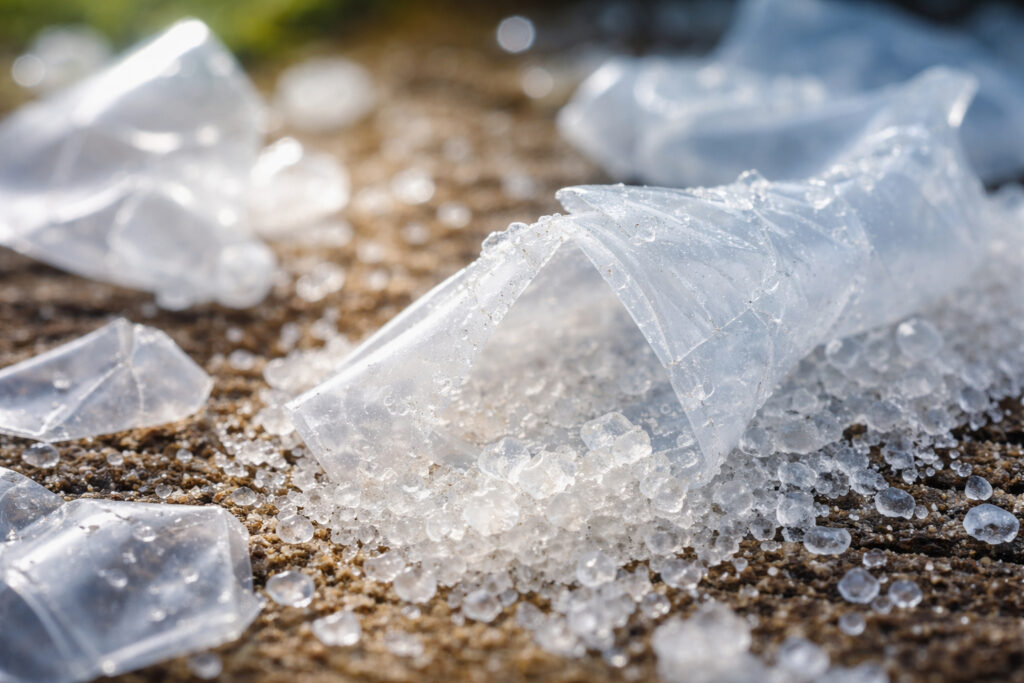
A scientific innovation of an environmental nature was recently presented by the École Polytechnique Fédérale de Lausanne (EPFL) in Switzerland, and has since attracted attention in the field. field of science Regarding materials, the team led by Lorenz Manker developed a biodegradable plastic that, when discarded, can degrade into sugar crystals, reducing the environmental impact associated with conventional polymers. The announcement reinforces the search for alternatives to traditional plastic, invented in 1907, whose long decomposition time still represents a persistent environmental challenge.
Technical development replaces traditional compounds.
The innovation stems from replacing formaldehyde with glyoxylic acid in the chemical process. According to Lorenz Manker, lead author of the study published by EPFL, this change allowed the removal of chemical groups considered “sticky” from the sugar molecules. As a result, these molecules began to act as building blocks for the new plastic. Applying this technique made it possible to transform up to 25% of the weight of agricultural waste into plastic material. Furthermore, when using pure sugar, the conversion reached up to 95%, demonstrating high efficiency in the utilization of plant biomass.
Resistance comparable to PET expands possibilities.
The developed material exhibits similar strength to that found in PET bottles, expanding its potential applications. At the same time, being derived from plant waste, it can be recycled through specific chemical processes or, alternatively, degraded naturally without generating harmful environmental residues. This characteristic differentiates the new polymer from conventional plastics, whose excessive durability has become a global environmental problem over the last few decades.

Environmental impact and historical context
Since the invention of plastic in the early 20th century, the material has been widely used to store various contents. However, precisely because of its resistance to degradation, it has accumulated in ecosystems around the world. In practice, containers produced more than a hundred years ago could still exist somewhere. In this context, the proposal presented by EPFL emerges as an alternative that combines technical performance and lower environmental impact, without promising unrealistic or immediate solutions to the global problem of plastic waste.
Transparency and rigor in scientific dissemination.
Furthermore, the École Polytechnique Fédérale de Lausanne (EPFL) officially released the study results. Therefore, the communication includes nominal statements from Lorenz Manker and describes technical parameters of the process. In this way, the disclosure prioritizes accuracy and transparency, avoiding exaggerated promises about immediate large-scale application. Thus, the advancement represents a relevant contribution to materials science, maintaining a commitment to academic rigor.
Given this scientific advancement, could replacing conventional polymers with plant-based alternatives represent a significant step in reducing the environmental impact of plastics over time?