
by Meliza Aguilera, Fort Worth Report
March 2, 2026
Every day brings another headline: rising defense spending in Europe, instability in the Middle East, and new questions about global supply chains and energy markets.
We are living through what a JPMorganChase foreign policy veteran calls a “plastic moment” in history — a time when geopolitical forces are reshaping economies, alliances and markets in real time.
For Fort Worth — home to major aerospace manufacturers, defense contractors, energy and technology firms — those global shifts carry real implications. Decisions made in Munich, Beijing or the Middle East can influence supply chains and investment flows across North Texas.
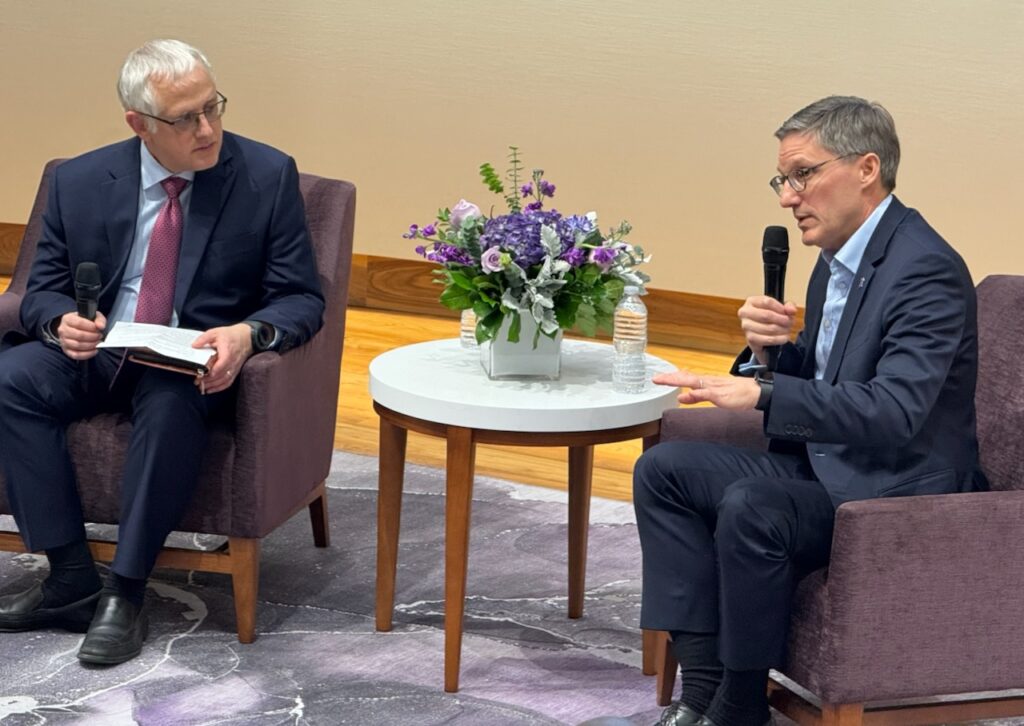
Those dynamics were the focus of a recent student fireside chat at Texas Christian University, featuring Derek Chollet, Head of JPMorganChase’s Center for Geopolitics.
Strengthening security and resiliency
Chollet’s visit comes following the launch of J.P. Morgan’s Special Advisory Services function, which provides clients with access to the firm’s expertise in critical areas including geopolitics, artificial intelligence and cybersecurity, among others, and as it seeks to help strengthen industries critical to national and economic security through its Security & Resiliency Initiative.
As part of the initiative, the firm plans to facilitate, finance and invest $1.5 trillion over the next 10 years, and will make direct equity investments for an initial amount of $10 billion to help select companies enhance their growth and accelerate strategic manufacturing. The initiative spans supply chain and advanced manufacturing, defense and aerospace, energy independence and resilience, frontier technologies such as artificial intelligence and cybersecurity, and pharma and healthtech.
“Businesses today are operating in one of the most complicated geopolitical landscapes any of us has faced,” Chollet said. “Understanding how global events affect markets is no longer optional — it’s essential.”
In fact, his remarks were made days before U.S. and Israeli forces launched strikes inside Iran.
For North Texas, where defense contractors and aviation companies play a significant role in the regional economy, rising global defense spending — particularly in Europe — has tangible effects.
Europe’s defense shift
Chollet had just returned from the Munich Security Conference, often described as the world’s premier gathering of global security leaders. This year’s dominant theme was Europe ramping up defense investment amid Russia’s ongoing war in Ukraine.
For decades, U.S. presidents have urged European allies to spend more on defense. Now, that shift is underway.
Germany and other European nations are investing heavily in new military equipment and capabilities. That could benefit U.S. defense manufacturers. But the shift also raises questions about how closely the U.S. and Europe will continue to work together through alliances like NATO.
“NATO remains a critical component of American leadership,” said Chollet, emphasizing the importance of strong U.S. engagement alongside allied investment.
For Fort Worth aerospace and defense companies, those debates could translate into real business impacts.
The defining U.S.-China relationship
Chollet described the relationship between the United States and China as “the most complicated and consequential” relationship in the world.
China’s growing strength in manufacturing — along with its rapidly expanding military — is reshaping global competition. At the same time, the two countries’ economies remain closely linked through trade, investment and supply chains.
“The U.S.-China relationship has elements of competition, elements of rivalry, and areas where cooperation remains necessary,” said Chollet.
That complexity carries real implications for supply chains, technology investment and energy markets — all major sectors in Texas.
At the same time, countries in the Gulf region — including Saudi Arabia and the United Arab Emirates — are investing heavily in artificial intelligence infrastructure and clean energy. Their goal is to reduce dependence on oil and lead the next generation of global technology.
Chollet said those moves show how power is changing. It’s no longer just about military strength. The countries that lead in energy, artificial intelligence, and manufacturing will have greater influence on the global stage.
Middle East volatility and opportunity
Chollet also addressed rising tensions with Iran, noting the United States had deployed its largest regional military presence in decades as negotiations over Iran’s nuclear program continued. He said it was likely the U.S. could strike in the next two weeks, which turned out to be case.
Despite growing instability, he expressed cautious optimism about economic transformation in parts of the Middle East, particularly in the Gulf, where diversification beyond oil is accelerating.
“Even amid turbulence, there are significant structural shifts underway,” Chollet said.
Preparing the next generation
The fireside chat, moderated by Michael Strausz, Professor and Chair of the Department of Political Science at TCU, drew questions from students studying business, political science and international affairs — many of whom will graduate into careers shaped by these global dynamics.
J.T. Aughinbaugh, Fort Worth Market Manager at J.P. Morgan Private Bank and Vice Chair of JPMorganChase’s Market Leadership Team in North Texas, said hosting the discussion reflects the region’s deep ties to the global economy.
“The outlook for Fort Worth businesses is strongly connected to global events and trends,” said Aughinbaugh, who is also a TCU alumnus. “From aerospace and defense to energy and technology, our region is tied to international markets and supply chains. Conversations like this help business leaders and students alike understand how global events shape local opportunity.”
Chollet closed with advice for students: stay curious and focus on learning.
“Every day, try to understand something new about the world,” Chollet said. “In a moment like this, curiosity is a competitive advantage.”
For Fort Worth, that mindset may prove just as important as any global policy decision.
JPMorganChase JPMorganChase has nearly 3 million consumer and small business clients across greater Dallas-Fort Worth. The firm has served DFW clients and communities for 150 years and has invested $40 million in North Texas non-profits since 2019. Chairman and CEO Jamie Dimon named TCU a key client and strategic partner in his 2024 Annual Letter to Shareholders. JPMorganChase was named the TCU Ralph Lowe Energy Institute’s Legendary Bank Partner in 2024 and sponsors the Inclusive Excellence Mentorship Program at the TCU Neeley School of Business.
This message is confidential and subject to terms at: https://www.jpmorgan.com/emaildisclaimer including on confidential, privileged or legal entity information, malicious content and monitoring of electronic messages. If you are not the intended recipient, please delete this message and notify the sender immediately. Any unauthorized use is strictly prohibited.
This <a target=”_blank” href=”https://fortworthreport.org/2026/03/02/tensions-local-impact-how-global-geopolitics-is-shaping-fort-worths-economy/”>article</a> first appeared on <a target=”_blank” href=”https://fortworthreport.org”>Fort Worth Report</a> and is republished here under a <a target=”_blank” href=”https://creativecommons.org/licenses/by-nd/4.0/”>Creative Commons Attribution-NoDerivatives 4.0 International License</a>.<img src=”https://i0.wp.com/fortworthreport.org/wp-content/uploads/2021/04/cropped-favicon.png?resize=150%2C150&quality=80&ssl=1″ style=”width:1em;height:1em;margin-left:10px;”>
<img id=”republication-tracker-tool-source” src=”https://fortworthreport.org/?republication-pixel=true&post=431358&ga4=2820184429″ style=”width:1px;height:1px;”><script> PARSELY = { autotrack: false, onload: function() { PARSELY.beacon.trackPageView({ url: “https://fortworthreport.org/2026/03/02/tensions-local-impact-how-global-geopolitics-is-shaping-fort-worths-economy/”, urlref: window.location.href }); } } </script> <script id=”parsely-cfg” src=”//cdn.parsely.com/keys/fortworthreport.org/p.js”></script>