
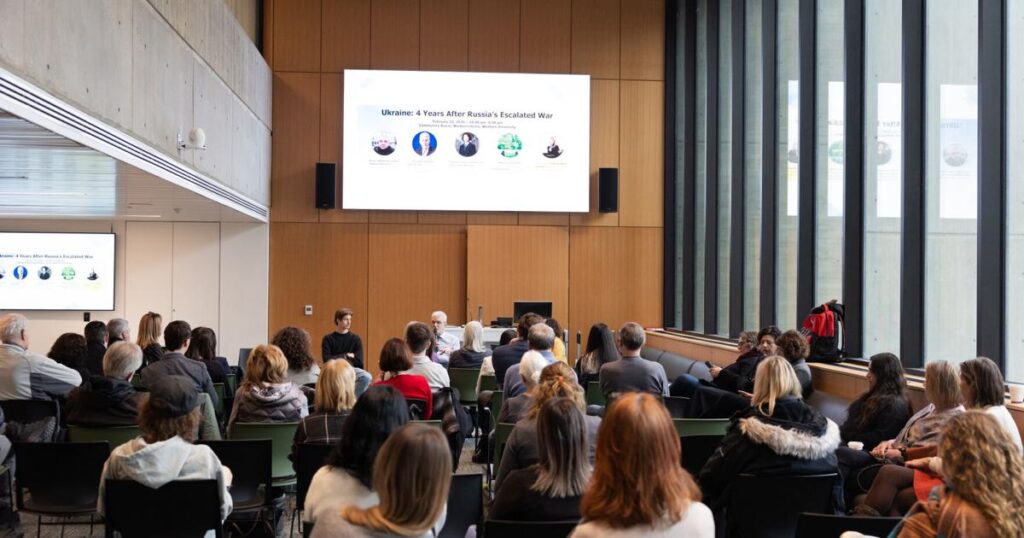
On Feb. 25, the Departments of History and Political Science brought three Ukrainian speakers to Western to reflect on Russia’s escalated war with Ukraine.
The conference saw speakers including human rights activist Maksym Butkevych, journalist Andriy Kulykov and museum director Olesia Ostrovska-Liuta reflect on the four-year anniversary of the full-scale invasion of Ukraine. More than 55 students, faculty and community members gathered for their presentations in the D.B. Weldon Library.
The Russia-Ukraine war began in 2014 when Russia invaded the Crimean Peninsula. On Feb. 24, 2022, Russian forces launched a full-scale invasion of Ukraine by land, air and sea, escalating the conflict.
In the four years since the invasion, Russia has gained around 10 per cent of Ukraine’s territory. The Center for Strategic and International Studies estimates Ukrainian forces have suffered between 500,000 and 600,000 casualties, including those killed, wounded and missing since the escalated invasion.
Russian forces have suffered around 1.2 million casualties according to the CSIS. In addition to presentations by the three speakers, the conference featured a screening of director Ganna Yarovenko’s 2025 documentary Mama’s Voice.

Olesia Ostrovska-Liuta, who formerly served as Ukraine’s First Deputy Minister of Culture and the First Deputy to the Head of the National Committee for UNESCO, and now is the Director General of the National Art and Culture Museum Complex, Feb. 24, 2026.
Ostrovska-Liuta, the director of Kyiv’s Mystetskyi Arsenal National Art and Culture Museum Complex and former Ukrainian deputy minister of culture, told the Gazette the war has come to represent a defence of Ukraine’s right to self-determination, which she explained continues to sustain resistance four years into the invasion.
“The whole worry about Russia’s war against Ukraine is exactly about Ukrainian society and its right to exist,” she said, adding that culture “manifests someone’s identity, historical path and society.”
She added that Russian forces looted museums and destroyed books in occupied Ukrainian territories. Despite this, Ostrovska-Liuta said cultural institutions continue to function despite power outages, growing staffing shortages and “daily shellings.”
She emphasized that preserving contemporary Ukrainian culture is as important as protecting the country’s national heritage.
“It’s important to create today,” she said.
Butkevych, a journalist and human rights advocate, volunteered to join the Ukrainian Armed Forces when the full-scale invasion began. Months into his service, he was captured by Russian forces and lived in captivity for two years and four months until his release.
Butkevych went on to co-found the charitable foundation Principle of Hope, which works to support prisoners of war released from Russian captivity.
Butkevych said Ukraine has registered approximately 200,000 cases of war crimes since the invasion. International institutions, including the International Criminal Court, are investigating alleged crimes dating back to 2013.
Maksym Butkevych, a Ukrainian journalist and war veteran who once spent two years in Russian captivity, continues advocating for human rights and social justice, Feb. 24, 2026.
“There is a huge demand for justice from Ukrainian society,” he said.
But, he added that it’s important “not to confuse justice and revenge.”
Butkevych said he is sometimes asked whether being in captivity disillusioned him about human rights.
“It actually worked the other way around,” he said. “One should find him or herself in a place where human rights mean nothing to those who control the situation to understand how important they are.”
In addition to information, Russian and Ukrainian military forces grapple to control access to territory.
Kulykov, a veteran journalist who began his career working as a Soviet Union propagandist for The News From Ukraine, said information infrastructure in eastern Ukraine became “first range targets” alongside military and energy facilities in the early days of the invasion.
“The only thing that you can actually lean upon in fighting propaganda is disseminating verified information,” he said.
Andriy Kulykov, Head of the Board of “Hromadske Radio,” began his career as a Soviet propagandist in “The News From Ukraine” weekly published by the Association for Cultural Relations with Ukrainians Abroad, Feb. 24, 2026.
On the first day of the full-scale invasion, Kulykov received a call from a foreign outlet that assumed Kyiv would fall to the Russians. He explained that this assumption reflected the strength of Russian propaganda networks globally.
“Russian propaganda is very very hard to compete with or to defeat,” he said. “The only thing that we can do if we want to succeed is to tell the truth.”
The event was organized by political science professor and history professor Marta Dyczok, who specializes in Ukrainian history and geopolitics.
Dyczok said she planned the conference to highlight the lived experience of Ukrainians as they remain resilient through the war. She added that hearing experiences firsthand has a unique impact on international audiences.
“It’s one thing to read an article,” Dyczok said. “It’s very different to hear somebody who’s living through these experiences.”
Sofiia Boitsova, a third-year economics and finance student and president of Western University’s Ukrainian club, attended the event and said many students “didn’t fully understand the scale” of what was happening in Ukraine.
She recalls that when the invasion began, many students reposted information about the war on social media and expressed shock. Now, four years later, fatigue has set in.
“People are kind of bored hearing about Ukraine,” she said, reflecting on diminishing public interest in the war.
Boitsova explained the contrast between daily life in Canada and Ukraine. While most Canadian students have access to reliable electricity and infrastructure, her peers in Kyiv face regular power outages.
Dyczok said the conference serves as a reminder of the fragility of democracy.
“Our rights are protected, and we have a nice standard of living … but we tend to sometimes take all of that for granted and forget how fragile democracy really is.”
According to Butkevych, Ukrainian resilience means defending the nation, but also preserving a set of values that include dignity, autonomy and human rights.
“We defend values which are common to all people who would like to live freely in mutual respect and without fear,” he said. “In order to secure that, it’s not only necessary to stop the actual fighting, it is necessary to do everything possible so that this huge injustice does not repeat itself in the future.”
— with files from Gabriella McKenna