
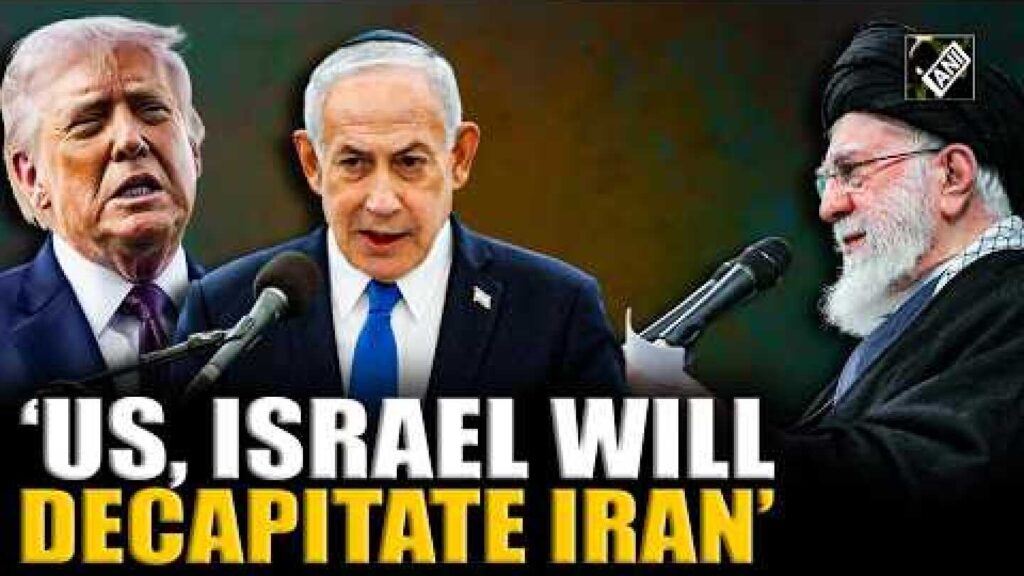
Middle East Forum Director of Policy Analysis Michael Rubin spoke with ANI News about the U.S.–Israel strikes on Iran, the collapse of diplomacy, and whether sustained military pressure could threaten the survival of the Islamic Republic. He discussed historical parallels, Iran’s internal dynamics, risks for President Trump, and the roles of China and Russia in accelerating the conflict.
ANI: As the sun rises here in Washington and the smoke is still clearing over Iran, Dr. Rubin, you’ve lived in post-revolution Iran and spent years advising the Pentagon. You’ve been part of the Pentagon yourself. Looking at Iran across different regimes, what’s your first reaction this morning?
RUBIN: My first reaction is that the Iranian regime is in a lot of trouble. That said, while the United States and Israel are going to try to take out ballistic missile launchers and decapitate the regime, the Iranian regime’s goal is simply to survive and then claim victory, much like what we saw with Hamas.
When it comes to using air power alone, President Trump has said there will not be boots on the ground and no U.S. troops inserted. I can think of only two parallels. The first is Imperial Japan, when the United States did not insert ground forces until after massive bombing and the emperor surrendered. The second is Kosovo. But Iran is about twenty times the size of Kosovo, so it’s not clear that what worked there would work in Iran.
ANI: After what we saw almost eight months ago, the U.S. and Israel had already hit Iran’s nuclear facilities. Why did it take another eight months to get here? Was Operation Midnight Hammer a failure, or was this always the plan?
RUBIN: Usually the timing of these attacks is determined by Iran’s air defenses. When we look at June 2025, that timing was driven by Iran reconstituting its anti-aircraft missile batteries that had been hit in April and October of 2024.
There have also been recent reports that China, and perhaps Russia, have been supplying Iran with advanced weaponry, including possibly carrier-killer missiles. Ironically, that may have accelerated the conflict rather than deterred it.
Between those military engagements, there was an opportunity for diplomacy, but diplomacy was never going to work on Iran’s nuclear program. Over the past forty years, Iran has lost roughly $2 trillion in sanctions and lost economic opportunity. Because of that, the supreme leader would be extraordinarily hard-pressed to give up the nuclear program.
Not only would ordinary Iranians, whom he doesn’t care much about, ask why they sacrificed, but even the Islamic Revolutionary Guard Corps would demand answers. We were on a collision course for some time, and today was the day of that collision.
ANI: Some analysts are already drawing comparisons to Russia. Russia told Ukraine to disarm and then invaded. The U.S. told Iran to disarm its nuclear program and then struck. Do you see any parallels?
RUBIN: There’s one major difference. Before the Ukraine war, Vladimir Putin questioned the very existence of Ukraine. He argued Ukrainians were essentially Russians. No one is arguing that the United States seeks to annex Iran or deny its existence.
Because of that, Iranians don’t have the same incentive to fight. They’re not defending the existence of their country, and they have no desire to defend a regime that recently killed upward of 30,000 people in the streets. That’s why we’re seeing videos of Iranian schoolchildren and others dancing in the streets of Tehran rather than rushing to grab arms.
ANI: President Trump has said Iran with nuclear weapons is a threat to the United States. Will his base reward him for this, or does the risk of a prolonged conflict put his political capital in jeopardy?
RUBIN: His base will support him. That said, not every Republican is his base. The party is divided between those who support him and a libertarian wing. Figures like Representative Tom Massie and Senator Rand Paul have already argued this is illegal without congressional approval.
Democrats have also criticized the action, but when push comes to shove, if this is a quick operation, there’s not much Congress can do. Congress has folded before, and there’s no reason to believe it will suddenly find its spine. Spines tend not to be stiff when they’re made of gelatin.
ANI: The president built his brand on not getting America into endless wars. Can he sell this as a quick, surgical operation, or is that wishful thinking?
RUBIN: He can sell it as quick only if it actually is quick. As days and weeks pass, Americans will start to question it.
We’ve seen this before. Operation Rough Rider against the Houthis lasted over fifty days. It began without a clear plan and ended with a declaration of success, even though the Houthis survived and claimed victory. After October 7, Israel declared its aim to eliminate Hamas control, yet Hamas still controls much of Gaza. The key question for the Islamic Revolutionary Guard Corps is whether the United States has not just the technology, but the patience to apply overwhelming force. If they believe time is on their side, the regime will survive and claim victory.
ANI: It appears the U.S. is focused on Iran’s nuclear infrastructure while Israel is targeting the regime’s leadership. Will that strategy succeed?
RUBIN: Ultimately yes, but the issue is that technologies can always be rebuilt. Nuclear programs and missile systems are replaceable. The real issue has never been the technology, but the ideology of the regime wielding it. That’s why we’re now seeing decapitation strikes.
In June 2025, President Trump reportedly told Prime Minister Netanyahu not to kill Supreme Leader Ali Khamenei because he wanted a deal and didn’t want a vacuum. Now he appears to have changed his mind. He recognizes the supreme leader won’t sign a deal and is willing to risk that vacuum.
We’re already seeing reports that Iran’s chief justice has been killed. That matters because he would have been part of the interim leadership if the supreme leader were removed. He was also the most hardline figure. A vacuum is already forming.
ANI: The president spoke about the loss of human lives, including U.S. citizens. How is this different from Operation Midnight Hammer?
RUBIN: The Iranian regime has been responsible for the deaths of hundreds of thousands of Americans since 1979. During the Iraq War, I was involved on the civilian side and around the Pentagon during secret negotiations in Geneva. Iranian diplomats promised not to interfere. They lied.
The IRGC inserted troops almost immediately, and we saw the use of explosively formed projectiles that killed Americans. When critics say the U.S. killed 100,000 people in Iraq, that ignores the agency of insurgents and Iran’s role in supporting them. The rhetoric goes wrong when it assumes Iran had no responsibility.
ANI: Finally, let’s talk about China. Beijing has been Iran’s economic lifeline, buying its oil and providing political cover. Where does China stand now?
RUBIN: Beijing will sit on the fence. Much of the oil wasn’t bought officially. It was diverted to so-called teapot refineries, allowing China to profit while maintaining plausible deniability.
Saudi Arabia is now telling China to buy oil either from them or from Iran, but without sanctions profiteering. China’s interest isn’t Iran. It’s checkmating the United States. If reports are true that Xi Jinping enabled Iran with carrier-killer missiles, that may have put a ticking clock on diplomacy. Xi may ultimately be remembered as the man who killed diplomacy by convincing Iran it had another path forward.
ANI: Thank you very much for your time.
RUBIN: Thank you.