
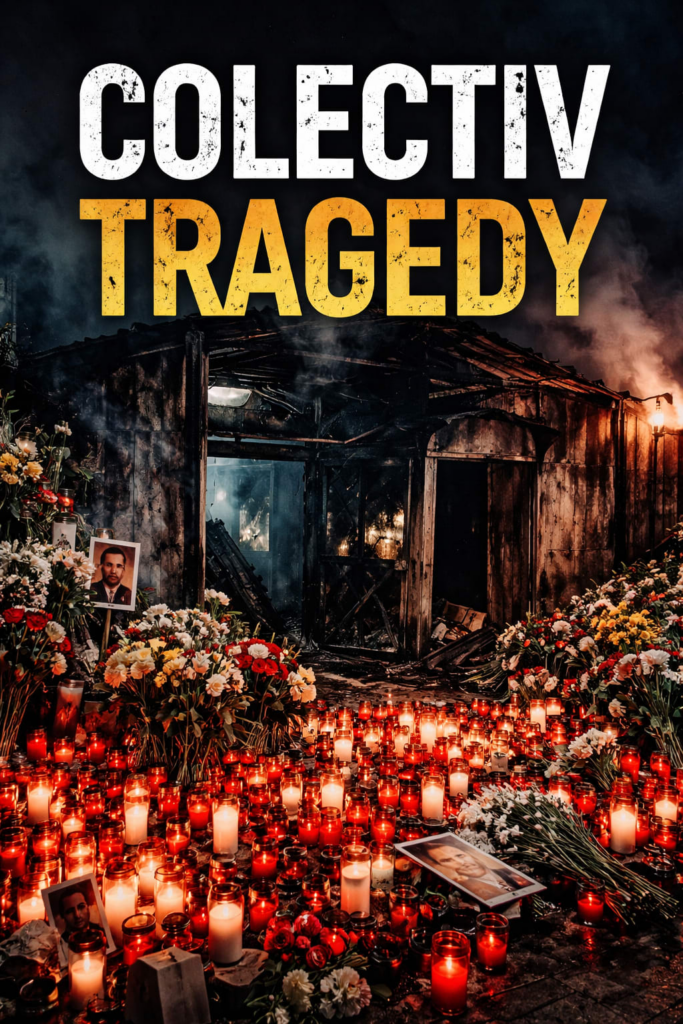
On October 30, 2015, Romania experienced one of the darkest nights in its modern history. What began as a normal concert in a crowded nightclub quickly turned into a national tragedy that shocked the entire country and made international headlines. The disaster at Colectiv nightclub would not only claim dozens of lives but also ignite a wave of anger, protests, and demands for accountability across Romania.
The event became known simply as the Colectiv nightclub fire — a tragedy that revealed serious problems within the Romanian system and forced the nation to confront uncomfortable truths about corruption and safety regulations.
A concert that turned into a nightmare
That Friday night, hundreds of young people gathered at Colectiv nightclub in Bucharest to attend a concert by the Romanian metal band Goodbye to Gravity. The band was celebrating the release of a new album, and the atmosphere was filled with excitement. Fans packed into the underground club, eager to enjoy the music and the show.
However, during the concert, indoor fireworks were used as part of the performance. The sparks from the pyrotechnics ignited highly flammable soundproofing foam on the club’s pillars and ceiling. Within seconds, flames spread rapidly across the interior of the building.
At first, many people believed the fire was part of the show. But within moments, thick smoke filled the room and panic began to spread among the crowd.
The club had only one small exit that most people could access easily. As the fire intensified, hundreds of people rushed toward the door at the same time. The result was chaos. People were trapped inside the burning building, struggling to escape the smoke and flames.
A devastating human toll
The tragedy quickly became one of the worst disasters in Romania’s recent history. In the first hours after the fire, 27 people died at the scene. Over the following weeks, many more victims passed away in hospitals due to severe burns and infections.
In total, 64 people lost their lives because of the Colectiv nightclub fire, while more than 180 others were injured.
Many of the victims were young students, musicians, photographers, and artists. They were part of a generation full of dreams and ambitions. Their sudden loss deeply affected Romanian society.
Among those who died were members of the band Goodbye to Gravity, who had been performing on stage when the fire started. Their deaths turned the tragedy into an even more emotional moment for fans and the music community.
The anger of a nation
As investigators began examining the disaster, disturbing details started to emerge. Authorities discovered that the club lacked proper fire safety measures. The building did not have enough emergency exits, and the materials used for soundproofing were highly flammable.
Even more shocking was the revelation that the club had been operating without proper permits for fire safety.
Many Romanians began asking a painful question: how could such a dangerous place have been allowed to operate?
The answer, many believed, was corruption and negligence within local institutions.
Public anger quickly spread across the country. Thousands of people took to the streets in massive protests in cities like Bucharest, Cluj-Napoca, and Timișoara. Protesters accused politicians and authorities of allowing corruption and ignoring safety regulations.
For many Romanians, the tragedy became a symbol of a system that had failed its citizens.
Political consequences
The protests that followed the tragedy were among the largest demonstrations Romania had seen since the fall of communism.
Crowds demanded responsibility from the government and called for major reforms.
Under intense public pressure, the Romanian Prime Minister at the time, Victor Ponta, announced his resignation on November 4, 2015.
His resignation marked one of the most dramatic political consequences of a public tragedy in Romania.
The fall of the government demonstrated the power of public anger and the growing frustration of Romanian citizens toward corruption and inefficiency in state institutions.
The struggle of the survivors
While the political consequences were immediate, the human impact of the tragedy continued for years.
Many survivors suffered severe burns and required complex medical treatments. Some victims had to be transported to hospitals in countries such as Germany, Austria, and the Netherlands because Romanian hospitals lacked the necessary equipment to treat severe burn injuries.
The situation revealed serious weaknesses in Romania’s healthcare system, particularly in the treatment of burn victims.
For survivors, the recovery process has been long and painful. Many still live with permanent physical scars and psychological trauma.
Families of the victims have also spent years fighting for justice and accountability.
A tragedy that exposed deeper problems
The Colectiv nightclub fire was more than just a terrible accident. For many Romanians, it became a symbol of deeper systemic issues.
The tragedy exposed how corruption, negligence, and weak enforcement of regulations could lead to catastrophic consequences.
Investigations revealed that safety inspections were often superficial or influenced by bribery. Businesses could sometimes operate without meeting essential safety standards.
This reality shocked many citizens who realized that similar dangers might exist in other places across the country.
A lasting impact on Romanian society
More than eight years after the tragedy, the memory of the victims remains deeply rooted in Romanian society.
Every year, commemorations are held to honor those who lost their lives that night. The tragedy also inspired documentaries, books, and the award-winning film Collective, which investigated the corruption and failures revealed after the disaster.
The film brought international attention to the case and was even nominated for two Academy Awards.
Today, the name “Colectiv” still carries powerful meaning in Romania. It represents grief, anger, and the demand for a safer and more accountable society.
Conclusion
The fire at Colectiv nightclub was not only a tragic accident—it was a moment that forced Romania to confront its own systemic problems.
The loss of 64 lives shocked the nation and triggered protests that led to political change. But perhaps the most important legacy of the tragedy is the awareness it created.
Romanians began demanding higher standards, stricter safety rules, and greater accountability from authorities.
The night of October 30, 2015 will forever remain a painful chapter in Romania’s history. Yet it also serves as a reminder that tragedies can sometimes awaken a society and push it toward change.