
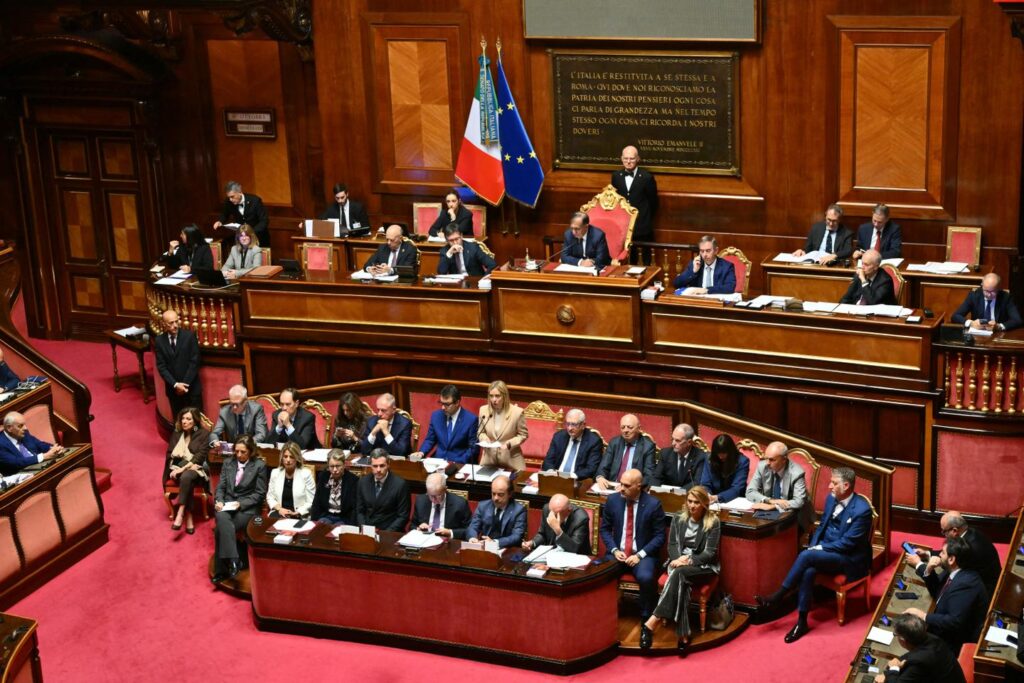
 Giorgia Meloni at the Italian Senate, Rome, October 22, 2025. ALBERTO PIZZOLI/AFP
Economic stagnation and uncertainty: Under far-right Council President Giorgia Meloni’s leadership, Italy is struggling to break out of what looks increasingly like a deadlock. In spite of a remarkable level of government stability and an ever-tenser political climate, Rome must settle for lackluster growth.
On Monday, March 2, the Italian National Institute of Statistics (ISTAT) revised downward its preliminary January estimate of 0.7% growth in 2025, issuing a final figure of 0.5%. Confirming a downward trend since 2023, Italy has fallen well below the eurozone average (1.5%), and far short of Socialist Pedro Sanchez’s Spain, which reached 2.9%.
The Israeli-American offensive against Iran is also casting the threat of rising inflation over Italy, where costs are already the highest in Europe, all while public finances remain a chief concern. The government’s central goal of bringing the public deficit below 3% of GDP to end the infringement procedure imposed by the European Commission now seems further out of reach; Istat provisionally estimated it at 3.1% for 2025.
These figures further illustrate Italy’s structural weaknesses: a shrinking population, low productivity and wages below the European average in 2025 and the absence of a national minimum income. South of the Alps, skepticism is often the prevailing attitude toward the idealized French vision of Italy as an economic miracle. Academics, analysts and business leaders see no reason for the kind of optimism that the government itself has not expressed.
You have 70.62% of this article left to read. The rest is for subscribers only.