
Ideas53:59Dreaming Georgians vs Georgian Dream
The republic of Georgia sits geographically at the crossroads between Europe and Asia. Politically, it sits between pro-Putin authoritarianism and Western liberalism. And what’s happening there has uncanny similarities with events closer to home, as that tension spills out onto the streets.
Radio documentarians David Zane Mairowitz and Malgorzata Zerwe went to Georgia’s capital, Tbilisi, to record a parade and a demonstration, each from opposing ends of the political spectrum. This is their story:
The list of recent anti-democratic actions by the government of Georgia is long.
Accusations of a stolen election, laws targeting NGOs and media, violent treatment of protestors, and a threat to imprison all members of opposition political parties.
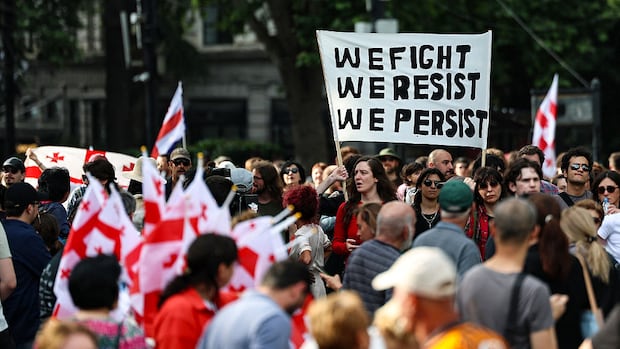
Since November 2024, tens of thousands of people have been taking to the streets to protest against the ruling political party called “Georgian Dream.” For many Georgians, the goal of the country has always been to join the European Union — it’s an objective that is enshrined in their constitution. But Georgian Dream has been steering the country toward a different path to become closer to Russia.
“We know that the 26 of October elections were rigged by this government. We think that we deserve to be a part of Western European countries. So why our illegitimate government tries to be a part of Russia, I don’t get,” said Mariam, a 26-year-old protester.
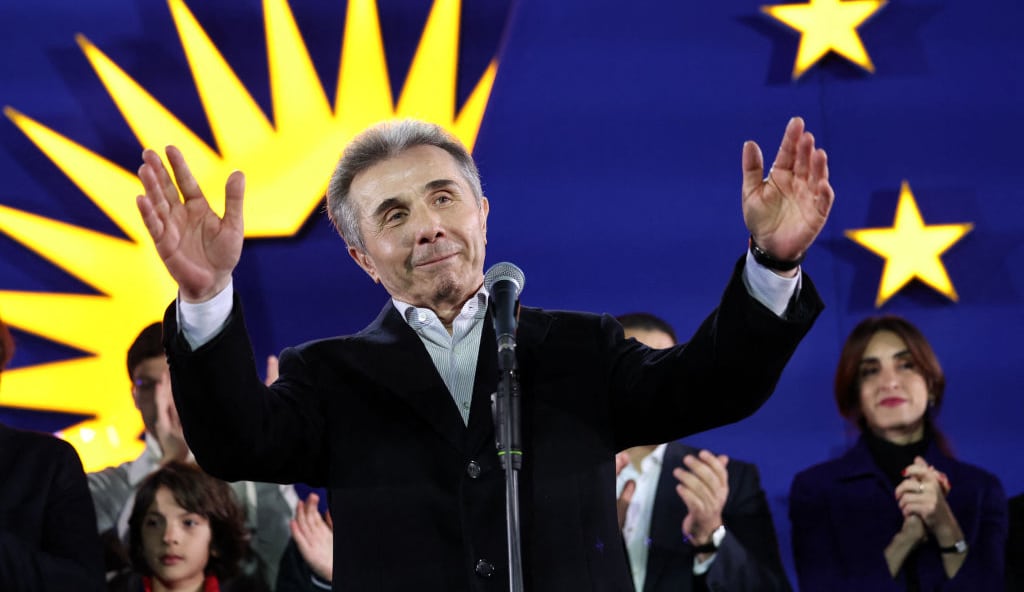
Founder of the ruling Georgian Dream party Bidzina Ivanishvili after parliamentary elections in Tbilisi, Oct. 27, 2024. The oligarch made a fortune from computers in Russia before returning to Georgia as a billionaire. (Giorgi Arjevanidze/AFP via Getty Images)
The Georgian Dream Party has been in power since 2012, although its authoritarian turn dates from 2016. It is led by the oligarch Bidzina Ivanishvili. Although not officially in the current government, he runs the country from the wings.
Ivanishvili is beholden to Vladimir Putin, and at the same time, his party is MAGA-inspired, modelled on right-wing populism in other countries like Hungary, pushing a “traditional values“ mindset, railing notably against the LGBTQ+ community and accusing Europe of trying to impose an alien agenda on conservative Georgians.
Targeted as ‘enemy of the state’
On May 9, 2025, we joined protestors on the Europe Day march, an event that supports the desire of most Georgians to join the European Union.
Our guide and interpreter, Tina Lagidze, is an actress and a known anti-regime activist. She tells us that there are A.I. street cameras watching them.
“I’m putting on my scarf to cover my face because the cameras zoom in on our faces and recognize them. And tomorrow I can get a bill for 5000 Lari ($2,500 CAD) to pay because I crossed the road illegally.“
During this march, we meet an important figure in the Georgian opposition, the director of the Civil Society Foundation, Keti Khutsishvili, whose case is alarming.
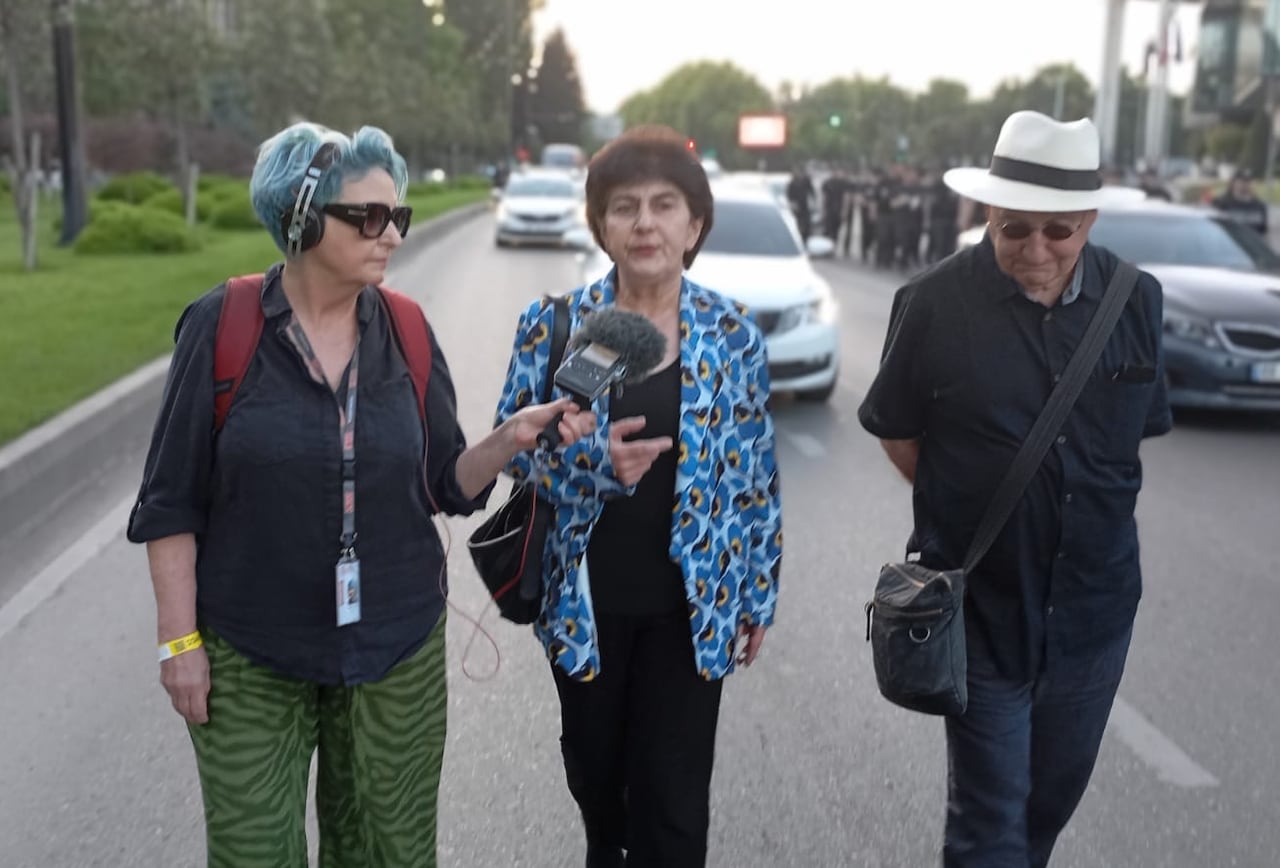
The political conflict is ‘a very existential moment in the modern history of Georgia, and if we lose this fight, tomorrow it can become Belarus,’ says Keti Khutsishvili, director of Civil Society Foundation. She’s flanked by IDEAS contributors Malgorzata Zerwe (left) and David Zane Mairowitz. (Submitted by David Zane Mairowitz )
“I live in a kind of old Soviet building. My niece came in, telling me there are posters with my pictures all around our building complex with inscriptions ‘enemy of the state, enemy of the nation’.” Khutsishvili tells us.
The planting of what amounts to a wanted poster in her building was an attempt to turn her neighbours against her.
Khutsishvili says the laws approved by Parliament are threatening but they are not legal under “falsified elections.”
“It’s against civil society, against freedom of expression, against freedom of speech. And they are trying everything to stop our activities and either to put us all in prisons or to push us out of the country. It’s the same playbook that Russia has been using against its civil society.”
The ‘truth’ behind the Family Purity Parade
Georgian Dream also has overwhelming support from the Georgian Orthodox Church, which operates under the influence of the pro-Putin Russian Orthodox Church. Which is why we decided to also attend and record the so-called “Family Purity Day” parade on May 17, 2025.
For many years, this date marked the day against homophobia in Georgia, but the church and Georgian Dream co-opted it and turned its purpose on its head.
A young man standing next to us in the “purity” crowd told us, “In this country, no LGBTQ demonstration will be made. That’s why our Patriarch made this day. I will ask you one thing: ‘If Georgia were gay, an LGBTQ society, would it win so many wars and last till today? Have you ever seen a war won by LGBT?’ “
From this chance encounter, the real meaning of the Family Purity Parade became clear. This is homophobia’s heyday. Clearly inspired by the Putin litany that homosexuality is a threat to the nation’s manhood and ultimate welfare.
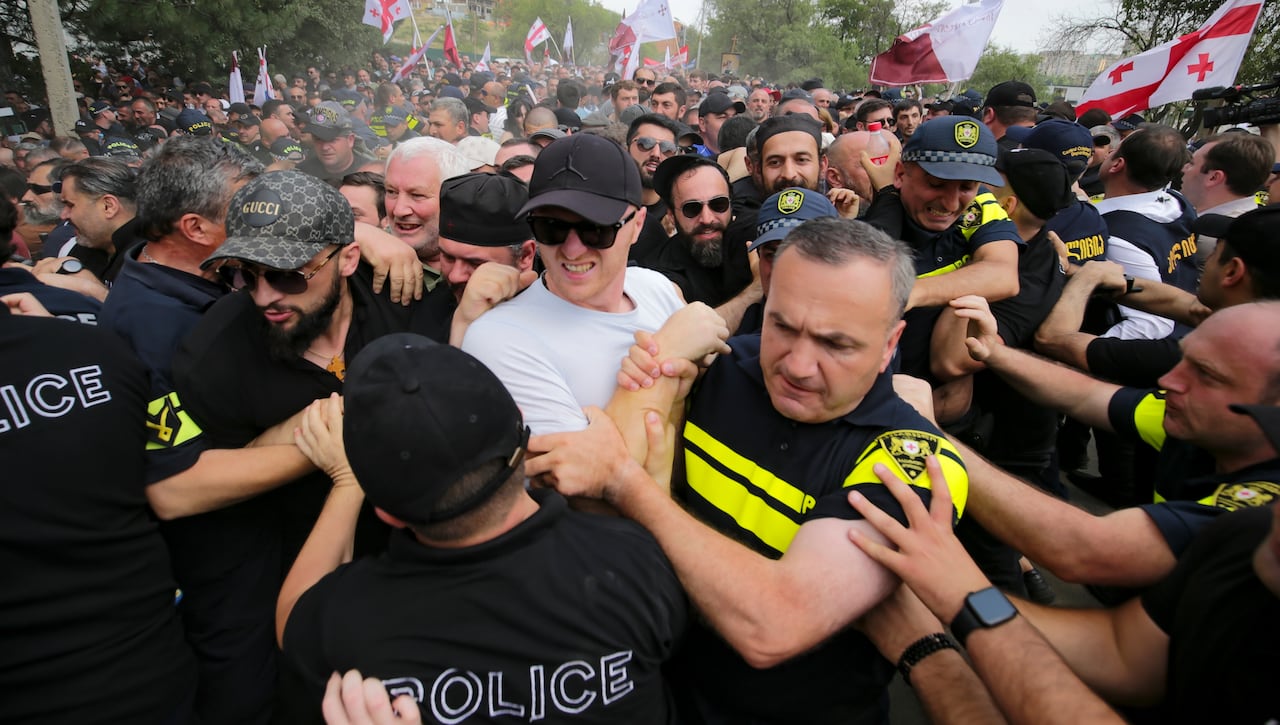
Police blocked opponents of gay rights at a Pride event in Tbilisi, Georgia, July 8, 2023. (Zurab Tsertsvadze/AP)
“They use homosexuality as something brought from the West to Georgia. And that’s why they established this so-called ‘family purity day’ on the 17th of May,” said Giorgi Kikonishvili, an activist and co-founder of the Equality Movement.
“The paradox here is that the Georgian Orthodox Church — I mean the priests — a very big part of them, are gays. And the Patriarch himself is gay. This is a guy who is on top of the most homophobic institution in the country … and he is gay!“
Officializing the homophobic bent of Georgian Dream, the parliament passed the “Law on Family Values and the Protection of Minors” in October 2024, prohibiting same-sex marriage. The MP from the Georgian Dream party, Lévan Makhashvili, defended this action to us.
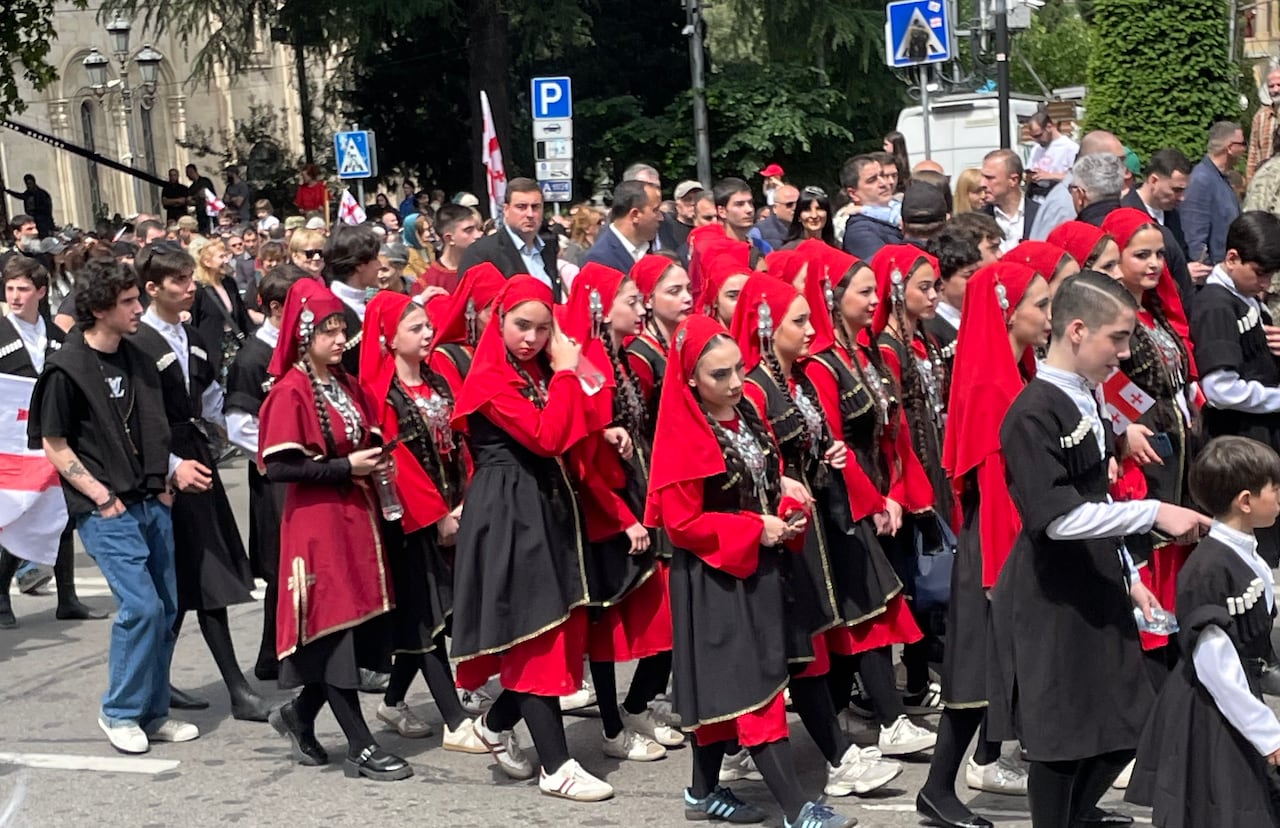
Young participants in the Family Purity Day Parade (David Zane Mairowitz)
“The promotion of this kind of ideology is not allowed. Advertisements near the schools are not allowed,” said Makhashvili.
This, of course, is Putin-speak, claiming that homosexuality is an “ideology” that “advertises,” a notion that also holds sway in many right-wing bastions.
“This was also a pre-election promise of Georgian Dream. If other political parties have a different worldview, let them say it loudly and win in the elections if they can,” Makhashvili added.
These three words – if they can – from the MP struck an ironic note with us. The October 2024 parliamentary elections in Georgia were denounced by the European Union, and many other observers, for being “neither free nor fair, full of serious electoral violations, including intimidation, vote manipulation, interference with election observers and media,” according to the EU parliament.
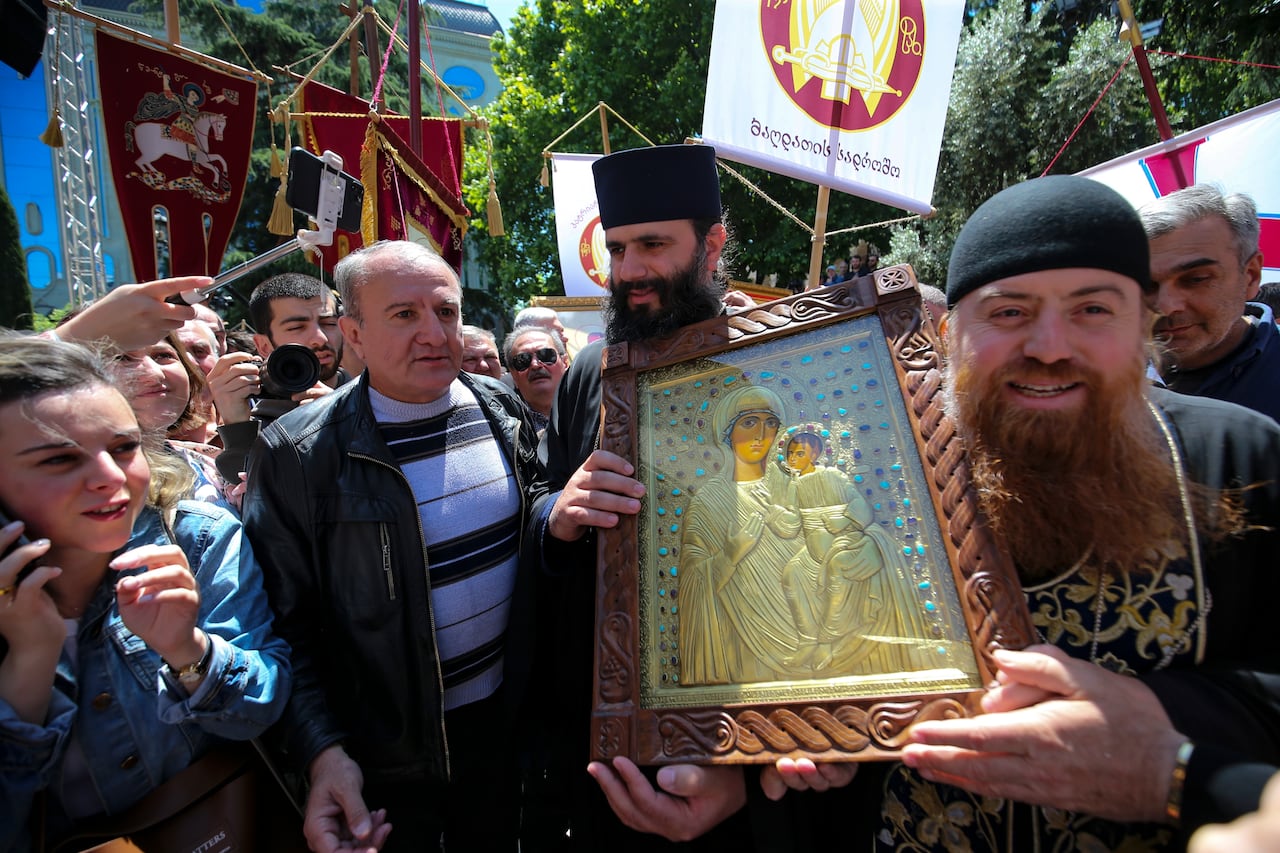
Thousands of people including Orthodox Church priests marched in front of Georgia’s parliament building in Tbilisi, May 17, 2025, marking Family Purity Day, to promote what they call ‘traditional family values.’ (Zurab Tsertsvadze/AP)
At the end of the Family Purity parade on May 17, 2025, the marchers converged at the Holy Trinity Cathedral, with high-ranking representatives of the Orthodox Church and politicians from the ruling Georgian Dream party.
Their speeches mixed overtly anti-European messages with Russian-tinged propaganda — disguised as a defense of “traditional values,” as a declaration of war against the supposed “dark forces” of a Western “deep state.”
Exposing reality
There are three prominent TV journalists in Tbilisi who’ve been attacked while reporting live on television. The most prominent of the three is Guram Rogava. He was reporting at night during a protest in November 2024 in front of the Hotel Tbilisi Marriott in the centre of town.
While holding his camera at the event, Rogava was suddenly struck on the back of his head and neck by a policeman wearing gloves covering brass knuckles.
“They wanted to show other journalists that if you try to broadcast reality, we will try to kill you,” he said.
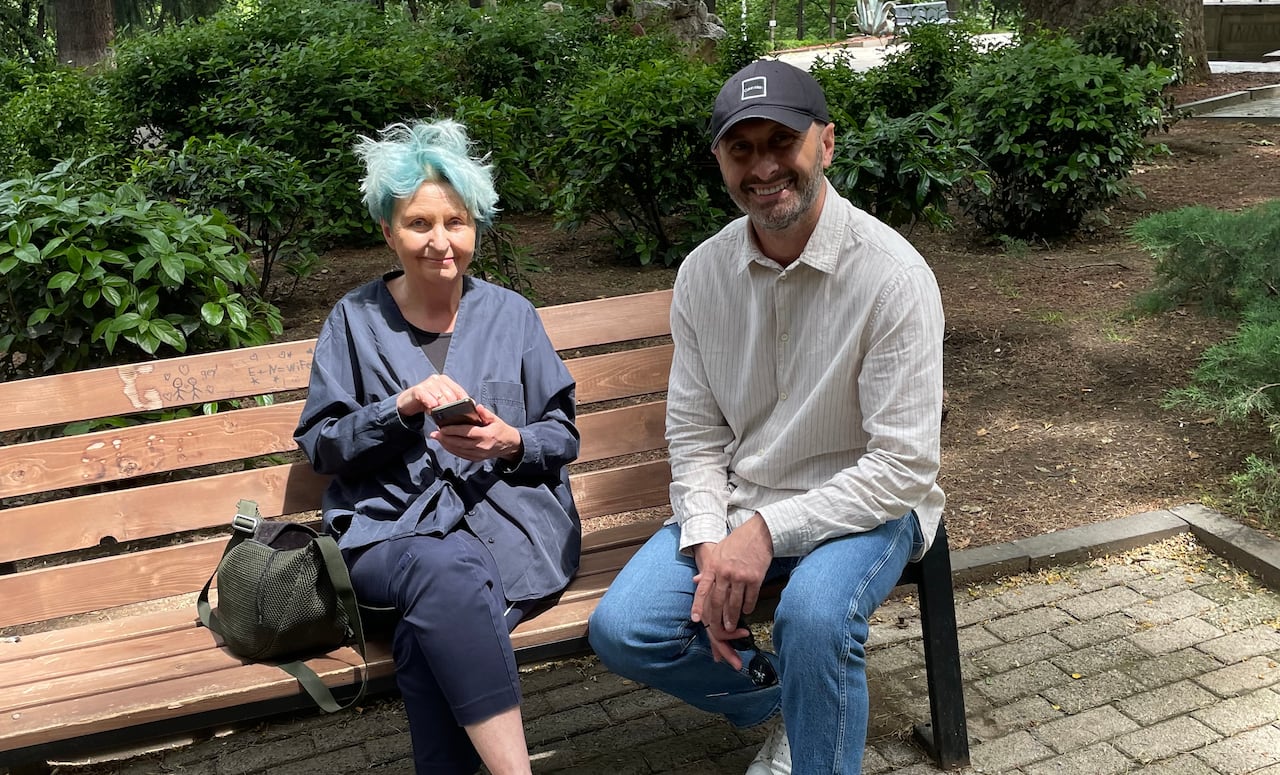
TV Journalist Guram Rogava was attacked and seriously injured by police while reporting on live television. He told documentarian Malgorzata Zerwe that doctors told him it was a miracle he was still alive. (David Zane Mairowitz )
There have been 400 consecutive days of protests before 2026 against the Georgian Dream government. The demonstrators’ concrete demands are: holding new elections and the release of political prisoners, including those jailed for protesting publicly.
Yet, 400 days of protests have only brought on more and more autocratic laws. And with both the U.S. and the European Union more or less abandoning Georgians to their fate, Georgian Dream seems to have a free path to continue its Russian-style political repression.
Written by David Zane Mairowitz.
This documentary was supported by the Pulitzer Center. It was also supported by the city of Gdansk with the “Gdansk Cultural Scholarship – Mobility Fund. It was produced by David Zane Mairowitz and Malgorzata Zerwe.