
By Aleksej Kišjuhas
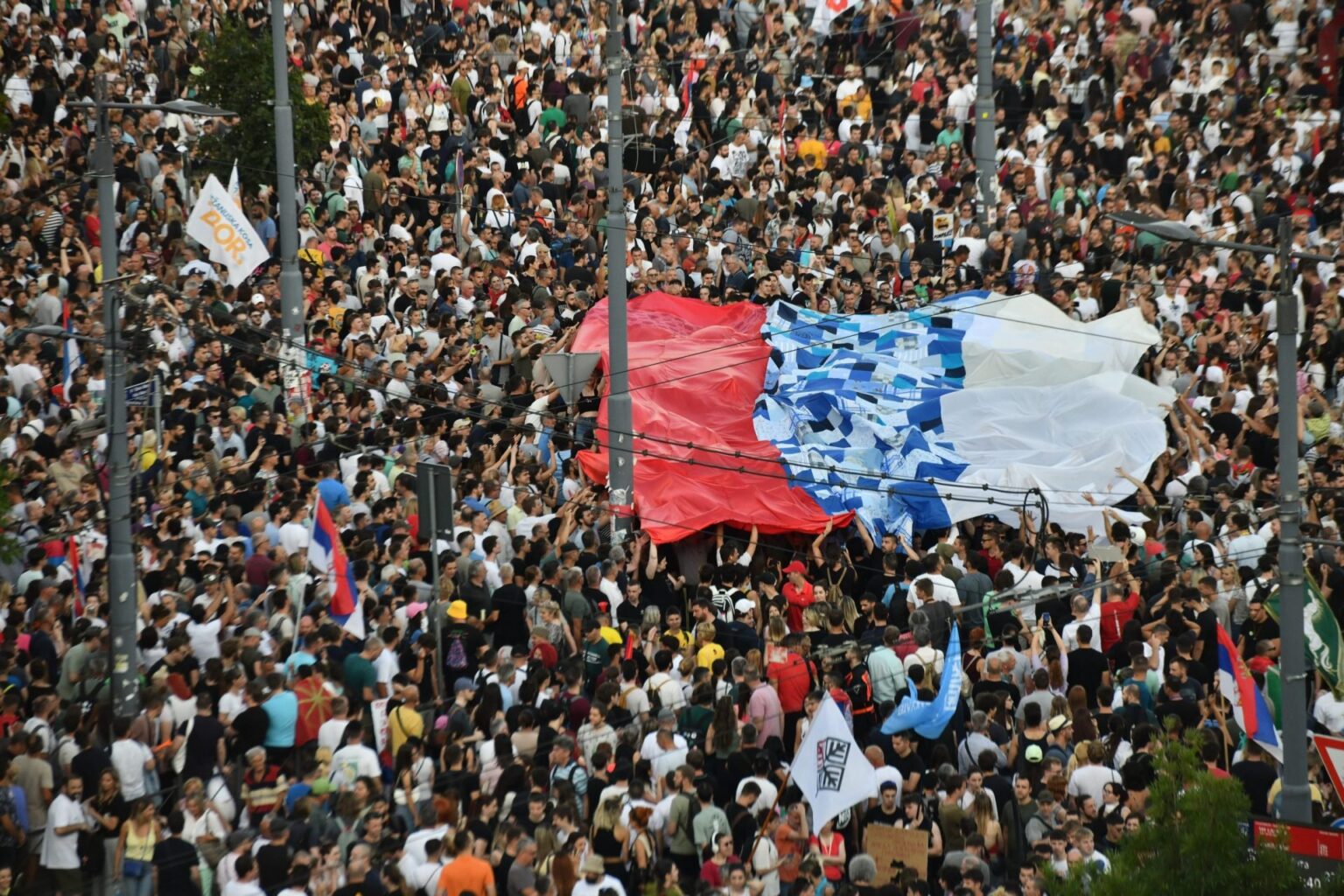
What did we witness? From February to the end of September 2025, more than 10,700 protests were held in almost every municipality in Serbia. There were probably the largest demonstrations in modern Serbian history, with around 300,000 people on the streets on 15 March 2025.
On 1 November, approximately 110,000 people attended a commemorative gathering in Novi Sad, the largest rally ever held in that city. Students walked for days and weeks across the whole of Serbia, and even cycled all the way to Strasbourg. All universities were placed under blockade, along with countless schools, while lawyers went on strike. In April, the Prime Minister was forced to resign. Simply put, Serbia experienced both the largest and the most widespread protests in its history, as well as one of the most striking civic movements in contemporary European history. And yet, at the beginning of 2026, Aleksandar Vučić remains firmly in power.
This is not a reproach to the students – their courage, creativity and solidarity were remarkable, and they put a generation of professional politicians and activists to shame. However, courage alone has never been enough to topple a regime. There is a vast gap between mobilising society and transforming its structure, and it is precisely within that gap that authoritarian regimes survive. Raising morale is one thing; launching a revolution is quite another.
One of the most famous myths about non-violent protest is the “3.5 per cent rule” associated with Erica Chenoweth and Maria J. Stephan, set out in Why Civil Resistance Works (2011). According to these political scientists, no government in history has survived a sustained non-violent campaign involving more than 3.5 per cent of the population, whereas violent action has often proved unsuccessful or counterproductive. This “finding” went viral and became extremely popular, including among students and their professors in Serbia, because it offered hope. It also gave demonstrators a precise figure to aim for.
The protest in Belgrade on 15 March far exceeded that threshold – and yet, nothing changed. Chenoweth herself, however, has urged caution in interpreting her research, warning that “3.5 per cent” is not a strictly proven scientific law nor a guaranteed recipe for regime change. First, Chenoweth and Stephan referred to sustained civil resistance, not a single protest. Secondly, the percentage represents a historical pattern, not a promise.
It applies across different political contexts – democracies, fragile states and authoritarian regimes – but begins to unravel when applied to what political scientists Steven Levitsky and Lucan Way describe as competitive authoritarianism, as outlined in Elections Without Democracy: The Rise of Competitive Authoritarianism (2002). Such regimes hold elections, tolerate a certain level of opposition activity and maintain a democratic façade, while systematically rigging the rules of the game in their own favour. This is subtler than outright dictatorship, and in many respects harder to dismantle. It is also a textbook example of Serbia under Vučić.
The renowned American political scientist Gene Sharp wrote the three-volume and highly influential The Politics of Nonviolent Action (1973), as well as the study From Dictatorship to Democracy: A Conceptual Framework for Liberation (1994). He founded the Albert Einstein Institution and was nominated several times for the Nobel Peace Prize. Sharp argued that every regime rests primarily on a set of “pillars of support”: the loyalty of the security forces, the cooperation of economic elites, the passivity of civil servants and the obedience of state-controlled media. Sound familiar? The key strategic task of any uprising, therefore, is not merely to fill squares and streets with people, but to undermine these pillars one by one until the entire structure collapses under its own weight. Viewed through this lens, the protests in Serbia have achieved something impressive – but not enough.
There have been significant symbolic victories: the arrest of several ministers and the fall of Miloš Vučević’s government; a breakthrough in the media blackout for many segments of the population; and a wave of solidarity that cut across class and ideological divisions in a way Serbian society has not witnessed for a generation. Mass protests have played a crucial role in political socialisation, mobilisation and raising awareness – freeing people from fear and exposing the true nature of the regime. For it responded to protests with brutal repression and open state terror. Yet the fundamental pillars of Vučić’s rule have neither fallen nor, in all likelihood, even cracked.
The security apparatus has remained loyal – and has been further reinforced with “ultra-loyalists”. Apart from a few individual, albeit important, exceptions, employees in the public sector have not switched sides. This likely involves around 700,000 people whose jobs are directly or indirectly linked to the Serbian Progressive Party. The parliamentary majority of the ruling coalition has also remained stable, without a single significant defection.
Economic elites remain silent and cooperative, as if nothing out of the ordinary were happening, and attempts to organise a general strike have failed. Finally, both state and para-state media remain ultra-loyal, accompanied by further pressure on – and announced closures of – the remaining independent outlets. None of this is accidental. One of the most studied characteristics of competitive authoritarian regimes is their ability to distribute patronage so widely and so deeply that withdrawing obedience becomes personally ruinous. When the price of changing sides is our job, our child’s nursery place, or perhaps even our freedom, the mathematics of loyalty shifts – regardless of what we privately believe. Public discontent has always been immense, yet revolutions are exceedingly rare. After all, regimes in Russia and Belarus, North Korea and Iran have endured for decades under a hard boot. A boot with a softer sole can be even more resilient.
The fall of Slobodan Milošević in October 2000 is an event today’s students have only heard about, as it occurred before they were born. It is wrongly remembered as the story of a single mass protest. In reality, it was a far more complex process rather than a single event. It combined mass mobilisation with a deeply organised political and civic coalition – the Otpor movement worked closely with the opposition – alongside disputed election results that provided a clear legal basis for action, defections by key actors within the security apparatus, and significant international pressure, from Brussels to Washington and Moscow. Remove any one of those elements and the outcome might have been different. By contrast, the students of 2024–2026 possess only one of these elements in abundance: mass mobilisation, perhaps even on a greater scale than in 2000. Despite their surplus of courage and imagination, what they have not yet managed to produce are elite defections, institutional fractures and external pressure to complete the equation.
There is no need for despair, however. Protests generate effects that are not immediately visible. They build civic capacity, create networks that outlast any single mobilisation, and raise the long-term costs of authoritarian rule. Serbia’s students have already changed something in the political culture of the Republic: the scale of participation and intergenerational solidarity, along with a rejection of political cynicism and apathy. That is no small achievement, and in time it may prove decisive. Yet history and political science are clear: moral legitimacy and numerical mass participation are necessary conditions for regime change, but not sufficient ones.
Regimes that fall under protest pressure are almost without exception those that have already lost the loyalty of those who wield political and economic power. Regimes that survive do so because, through patronage, fear, or a combination of both, they manage to maintain those loyalties long enough for the protest wave to exhaust itself. Protests are not enough – not because the demonstrators did anything wrong, but because dismantling a regime requires far more than crowded streets. It requires fractures within the system, the construction of a political entity capable of offering an alternative, and the securing of external support. Signs of such a scenario exist, but they remain in their infancy. The street is not the finishing line; it is merely the starting gun of the arduous marathon in which we live.
(Danas, 04.03.2026)