
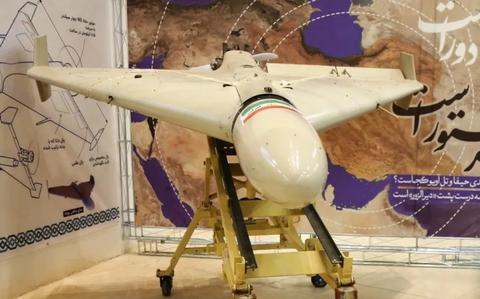
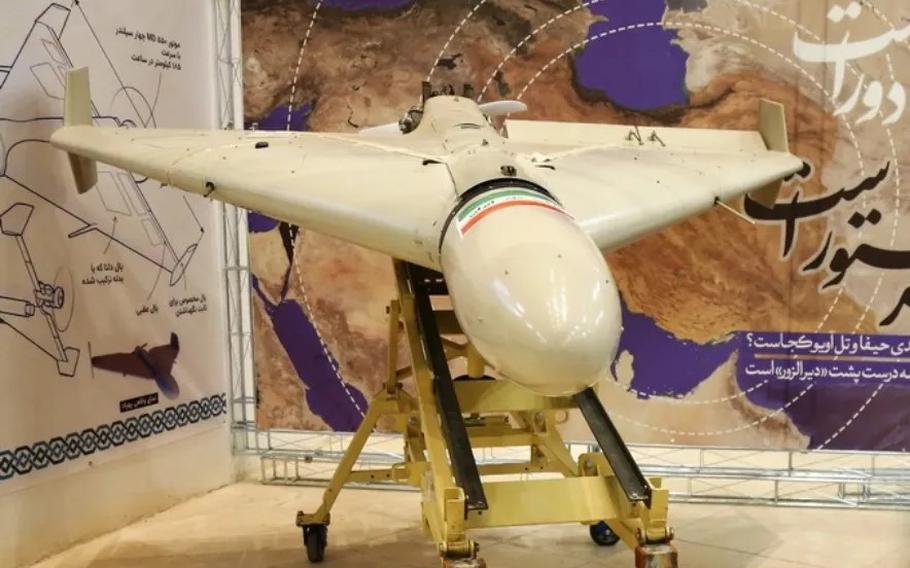
An Iranian Shahed 136 drone is displayed at a defense exhibition in Qom, Iran. (West Point)
Ukraine is prepared to send military experts to the Middle East to help the U.S. and its partners counter Iranian drones, the country’s president said this week.
President Volodymyr Zelenskyy said Wednesday that Ukraine has been consulting with the United States and countries under direct attack about the challenges posed by Iran’s drones, which have been a major feature of Russia’s war in Ukraine.
“Partners are reaching out to us,” Zelenskyy said.
Ukraine is now exploring options for helping affected countries and providing aid in a manner that doesn’t weaken its own defenses at home given the ongoing war there, Zelenskyy said.
“Our military possesses the necessary capabilities,” Zelenskyy said. “Ukrainian experts will operate on site, and teams are already coordinating these efforts. And we are ready to help protect lives, defend civilians and support real efforts to stabilize the situation and, in particular, restore safe navigation in the region.”
It wasn’t clear from Zelenskky’s statement what capabilities or tactics Kyiv was prepared to bring to the Middle East.
During the war with Russia, Ukraine’s military has emerged as the world’s most battle-tested force when it comes to countering swarms of drones.
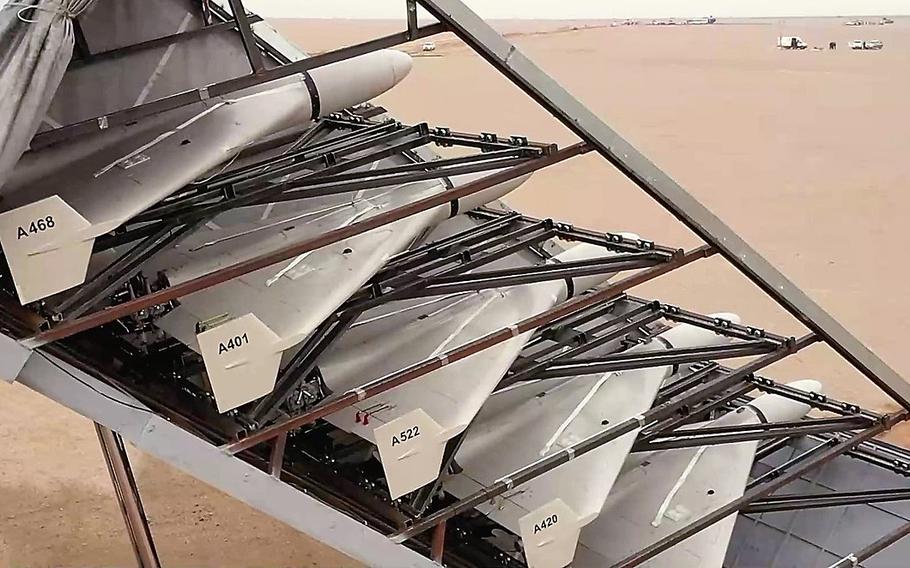
Iranian Shahed 136 drones in a transport container. (U.S. Army)
Many of Russia’s unmanned aerial systems, used against Ukrainian forces and civilians alike, have been provided by Iran.
The proliferation of such cheaply mass-produced weapons systems has challenged Western militaries’ ability to come up with affordable counter–drone alternatives.
Iran’s Shahed drones, estimated to cost between $20,000 and $50,000 each, have been able to penetrate air defenses in numerous countries in the aftermath of the U.S.-Israel airstrike campaign launched last week.
While the U.S. and its partners have shot down most incoming missiles and drones, multimillion–dollar weapons systems and costly interceptors are being heavily relied on to do the job.
Ukraine also uses high-end systems, such as Patriot interceptors, to provide a layered air defense. But Ukraine also makes heavy use of small interceptor drones, some costing as little as $2,000 to produce, to take down drones such as the Shahed.
The U.S. also has a wide range of capabilities, but the military has been on the hunt for more cheap and effective counter–drone systems. Various task forces among the military’s service components also are focused on the issue.
Defense Secretary Pete Hegseth said Wednesday that the Pentagon has “pushed every counter UAS system possible forward, sparing no expense or capability.”
However, the U.S. remains overly focused on more expensive systems, according to a recent report by the Center for a New American Security that focused on tactics for countering drones.
“All too often, U.S. forces use exquisite precision-guided missiles worth hundreds of thousands if not millions of dollars apiece to destroy cheap drones,” the report said.
Having a depth of inexpensive interceptors is crucial because it will enable U.S. forces to conserve and direct expensive munitions toward higher-end threats, the report said.