
NielsenIQ (NIQ) Romania has published its analysis of the State of the Nation in Retail for 2025, which shows continued growth in the value and volume of retail sales. Romanian consumers spent RON 139.8 billion on fast-moving consumer goods (FMCG) and electro-IT products during the year, an increase of 5% over the previous year, according to sales from the 62,000 stores monitored by NIQ.
Sales of fast-moving consumer goods rose 6% year-on-year, with consumers prioritizing basic products in their spending. Against a backdrop of high inflation and Romania’s entry into technical recession in the second half of the year, consumers increasingly resorted to saving tactics to keep their daily shopping basket under control. They visited discount stores more frequently, chose cheaper products, bought larger packages or promotional products.
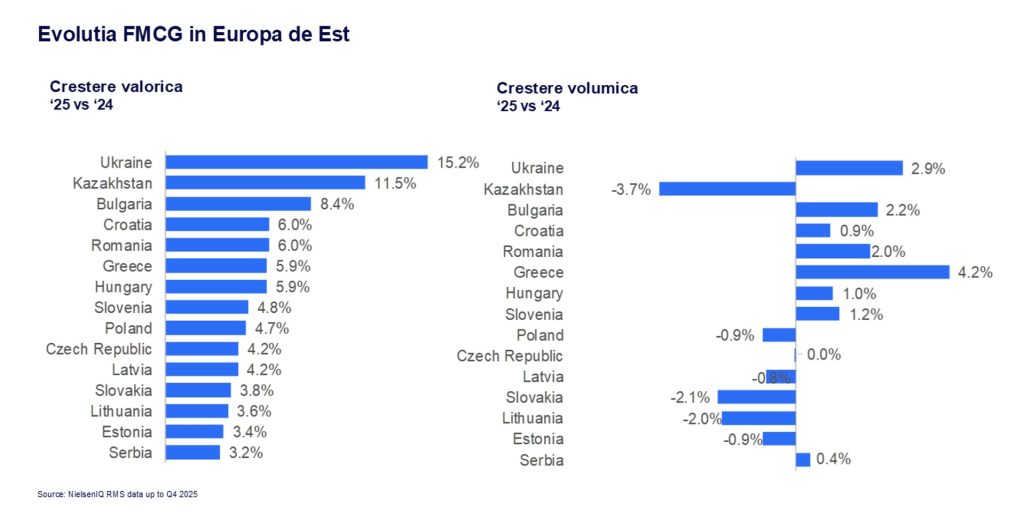
Nevertheless, annual consumption increased by 2%, with Romania being surpassed in this regard only by Greece, Ukraine, and Bulgaria, while countries such as Poland, Slovakia, and Lithuania saw a decline in consumption.
 NIQ
NIQ
The Electro-IT sector recorded growth of only 0.1% in value terms for 2025 as a whole, but declined by 3.8% in the fourth quarter. The telecom category, the largest category, recorded a 6.9% decline in unit sales, as longer replacement cycles, lack of product innovation, and the trend toward purchasing refurbished devices dampened demand. In contrast, the small appliances segment, for example, continued to grow throughout the year.
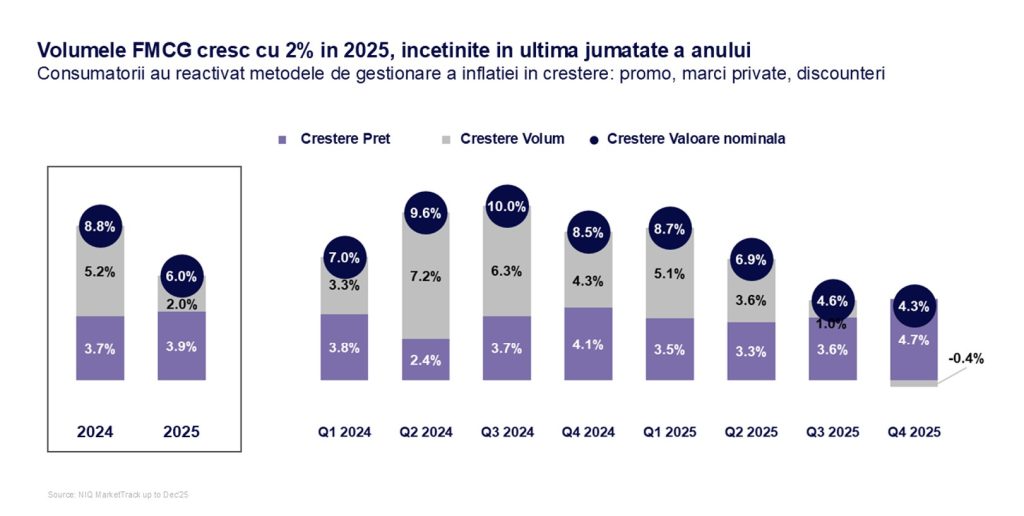
“The FMCG sector started 2025 strongly, but we saw signs of pressure on consumers in the second half of the year,” says Iulia Pencea, general manager of NIQ Romania. “Volumes turned slightly negative (-0.4%) in the fourth quarter of 2025, as higher energy costs, stagnant wages, and VAT increases reduced Romanians’ purchasing power.”
FMCG market: Sales of basic products are up, consumers are staying home more to save money
All major categories of consumer goods tracked by NIQ recorded value growth in 2025. Food, the largest category representing 55% of FMCG value, grew by 6.9%. Alcoholic beverages (13% of value) recorded a 6% increase, while non-alcoholic beverages (19% of value) grew by 6.6%. Non-food products (personal and home care, 14% of FMCG) recorded a more modest increase in value, only 1.6%, but increased in consumption due to the shift towards cheaper products.
Throughout the year, price increases reduced demand for “luxury” products such as beer, soft drinks, and especially chocolate, leading to lower sales volumes. Fresh products such as milk, eggs, meat, and vegetables saw increased demand in terms of volume. Since September, consumer goods prices have started to rise again, and volumes fell by -0.4% in the fourth quarter.

Consumers turn to private labels, promotions, discounters, and e-commerce to save money.
Under pressure from inflation, Romanian shoppers are turning more to private labels, which offer good value for money, and to promotional offers. Promotions played a key role in boosting the FMCG market in 2025, with 27.4% of total sales being made on promotion. This represents an increase of 0.9 percentage points compared to 2024. Promotional activity accelerated in the fourth quarter as the struggle to manage spending intensified in a deteriorating economy. An increase in the effectiveness of promotions, not just their number, highlighted the agility of manufacturers and retailers in adapting to the changing landscape, but also the tendency of consumers to gravitate predominantly towards products with reduced price offers.
Private labels continued to gain market share in most categories nationwide, except for non-food products, where their share remained constant at 17.2%. The share of private labels in the food category increased by 0.4 pp to 29.5%, while the share of non-alcoholic beverages increased by 0.6 pp to 8%. Private labels have the smallest share in alcoholic beverages, where they increased by 0.3 percentage points to 4.2%.
 NIQ
NIQ
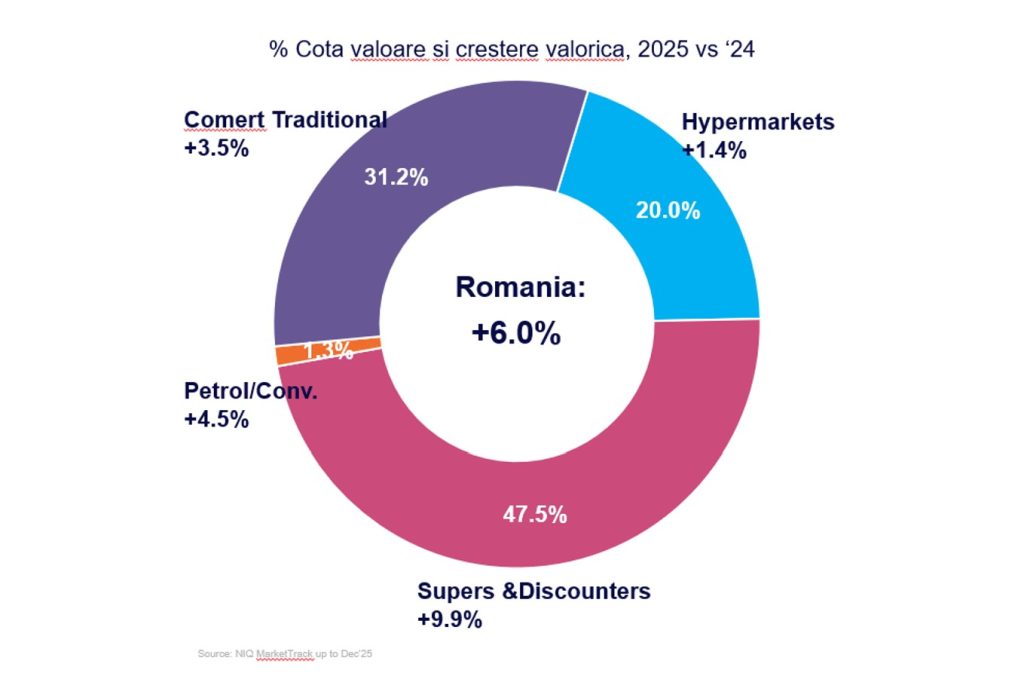
In terms of the mix of retail channels, supermarkets and discount stores accounted for 47.5% of the total value share, followed by traditional trade with 31.2%, hypermarkets with 20% and retail trade at gas stations with 1.3%. Supermarkets and discounters increased their share in all categories, capturing 53.2% of food retail, 46.8% of non-food retail, 39.9% of non-alcoholic beverages, and 35.2% of alcoholic beverages. In fact, the increase in shopper traffic and the accelerated development of discount store chains are also behind the growth of private labels in Romania, with private labels being most important in these formats.
The total value of FMCG recorded by NIQ in e-commerce in 2025 grew more than that recorded in physical stores, with a 10% increase compared to 2024, reaching approximately RON 2.1 billion. This growth is also supported by the increasing maturity of fast commerce (delivery services) in urban areas. Online sales accelerated in 2025, mainly in the food categories, with +20%, as well as in non-alcoholic beverages with 23.3%. In contrast, non-food sales, which historically had a higher share of online sales, grew by only 1.9%, and alcoholic beverages by 3.8%.
Iulia Pencea: “To remain competitive, it will be essential for retailers and brands to build trust through business transparency and messages that highlight the safety of use and added value of products – elements that cautious consumers are looking for. Shoppers are becoming increasingly demanding and willing to diversify their choices of both stores and brands to get what they want. In this environment, loyalty must be earned every day.”