
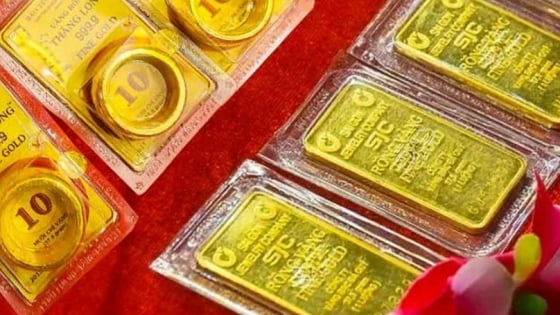
Amid escalating geopolitical tensions, global capital flows tend to shift toward defensive assets such as gold in the short term, while in the medium and long term funds may increasingly return to equities and real estate, analysts say.
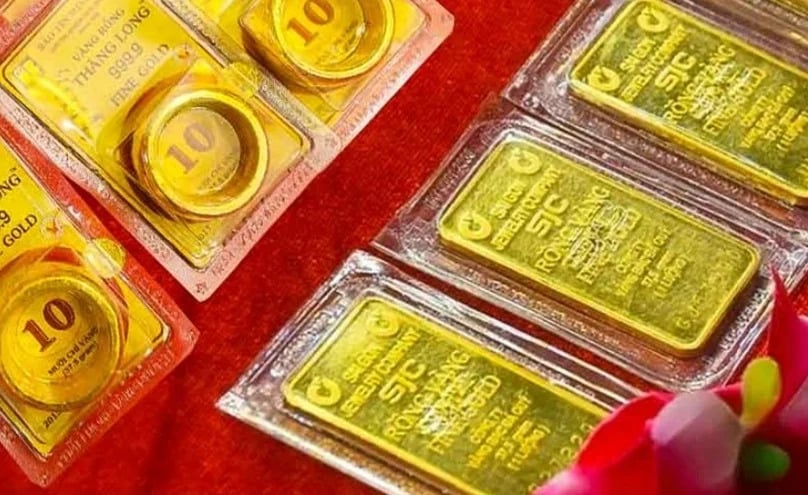 SJC gold bars and rings. Photo courtesy of the company.
Capital seeks safe havens
Global financial markets have experienced sharp volatility recently as tensions in the Middle East intensified. Several major stock indices have seen sell-offs, and Vietnam’s VN-Index has been no exception.
The declines reflect slowing cross-border investment, disruptions to international trade, and a broader defensive sentiment among investors.
VN-Index, which tracks the performance of Ho Chi Minh Stock Exchange, posted several steep losses in recent sessions, with most stocks trading lower. While some oil and gas stocks have surged, they have not been able to offset the broader market decline amid heightened uncertainty.
However, many international institutions view the turbulence largely as a short-term reaction driven partly by investor FOMO (fear of missing out) and market sentiment. In periods of uncertainty, capital typically moves toward safe-haven assets, with gold and other precious metals expected to retain positive prospects over the medium to long term.
Vietnam’s stock market is also expected to recover relatively well, supported by domestic economic fundamentals, resilient consumption, and flexible policy management.
According to analysts at Maybank Securities Vietnam (MSVN), current market valuations already reflect the risk of a prolonged conflict, while expectations that oil prices could remain at $100-120 per barrel appear excessive.
Such levels would likely trigger demand destruction and recessionary pressures, ultimately pushing prices lower. Energy stocks, particularly in oil and gas and fertilizer sectors, are benefiting from speculative gains, while the broader market continues to price in geopolitical risks.
Once valuations adjust downward, investment opportunities could emerge, similar to the sharp market swings during the 2020 shock triggered by the Covid-19 pandemic.
MSVN analysts also noted that oil prices above $85 per barrel are already sufficient to create significant inflationary pressure, forcing central banks worldwide to reassess interest-rate paths and monetary stability. For Vietnam, this could translate into prolonged pressure on the exchange rate and subsequently on interest rates.
Could capital return to equities?
Speaking to The Investor, Vo Diep Thanh Thoai, head of private client services at DNSE Securities, said that during geopolitical conflicts, global capital typically shifts toward defensive assets in the short term, particularly gold.
This trend becomes more pronounced as risks to global energy supply increase following Iran’s statement about potentially closing the Strait of Hormuz, a critical global oil shipping route. However, in the medium and long term, investment capital generally flows back to markets with stable macroeconomic fundamentals, strong growth prospects, and attractive valuations.
“In that context, Vietnam’s stock market could continue to attract capital due to relatively reasonable valuations compared with regional peers, while the outlook for economic growth and corporate earnings remains positive,” Thoai noted.
By contrast, the real estate market often reacts with a lag to geopolitical developments as it depends heavily on credit cycles and market liquidity, he added.
If capital does return to equities, Thoai said market performance is likely to become more selective rather than broadly rising as in previous cycles. Funds are expected to concentrate on sectors that play key roles in the economy and have solid fundamentals.
Banking stocks are likely to remain the backbone of the market, particularly state-controlled lenders that benefit from policy support aimed at boosting credit growth and stabilizing the financial system like the Politburo’s Resolution 79 on state economic sector development.
Meanwhile, construction, building materials and infrastructure companies could benefit significantly from accelerated public investment disbursement, which remains a key driver of economic growth. The government has set a target of GDP growth exceeding 10% this year, making stronger public investment essential amid external uncertainties.
Leading export-oriented companies with strong competitiveness may also attract capital as global trade gradually recovers. In volatile markets, firms with solid financial foundations, transparent governance and consistent profit growth tend to remain preferred destinations for investment capital.
Sector winners and losers from rising oil prices
Analysts at VinaCapital identified several sectors that could benefit from higher oil prices.
Petrol retailers that will see gains on their existing oil inventories; Vietnam’s listed oil refiner, which benefits from wider refining margins (aka “crack spreads”) that accompany higher oil prices (crack spreads are trading at multi-year highs); E&P adjacent oil services companies that benefit from higher oil prices and natural rubber producers that benefit because of the strong correlation between synthetic rubber and natural rubber prices.
The analysts noted that if the Strait of Hormuz is shut for a protracted period of time, petrol retailers would encounter difficulties sourcing refined oil from the Middle East, and Vietnam’s natural gas industry leader (GAS) is already having difficulties sourcing the LPG that it imports and sells in Vietnam.
Conversely, sectors such as aviation, tourism and travel-related businesses may suffer from rising fuel costs.
Local shipping companies that benefit from higher shipping rates and the likelihood of elongated routes due to the war and listed port stocks in Vietnam, which have generally benefitted from geopolitical tensions in the past because higher shipping rates tend to drive port operators’ handling and storage fees higher (although a protracted war and/or blockage of the Strait of Hormuz would almost certainly, severely impact global shipping volumes).
Vietnam’s listed urea fertilizer producers should benefit from the fact that Iran produces about 10% of global urea exports; jewelry companies benefit from both gains on existing inventory of gold, and from the fact that higher gold prices and “safe haven” demand will boost revenue growth.
On the downside, Vietnamese companies that export their products to customers in the Middle East will suffer some reduced sales, although revenues derived from those exports account for less than 10% of overall sales of those listed companies.
In addition to those sectors mentioned above, VinaCapital cautioned that higher interest rates would negatively impact rate sensitive stocks, including real estate developers. The analysts wrote they believe U.S. equities are more vulnerable to this shock than emerging markets, because U.S. markets were already grappling with concerns about the impact of AI on “software as a service (SaaS)” companies and private credit lending to those companies.